What are these wires?

Status
Not open for further replies.

areams

Member
Messages
74
Reaction score
0
Location
Iowa
Hey everyone, hopefully someone can shed some light here for me. Working with a Honda gx390.

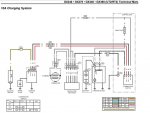
This is how I got the motor. These wires were cut and this was it. I can’t tell color of them they both look to be the same (a whiteish gray). They are from the charging coil and every diagram I find only shows one wire for this motor. Anyone have an idea?

What I am hoping to do is to buy a universal regulator/rectifier to wire up a charging system for a battery so I can use electric start and lights. Anybody had any success with a universal eBay reg/rectifier?

Any help or hints in the right direction would be great. Thanks in advanced!
 

Attachments

  • 194F2C92-89C3-4592-A7D7-894FED3B0364.jpg
    194F2C92-89C3-4592-A7D7-894FED3B0364.jpg
    259.9 KB · Views: 23

areams

Member
Messages
74
Reaction score
0
Location
Iowa
I didn’t cut anything. These were the only wires coming out from behind the flywheel. There were two charging coils and if I remember right they are wired parallel. It’s kind of hard to see but there are two wires that goes to one for each of those wires that the picture is of. (Hopefully that makes sense, basically there’s 4 wires total behind the flywheel then there are two separate connections of 2 and 2 of the 4 down to 1 and 1 and that’s what you’re seeing here).

Would one of the wires be a ground and the other should measure AC current when I hook up my multimeter? I can’t really tell color as they are both equally dirty, might have to try and peel back some of the insulation.

Anything else I’m missing here?

Thanks again for the replies!
 

anderkart

Moderator
Messages
6,432
Reaction score
391
Location
Surprise Arizona USA
Besides the wires shown in your pic, have you also found an another (Magneto/kill-switch) wire running to the low-oil sensor?

---------- Post added at 08:19 AM ---------- Previous post was at 07:39 AM ----------

I think your engine might have the optional 18 Amp (216 watt) charging coil.

After removing the flywheel, you could confirm this by comparing your charging coil to the pics you'll find at this site: http://www.nrracing.com/category-s/1836.htm

You need to make 100% sure which one of the optional charging coils you have, so you can be confident in purchasing the correct type of rectifier, don't just guess...
 

areams

Member
Messages
74
Reaction score
0
Location
Iowa
Besides the wires shown in your pic, have you also found an another (Magneto/kill-switch) wire running to the low-oil sensor?

---------- Post added at 08:19 AM ---------- Previous post was at 07:39 AM ----------

I think your engine might have the optional 18 Amp (216 watt) charging coil.

After removing the flywheel, you could confirm this by comparing your charging coil to the pics you'll find at this site: http://www.nrracing.com/category-s/1836.htm

You need to make 100% sure which one of the optional charging coils you have, so you can be confident in purchasing the correct type of rectifier, don't just guess...


I rebuilt this engine but didn’t change any of the wiring that was in place. The low oil sensor was already removed so the only other wire on this engine is the kill switch from the coil. After looking at the NR racing link, I have the 10amp 50watt charging system.
 
Last edited:

bob58o

SuckSqueezeBangBlow
Messages
9,646
Reaction score
1,865
Location
Chicago-town USA
Next question... how is a 12 V, 10amp system 50 watts.

P = I*V
If V=12 and I=10
P=120 watts

if P=50 and V=12
50 = I*12
I = 50 / 12
I = 4.2 amps

Only way to get 50 Watts with 10 Amps is with 5 volts, not 12.
 

areams

Member
Messages
74
Reaction score
0
Location
Iowa
Next question... how is a 12 V, 10amp system 50 watts.

P = I*V
If V=12 and I=10
P=120 watts

if P=50 and V=12
50 = I*12
I = 50 / 12
I = 4.2 amps

Only way to get 50 Watts with 10 Amps is with 5 volts, not 12.


Agreed, but I was just listing what NR racing said for the charging system specifications.

I am going to multimeter then next time I have it running, next question would be then is one of the wires a ground and one will provide AC current? Or should they both have some AC current reading from them?
 

bob58o

SuckSqueezeBangBlow
Messages
9,646
Reaction score
1,865
Location
Chicago-town USA
I would assume that if your output is AC, then you measure the AC voltage across the two wires. If you want to rectify, then you put both of those wires into the two AC inputs on the rectifier/regulator. Being AC, it doesn't matter which wire goes into which input.

My charging coil is strange. It only has one wire, but the output is AC. It grounds to the engine block. When I want to measure the output voltage, I need to connect one DMM lead to the single coil output wire and the other DMM lead to a bolt on the block.
 

anderkart

Moderator
Messages
6,432
Reaction score
391
Location
Surprise Arizona USA
areams,
The rectifiers for higher-output charging coils like yours also act as a voltage regulator to control overcharging issues. That's why I suggested purchasing the correct variety that exactly matches your charging coil...
 

Joe-405

Enjoying New Projects
Messages
2,673
Reaction score
98
Location
U.S.A.
Are we 100% sure it’s a Honda ? Cause all Honda’s come with a red cover not a blue one. Just checking.
 

areams

Member
Messages
74
Reaction score
0
Location
Iowa
Are we 100% sure it’s a Honda ? Cause all Honda’s come with a red cover not a blue one. Just checking.

Positive it's a Honda. I painted the cover after I installed new cam, lifters, rings and gaskets.

---------- Post added at 03:00 PM ---------- Previous post was at 02:55 PM ----------

areams,
The rectifiers for higher-output charging coils like yours also act as a voltage regulator to control overcharging issues. That's why I suggested purchasing the correct variety that exactly matches your charging coil...

I am trying to avoid spending 130ish on the Honda OEM reg/rectifier if possible. That's why I am picking all your brains here first before I buy.

There's an eBay regulator/rectifier that supports 55 watts and 20-60 AC volts I am hoping will work. Need to test still for ac voltage but hoping I can use this one.

So far everything I've found says the 10A system is 50 watts but mathematically that doesn't add up like was pointed out before.
 

anderkart

Moderator
Messages
6,432
Reaction score
391
Location
Surprise Arizona USA
Those wattage/voltage specifications might have just been mistakenly mis-typed...

That NR-racing link I posted above gives the part numbers for all of the genuine Honda Rectifiers. You could contact those other shops that sell those lower priced chinese copies, and confirm if one of their rectifiers will correctly interchange...

Are you just guessing, or have you already removed your flywheel to make 100% absolutely sure which variety of charging coil you have?
 

areams

Member
Messages
74
Reaction score
0
Location
Iowa
Those wattage/voltage specifications might have just been mistakenly mis-typed...

That NR-racing link I posted above gives the part numbers for all of the genuine Honda Rectifiers. You could contact those other shops that sell those lower priced chinese copies, and confirm if one of their rectifiers will correctly interchange...

Are you just guessing, or have you already removed your flywheel to make 100% absolutely sure which variety of charging coil you have?

Correct me if I'm wrong, but the 1 and 3 amp systems only have the single coil. The 10 amp has two coils. And the 18 amp has the larger round coil.

I have 2 charging coils like are shown for the 10amp system on NR Racing. I will try to confirm with the couple companies that I have found them at and see what they say. Thanks for the tip!
 
Status
Not open for further replies.
Top