Weld broke on my brakes

bruin27

New member
Messages
19
Reaction score
0
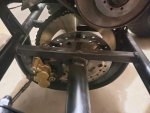
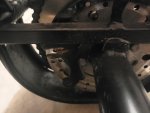
So it looks like the previous owner welding these brakes on, assuming he couldnt get a match for whatever this had before so had to weld this on? Driving last night and it snapped off, just regular driving, musta been alot of vibration.

Question is can I just re weld this on but put a bigger weld all around this. I've never welded before and just got a cheap HF welder to give it a shot.
 

Attachments

  • 20200620_130542.jpg
    20200620_130542.jpg
    251.1 KB · Views: 20

anickode

Active member
Messages
2,296
Reaction score
70
Location
S.E. Michigan
That weld was junk. Zero penetration. No fusion whatsoever.

That is the problem with 120v wire feed welders (and MIG in general in inexperienced hands). It's entirely possible to make a weld that looks perfect but is literally sitting on top of the metal. Might as well have been JB weld or hot glue.

Grind that booger off of there, CLEAN THE STEEL, then reweld. Those little machines have trouble burning through mill scale. A tack weld is not a structural weld either.

My best recommendation is for you to get some scrap metal and practice quite a bit before welding something that is so potentially critical to your safety.
 

BigWes

Member
Messages
829
Reaction score
30
Location
Alabama
I agree with Anickode. That weld was garbage.

There was no prep at all. I can't even see any scuff marks from even a simple attempt at a wire brush under there. I'll always prep with something.

That weld was what I call a cold weld. It wouldn't have made it past my chipping hammer to be honest. Actually the welder should have seen that his weld pool was bubbling up and not flowing. Or in reality there was no weld pool.

I'm not a pro by any means. Grind all that off. Get a clean working surface going. And degrease it prior to welding. MiG works fine but I run 240v, .024 wire on small parts and run as hot as I can get by with on whatever I weld. Actually the more I weld I like using smaller wire and higher heat.

But that's just my novice preference.

That part is easily salvageable. I personally don't care for the cheap harbor freight welders.
 

anickode

Active member
Messages
2,296
Reaction score
70
Location
S.E. Michigan
I agree with Anickode. That weld was garbage.

There was no prep at all. I can't even see any scuff marks from even a simple attempt at a wire brush under there. I'll always prep with something.

That weld was what I call a cold weld. It wouldn't have made it past my chipping hammer to be honest. Actually the welder should have seen that his weld pool was bubbling up and not flowing. Or in reality there was no weld pool.

I'm not a pro by any means. Grind all that off. Get a clean working surface going. And degrease it prior to welding. MiG works fine but I run 240v, .024 wire on small parts and run as hot as I can get by with on whatever I weld. Actually the more I weld I like using smaller wire and higher heat.

But that's just my novice preference.

That part is easily salvageable. I personally don't care for the cheap harbor freight welders.

Looks to me like a giant tack weld. The problem with doing that is that the initial puddle hits the cold steel and freezes, then the underpowered machine cannot penetrate through what's already been laid down, and just keeps piling more metal on top.

Frankly, that can happen with ANY machine if you're not running it correctly, but the little ones are the worst offenders.

Don't just clean it, make sure the mill scale is gone before you start welding.

And when you degrease, do not EVER under ANY CIRCUMSTANCES use brake cleaner, or any chlorinated cleaner for weld prep. Ever. The unique combination of heat, ultraviolet, and an inert atmosphere can create phosgene gas. You can look it up if you want, but suffice to say it is something you do not want to breathe.
 

mckutzy

Well-known member
Messages
8,353
Reaction score
107
Location
bc, canada
Let's see some more pics of the setup you have there..
It looks like there's more too this..
Off hand it looks like the brake is hard mounted, so it'll break anyways...
 

jmaack

Active member
Messages
625
Reaction score
136
that is a cold weld. I could probably do better with 2 car batteries and jumper cables.
 

bruin27

New member
Messages
19
Reaction score
0
Let's see some more pics of the setup you have there..
It looks like there's more too this..
Off hand it looks like the brake is hard mounted, so it'll break anyways...

Heres how it looks on and off,assuming that old bracket was where the old brakes were connected?
 

Attachments

  • 20200620_211509.jpg
    20200620_211509.jpg
    252.7 KB · Views: 5
  • 20200620_211451.jpg
    20200620_211451.jpg
    290.4 KB · Views: 6

mckutzy

Well-known member
Messages
8,353
Reaction score
107
Location
bc, canada
On any typical disc caliper setup, mech or hydraulic, The caliper need to clamp on both sides of the disc evenly.
When this happens, there has to be a method of allowing the movement, IE the caliper floats on the bracket(allow free move on its mount, like a typical car) or the disc moves(on a typical high end motorcycle).
Being a hard mounted caliper, can cause the disc to warp or significantly bend, or break the caliper(if anything cause irregular wear on the pads and disc).

IN this case....I suspect the mount broke due to being hard mounted and, improper weld preparation.
 

bruin27

New member
Messages
19
Reaction score
0
On any typical disc caliper setup, mech or hydraulic, The caliper need to clamp on both sides of the disc evenly.
When this happens, there has to be a method of allowing the movement, IE the caliper floats on the bracket(allow free move on its mount, like a typical car) or the disc moves(on a typical high end motorcycle).
Being a hard mounted caliper, can cause the disc to warp or significantly bend, or break the caliper(if anything cause irregular wear on the pads and disc).

IN this case....I suspect the mount broke due to being hard mounted and, improper weld preparation.

Gotcha, yea this looks to be hard mounted, I checked my other kart with mechanical brakes and it does "float" so I get what you mean if it's hard mounted it could wear faster and break. At this point I'm not sure how else to mount besides hard mounting.
 

itsid

Moderator
Staff member
Messages
11,563
Reaction score
240
Location
Ruhrpott [Germany]
there are several ways to mount calipers.

cheaper (in terms of simpler) single sided calipers usually mechanical ones have a slide bracket that is hard mounted to the frame in which the caliper can move.

more sophisticated (in terms of being slightly more complex) single sided calipers (usually hydraulic ones)
have a fixed caliper mount on the frame and the caliper is mounted with two spring suspended bolts to it.
the springs allow the caliper to move along those bolts if it needs to.
double sided brakes use the same mounts and shorter bolts (just to take up the disc wobble if there is any)

high end brakes are floating everywhere, the brake rotor is floating on its hub (allowing it to expand under heat and move laterally if it wants.
the calipers are double sided but still allow for some generous lateral movement too.

I think you'rs looks to be an option B variant.. the caliper should have a non slide-bracket mount but two eyelets.
(either on each end.. or in your case like one sitting in between the pistons)
the looong protrusion you see poking out nect to the pistons is one of those.
in it you wind a PU rubber (that is the springy part for your mount)
and the lower one will have a slightly smaller and likely even exposed rubber bolt bearing.
those two rubbers take care of the lateral movement (float) you need.
it's barely enough for a well centered and straight brake rotor.. just enough to compensate for the needed caliper offset (on a properly dimensioned disc rotor.. so check width)

Or to say the same in much shorter terms:
"Don't worry.. your caliper is floating as it should if the rotor is correct and correctly mounted!"

'sid
 

BigWes

Member
Messages
829
Reaction score
30
Location
Alabama
Looks to me like a giant tack weld. The problem with doing that is that the initial puddle hits the cold steel and freezes, then the underpowered machine cannot penetrate through what's already been laid down, and just keeps piling more metal on top.

Frankly, that can happen with ANY machine if you're not running it correctly, but the little ones are the worst offenders.

Don't just clean it, make sure the mill scale is gone before you start welding.

And when you degrease, do not EVER under ANY CIRCUMSTANCES use brake cleaner, or any chlorinated cleaner for weld prep. Ever. The unique combination of heat, ultraviolet, and an inert atmosphere can create phosgene gas. You can look it up if you want, but suffice to say it is something you do not want to breathe.

I know what it is. At any rate I degrease with acetone and blue shop towels. To each his own. I use a small 2" orbital air sander for small hard to reach places. I use an air powered wire wheel attachment on an air grinder as well. It's all dependent on what I am cleaning and what it requires. I have big electric grinders and wire brushes and flap wheels and all that as well. sometimes I use the media blaster.

Hopefully the dude gets this sorted out and back on the road.
 
Top