Stopping oil loss through breather

Rat

Well-known member
Messages
1,750
Reaction score
1,284
Location
SW Virginia
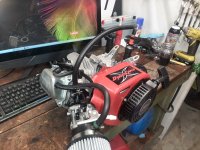
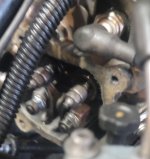
So I put HD Champion 1:1 roller rockers in my Husqvarna 208 when I first got it (along with several other tweaks) which require more valve cover clearance than the stock rockers; UNLESS I cut the tops of the studs down, so the easiest option (turned out to also be the messiest) was to remove the breather insert (I still have it somewhere).

The engine calls for 16oz of oil and even routing a custom breather tube up and around the cover to a catch can doesn't do a lot to lighten the oil spray.

FWIW: the stock valve springs are 18lb

So Im wondering if I should I cut the tops of the studs down, or fabricate some sort of splash plate I can bolt into the tops of the bosses that clears the rockers but deflects the oil from having a clear easy exit out of the breather port?

I've also considered possibly using the original governor passage (threaded and plugged with a bolt) as the breather by using an automotive valve cover PCV check valve, and just sealing up the valve cover entirely, but it's almost directly above the crank and slinger so I'm not really sure if that's the best idea.
 

Denny

Canned Monster
Messages
11,575
Reaction score
7,992
Location
Mayberry, Indiana
Governor hole is an even worse idea! Make a valve cover spacer to raise it up and put the baffle back in. Or you could try to design and build your own spacer.
 

Rat

Well-known member
Messages
1,750
Reaction score
1,284
Location
SW Virginia
Governor hole is an even worse idea!
Figured as much, which is why I hadn't convinced myself to try it.
Make a valve cover spacer to raise it up and put the baffle back in. Or you could try to design and build your own spacer.
Not an option... at least not without a bunch of extra other work for clearance. I actually swapped the OE valve cover for that from a Genuine Honda GX200 powered generator engine because it had a lower profile because of clearance reasons.

So again I'm at making a splash deflector that blocks but doesn't seal the breather port from the inside. I'm currently out of E71T-11 so pretty much all my projects are on hold as is.
 

Snaker

Active member
Messages
341
Reaction score
182
I slightly followed some talk in the scooter world about this.
It's common to replace the factory airbox with a pod.
They were plumbing the vent to the oil fill and teeing off a vent line somewhere in the middle.
Supposedly the oil would separate and drain into the fill hole?
Not sure if there was a kit to buy or if it was DIY.
 

Rat

Well-known member
Messages
1,750
Reaction score
1,284
Location
SW Virginia
I slightly followed some talk in the scooter world about this.
It's common to replace the factory airbox with a pod.
They were plumbing the vent to the oil fill and teeing off a vent line somewhere in the middle.
Supposedly the oil would separate and drain into the fill hole?
Not sure if there was a kit to buy or if it was DIY.
Definitely DIY and can be done fairly easily especially if one of the cover oil caps is one of the flatter plug ones. Drill, thread, install a barb fitting in the plastic.
From a physics perspective a 30° Y fitting would be more effective than a 90°T at gravity separating the oil
 

panchothedog

Well-known member
Messages
2,788
Reaction score
3,735
Not that it helps your problem, but I have been amazed at how well the top end
of these little motors oil them selves. On a couple of mine ( the higher rpm ones
seem to be worse ) I run a catch can. A fitting on the valve cover with a line to the can mounted a bit lower. LOVE those CHAMPIONS. Great part at a good price. Have never had a problem with them and some pretty high RPM 's.
 
  • Like
Reactions: Rat

Rat

Well-known member
Messages
1,750
Reaction score
1,284
Location
SW Virginia
Not that it helps your problem, but I have been amazed at how well the top end
of these little motors oil them selves. On a couple of mine ( the higher rpm ones
seem to be worse ) I run a catch can. A fitting on the valve cover with a line to the can mounted a bit lower. LOVE those CHAMPIONS. Great part at a good price. Have never had a problem with them and some pretty high RPM 's.
I have no way to legitimately clock the crank speed, but I can definitely tell you that it makes more power than I was bargaining for and easily spins above 5k.
I will say I was stunned to figure out it had 18lb valve springs when I did the porting, I required a DIY compressor to get the springs out of the Husqy where this Hemi 212 I popped them by hand like a cheap bic click pen.

I've got the older style Champs (I believe) definitely cast iron with the adjustable tappets and weep hole to keep the rod head nice and wet.

I do know the tappets are part of the clearance issue, not just the stud tops so I am also debating cutting the original pulse pump pan to create an area of extra clearance since it does fit snugly I think I might be able to pull it off and do away with a catch can entirely.

If it doesn't work, its no loss and I have plenty of 1/4 ID automotive transmission and fuel line scraps and everything needed to set up the style of venting/catch can system mentioned in #4
 

Attachments

  • Screenshot_20220729-021721_Video Player.jpg
    Screenshot_20220729-021721_Video Player.jpg
    208.3 KB · Views: 5
Last edited:

Rat

Well-known member
Messages
1,750
Reaction score
1,284
Location
SW Virginia
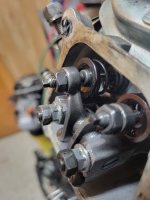
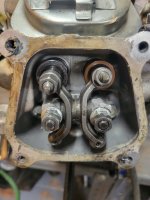
So I had put it together to with the check valve plate in before I realized it was a clearnce issue.

Little did I know that pulling the cord only once (prior to recoil delete) would not only tell me there was a serious problem, but it left ontact impressions... the studs are NOT the issue at all.

So it seems I could probably shape a pair of reliefs for the tappets and be okay to put it back in and solve the issue without a catch can after checking it out closer at peak lift.
 

Attachments

  • 20220729_201531.jpg
    20220729_201531.jpg
    1.3 MB · Views: 2
  • 20220729_201519.jpg
    20220729_201519.jpg
    1.5 MB · Views: 2

Rat

Well-known member
Messages
1,750
Reaction score
1,284
Location
SW Virginia
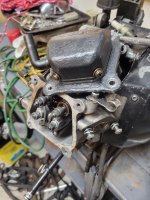
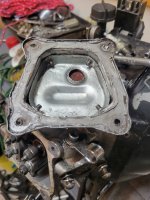
A came up with a solution and put a fresh gasket in. the screws are temporary until I resupply my welder.
 

Attachments

  • 20220730_010829.jpg
    20220730_010829.jpg
    1.6 MB · Views: 4
  • 20220730_010822.jpg
    20220730_010822.jpg
    1.6 MB · Views: 4

Willie1

Active member
Messages
589
Reaction score
150
Location
Newport, Mi
On modified engines that see more windage, blow-by, RPM related oil foaming, ect. -
I don't understand why people vent CRANKCASE pressure pulses through the valve cover breather.
They are not generated there - they are CRANKCASE GENERATED pulses/vapors trying to exit through
the only point provided - the point of least resistance, and there is no factory venting in the crank sump.

The only reason to vent ANY crankcase vapors through the valve cover area is so the oil in the vapors
lubricate the rocker arms and valve stems, so yes - a SMALL amount of crankcase vapors need to exit
through the valve cover. But the majority of the vapors and windage should be controlled in the crank
case sump area - WHERE THEY ARE GENERATED - preferably with extra venting to a catch/return can.
Once the governor is removed, the hole the shaft place through is a good place to install a vent, even
if it's just a short hose to a simple filter. Some people run extra venting points at the top of the side cover.

Point is fix the problem at the root of the problem - properly vent the crankcase pressures that are trying
to exit out the valve cover AT THE CRANKCASE and the engine gaskets and seals will thank you.

And yes, I realize that some engines recognize this and run a vent from the crankcase area to the air cleaner
assembly to help vent the crank area. My point is not to use the valve cover as the main source of venting
crankcase turbulence and vapors.
 

Rat

Well-known member
Messages
1,750
Reaction score
1,284
Location
SW Virginia
On modified engines that see more windage, blow-by, RPM related oil foaming, ect. -
I don't understand why people vent CRANKCASE pressure pulses through the valve cover breather.
They are not generated there - they are CRANKCASE GENERATED pulses/vapors trying to exit through
the only point provided - the point of least resistance, and there is no factory venting in the crank sump.

The only reason to vent ANY crankcase vapors through the valve cover area is so the oil in the vapors
lubricate the rocker arms and valve stems, so yes - a SMALL amount of crankcase vapors need to exit
through the valve cover. But the majority of the vapors and windage should be controlled in the crank
case sump area - WHERE THEY ARE GENERATED - preferably with extra venting to a catch/return can.
Once the governor is removed, the hole the shaft place through is a good place to install a vent, even
if it's just a short hose to a simple filter. Some people run extra venting points at the top of the side cover.

Point is fix the problem at the root of the problem - properly vent the crankcase pressures that are trying
to exit out the valve cover AT THE CRANKCASE and the engine gaskets and seals will thank you.

And yes, I realize that some engines recognize this and run a vent from the crankcase area to the air cleaner
assembly to help vent the crank area. My point is not to use the valve cover as the main source of venting
crankcase turbulence and vapors.
First off: I know all this from working on various engines. I ALSO KNOW it to be incomplete and misleading.

Secondly: Do you really think that if the issue was actually that serious and there was in fact a much better way to do it that theyd be doing it the same way they've been doing it for 60+ years?!?!?

The issue I know of with THESE engines and case venting is a combination of crankcase volume, oil slinger, and oil level... venting from the case possess the realistic issue of belching even more oil being directly overhead and unobstructed from litteral chaos and pandemonium in terms of fluid dynamics.

Most motorcycle engines have a baffled cove that blocks most of the oil from reaching the breather port... and even if it does its location uses gravity prohibitively to prevent it's actual exit through the port with the only exception generally being an engine that has too much oil in it.
For THESE engines to have the same thing would require tig welding a similar tray in where the governor would have been to box of the breather port ideally leaving an exposed face towards the side cover for cleaning it out should there be an obstruction.

I've ran this engine with the valve cover completely off and can say it doesn't spit gobs of oil into the valve train as much as a constant mist which ends up collecting on the rockers until gets ejected as a larger droplet.

While your logic is solid, I agree completely (to an extent) and I did consider an automotive valve cover PCV check valve mounted in the case where I removed the governor and plugged with a bolt.
I completely understand why a PCV check won't work... valve covers on cars tend to have a splash plate just below the pcv port, and also the port is rare directly over a valve at all

Don't come preaching incomplete and half educated information at some one with more hands on experience inside more engines than the average hobbyist.
I'm well beyond average, and if it has T!ts or tires I can and will make it scream
 

Denny

Canned Monster
Messages
11,575
Reaction score
7,992
Location
Mayberry, Indiana
There is a very good reason that the engine is vented through the valve cover. The windage of the oil getting whipped around by the crank counter weights and rod make it impossible to vent any lower. Most modern engines in cars in fact vent through the valve cover unless an extensive baffle in in place in the crank case. There is nothing wrong with venting through the valve cover. The pushrod holes are open plenty for this to be a viable area. It also helps keep the windage away from the vent. Trying to vent at the crankcase would puke all the oil out of the crankcase in a matter of minutes. No engine in the history of engines ever vented near the crankshaft.
 

Rat

Well-known member
Messages
1,750
Reaction score
1,284
Location
SW Virginia
There is a very good reason that the engine is vented through the valve cover. The windage of the oil getting whipped around by the crank counter weights and rod make it impossible to vent any lower. Most modern engines in cars in fact vent through the valve cover unless an extensive baffle in in place in the crank case. There is nothing wrong with venting through the valve cover. The pushrod holes are open plenty for this to be a viable area. It also helps keep the windage away from the vent. Trying to vent at the crankcase would puke all the oil out of the crankcase in a matter of minutes. No engine in the history of engines ever vented near the crankshaft.
Modern cars? You're too kind... try pretty much any automotive engine built after Flatheads.

And to elaborate the crankcase venting specifically in motorcycles many OHC have trended to venting through the rockerbox lid...and much like an OHV they have a wide open passage beside the cylinder bore, for them its cam chain instead of pushrods.

Going towards 60's to 80's where case venting was still most common, the vent was behind/above the transmission more specifically in the vicinity of the kicker spindle some were internally baffled but since there's nothing high RPM to throw oilt most didn't need even a breather tube.

The few that were vented more in the gearbox are were oil spitters and often used the breather tube to lubricate the drivetrain with the oil mist
 
Last edited:

Denny

Canned Monster
Messages
11,575
Reaction score
7,992
Location
Mayberry, Indiana
Honda used cast in internal baffles in the crank case. Most of the unclean masses do not realize that by taking away the stock air filter you have no way to pull out the moisture and volatile organic compounds out of the crank case oil once it heats up. Thereby allowing harmful acids to build up and start eating away the bearing surfaces first and then onto the other surfaces on a microscopic level.
 
  • Like
Reactions: Rat

Rat

Well-known member
Messages
1,750
Reaction score
1,284
Location
SW Virginia
Honda used cast in internal baffles in the crank case. Most of the unclean masses do not realize that by taking away the stock air filter you have no way to pull out the moisture and volatile organic compounds out of the crank case oil once it heats up. Thereby allowing harmful acids to build up and start eating away the bearing surfaces first and then onto the other surfaces on a microscopic level.
Yep and then microscopic pitting turns into seizing or exploding bearings... some just never learn
 

Rat

Well-known member
Messages
1,750
Reaction score
1,284
Location
SW Virginia
Mostly I asked the newb question on doing a crankcase breather to see if I'd get answers anything similar to what I already knew to be fact... weeding out newbs from rookies, and rookies from those with a mechanical background or at least decades of experience wielding wrenches.

I might be an a$$hole 🤷🏻‍♂️
 

karl

Well-known member
Messages
2,447
Reaction score
706
Location
North east Ohio
I've got the older style Champs (I believe) definitely cast iron with the adjustable tappets and weep hole to keep the rod head nice and wet.
I got the same, the cast steel forged older style are much stronger than the stamped steel new ones.

This was my first attempt at PCV with an automotive valve, had to add a cutoff valve partially open to prevent it from
directly sucking in crankcase oil.
 

Attachments

  • 20220214_003606.jpg
    20220214_003606.jpg
    3.3 MB · Views: 5

Rat

Well-known member
Messages
1,750
Reaction score
1,284
Location
SW Virginia
I got the same, the cast steel forged older style are much stronger than the stamped steel new ones.

This was my first attempt at PCV with an automotive valve, had to add a cutoff valve partially open to prevent it from
directly sucking in crankcase oil.
If I were to add a PCV check, it would be directly to the head Outlet... not sure what the hell you've got going on there looks like coming out of where the Gov linkage would have been, but I don't build with clearance like that.

It looks like you plumbed from the valve cover to the filter boot which is 1000% sufficient to vent any crank pressures, and the PCV hooked to the intake is redundant, pointless, and begging for nothing but headaches and hell.
 

karl

Well-known member
Messages
2,447
Reaction score
706
Location
North east Ohio
It looks like you plumbed from the valve cover to the filter boot which is 1000% sufficient to vent any crank pressures, and the PCV hooked to the intake is redundant
Yep you got it. Reed valve in the cover you had to add back in becomes unnecessary when you plumb the vent into the air filter.
 

Rat

Well-known member
Messages
1,750
Reaction score
1,284
Location
SW Virginia
Yep you got it. Reed valve in the cover you had to add back in becomes unnecessary when you plumb the vent into the air filter.
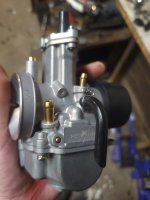
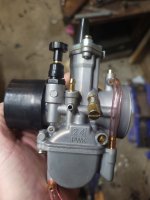
I don't use an airfilter, airbox, or a stock (or stock type) carb nor will I.
 

Attachments

  • 20210818_220901.jpg
    20210818_220901.jpg
    1.4 MB · Views: 0
  • 20210818_220854.jpg
    20210818_220854.jpg
    1.4 MB · Views: 0
Top