Russell ATV
New member
High Power Kart Part 2
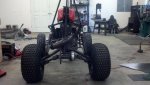
Once you have experienced 4 wheel independent suspension on an off road kart, there is no other alternative. There is a reason the high dollar ATVs and Side by Sides use an independent suspension. It comes down to cornering. The swing arm set up forces your front tires to compress when you hit an uneven surface in the rear. When in a corner, this forces the front on the outside of the corner to dive, and the inside rear tire to lift. This pitches the vehicle forward and away from the corner like you are going to roll. On top of that, the rear outside tire starts to exhibit positive camber (bottom part of the wheel is further inward than the top) which can suddenly dig into the ground. With a fully independent suspension, cornering is more predictable, and based on your rear suspension design, you can control camber through the compression of the suspension.
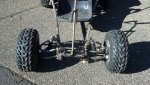
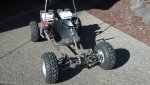
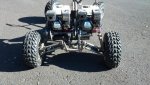
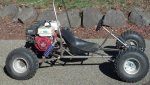
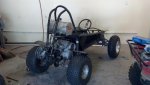
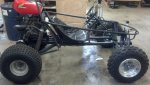
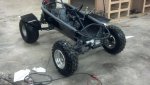
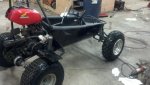
Enough of the theory, this is what I did. I wanted to use the 3 link tailing arm similar to the Long travel kart, but was concerned about the strength of the links. So, I tried a different type of rear suspension called the simi trailing arm. The benefit of this design, is that arms travel on an angle that adds lots of negative camber on the turns, suffers no scrub (outward push when suspension is compressed), and can be built very stout. I placed the engine behind the driver, and reused all the kart I had built but with some changes. The seat was centered (good thing), the rear frame was added to base, and shock tower was moved outward and slopped back.
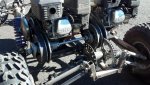
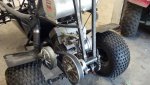
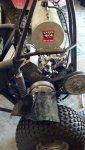
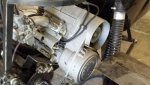
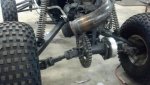
Now, the disadvantage of the semi trailing arm rear suspension is the requirement to telescope the rear drive line to account for the change in axle length as it operates. However, I used the same design as with the long travel kart using 3/4" square tubing (1/8" wall) for the ID and 1" (1/8" wall) square tubing for the OD. The solution worked well, but I did make an improvement later and changed the 3/4" tubing out for 3/4" bar, as the torque from the engine was twisting the tubing.
Since this designed worked well, I completed the design and used .1" polycarbonate to wrap the frame and provide lightweight protection from the ground and create finders to keep dirt from flying off the tires and landing on me. One trick I learned long ago, is that you can paint the inside of the polycarbonate and it will look like thick perfect strayed paint with a ton of gloss on top.
Only one problem remained, shifting a clutch in a mountain trail can be a real pain. Part 3 build perhaps.........
Once you have experienced 4 wheel independent suspension on an off road kart, there is no other alternative. There is a reason the high dollar ATVs and Side by Sides use an independent suspension. It comes down to cornering. The swing arm set up forces your front tires to compress when you hit an uneven surface in the rear. When in a corner, this forces the front on the outside of the corner to dive, and the inside rear tire to lift. This pitches the vehicle forward and away from the corner like you are going to roll. On top of that, the rear outside tire starts to exhibit positive camber (bottom part of the wheel is further inward than the top) which can suddenly dig into the ground. With a fully independent suspension, cornering is more predictable, and based on your rear suspension design, you can control camber through the compression of the suspension.
Enough of the theory, this is what I did. I wanted to use the 3 link tailing arm similar to the Long travel kart, but was concerned about the strength of the links. So, I tried a different type of rear suspension called the simi trailing arm. The benefit of this design, is that arms travel on an angle that adds lots of negative camber on the turns, suffers no scrub (outward push when suspension is compressed), and can be built very stout. I placed the engine behind the driver, and reused all the kart I had built but with some changes. The seat was centered (good thing), the rear frame was added to base, and shock tower was moved outward and slopped back.
Now, the disadvantage of the semi trailing arm rear suspension is the requirement to telescope the rear drive line to account for the change in axle length as it operates. However, I used the same design as with the long travel kart using 3/4" square tubing (1/8" wall) for the ID and 1" (1/8" wall) square tubing for the OD. The solution worked well, but I did make an improvement later and changed the 3/4" tubing out for 3/4" bar, as the torque from the engine was twisting the tubing.
Since this designed worked well, I completed the design and used .1" polycarbonate to wrap the frame and provide lightweight protection from the ground and create finders to keep dirt from flying off the tires and landing on me. One trick I learned long ago, is that you can paint the inside of the polycarbonate and it will look like thick perfect strayed paint with a ton of gloss on top.
Only one problem remained, shifting a clutch in a mountain trail can be a real pain. Part 3 build perhaps.........
Attachments
-
 IMG_20130626_185718_034.jpg73.2 KB · Views: 18
 -
 IMG_20130626_185602_477.jpg70.2 KB · Views: 16
 -
 IMG_20130626_185630_290.jpg71.2 KB · Views: 18
 -
 IMG_20130626_210824_504.jpg69.5 KB · Views: 17
 -
 IMG_20130626_210908_201.jpg64.3 KB · Views: 14