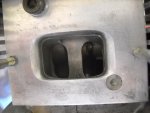
Rotax 277 piston port to reed valve conversion

Status
Not open for further replies.

Desertduler

Active member
Messages
1,736
Reaction score
10
Rodney,in the video that you are referring to as (looks fast) the kart ran pretty good with that set up that I was testing but not the best, I have different cylinders which I have modified for different power delivery and rpm levels and the best one overall that I tested and settled on is the one in this video which does not give the maximum rpm that I can achieve with this engine which is a tad over 9000 rpm it is the one that the engine rpm turns 7500 and change, the 7500 rpm cylinder gives the kart a top end around the mid 50's but the kart is faster overall with better lap times on the lakebed tracks that I set up, the rear tires brake loose of course on the lake bed dirt to a degree when the engine spools up on the pipe but I can control it and I may play around with adding some weight to the flywheel in order to smooth out the powerband a bit and try to achieve more tractable power. So far this is my favorite set up here in this video, not the the fastest on the top end like I say but the best overall with one gear ratio.
https://www.youtube.com/watch?v=FaTL65TtVaI
 

Desertduler

Active member
Messages
1,736
Reaction score
10
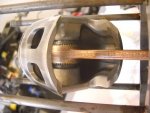
Going back together with the engine after replacing the connecting rod, here are a couple of photos of the cageless wrist pin bearings installed, these bearings and the underside of the piston get fresh air fuel mixture blasted on them during the intake cycle thus cooling them down and giving the wrist pin bearings and the wrist pin added lubrication during the intake cycle from the oil that is mixed in the fuel, just another benefit from reed valve induction compared to the original piston port configuration. Notice also the angle of the piston windows, I milled them in the direction that the intake gases flow from the intake port so the air fuel mixture would transfer better through the windows and at the correct transition angle, a very important detail.
 

Attachments

  • 009.jpg
    009.jpg
    272.5 KB · Views: 6
  • 011.jpg
    011.jpg
    278.8 KB · Views: 4

itsid

Moderator
Staff member
Messages
11,564
Reaction score
229
Location
Ruhrpott [Germany]
You know me Bret, so here I am with yet another (maybe stupid) question :D

Shouldn't the edges of the piston windows be smooth?

As you said intake gases... at one point they'll hit the edge and create turbulences, right?
and with a sharp edge like that appears to be... *shrugs* isn't a smoothed out edge beneficial for flow rates?
Or do you need such turbulences to prevent the air fuel mix from seperating?
Or is the effect so tiny that it doesn't make a difference?

What am I missing?

'sid
 

Desertduler

Active member
Messages
1,736
Reaction score
10
You know me Bret, so here I am with yet another (maybe stupid) question :D

Shouldn't the edges of the piston windows be smooth?

As you said intake gases... at one point they'll hit the edge and create turbulences, right?
and with a sharp edge like that appears to be... *shrugs* isn't a smoothed out edge beneficial for flow rates?
Or do you need such turbulences to prevent the air fuel mix from seperating?
Or is the effect so tiny that it doesn't make a difference?

What am I missing?

'sid
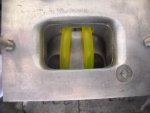
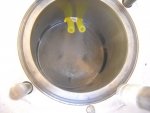
Alex, your question is not stupid, there indeed are some locations of the piston windows that could have some chamfering done, the center pillar between the windows and the tops of the windows, the sides would be fruitless to chamfer as they are flush with the sides of the intake port. Follow the path of the small fuel lines that I have installed in the piston windows and the rear boost port and you can see which way the chamfering should be directed in the tops of the windows, I have used this piston in a cylinder with two rear boost ports that I have tested and I am using it now in this single rear boost port cylinder and I plan on sticking with this current single rear boost port cylinder so now I will do some more testing and make a new pipe for this engine configuration and I will buy a Wiseco forged piston and modify it and chamfer it in the direction that will aid in the flow of gases using just the single rear boost port and then I will test different window locations in the piston skirts, pay no attention to the intake mounting plate to intake port mismatch as the mounting plate was matched to a cylinder that had a slightly bigger intake opening in the early stages of my testing , I fill those corners with JB weld and blend the areas so to not leave a overhanging edge in the intake port. Remember air fuel mixture travels both ways through the windows and when the piston moves upwards towards T.D.C. the bottom of the intake side of the piston skirt uncovers the intake port completely, needless to say this engine runs pretty good.
 

Attachments

  • 025.jpg
    025.jpg
    236.7 KB · Views: 3
  • 017.jpg
    017.jpg
    236.5 KB · Views: 1
  • 015.jpg
    015.jpg
    176.9 KB · Views: 1

itsid

Moderator
Staff member
Messages
11,564
Reaction score
229
Location
Ruhrpott [Germany]
Thanks Bret,
the fuel lines helped wrapping my head around which way is up :thumbsup:

glad I wasn't too far off with what I imagined, I was a little scared actually :D

Anywhoo..
thanks for the explanation!

'sid
 

Desertduler

Active member
Messages
1,736
Reaction score
10
Thanks Bret,
the fuel lines helped wrapping my head around which way is up :thumbsup:

glad I wasn't too far off with what I imagined, I was a little scared actually :D

Anywhoo..
thanks for the explanation!

'sid
Lol! Nothing to be scared of my friend! It's just metal parts going up and down around and around, inhaling and exhaling and were trying to make it do it all better than it did in the stock form, you are on the right track. :cheers2:
 

Armilite

New member
Messages
23
Reaction score
2
Location
Ames, IA
Rods

The connecting rod on the right is 17mm wide which is used with engines with CDI ignition crankshafts, the connecting rod on the right is 15mm wide which is used with engines with points ignition crankshafts.
==================================================
For Rod Spec's:
http://www.transcanimports.com/downloads/Snowmobile Catalogue/Engine - Connecting Rods.pdf

Many Skidoo/Rotax Rods used the Top 18x22x22 Bearing, and also used the 24mm Crank Pin. So other Rods can be adapted.

You can convert all the Points engines to Nippon CDI, by using the same Bosch Points (4) Magnet Flywheel, just take the Coil off a newer Horse Shoe Type CDI Stator, and replace with the one on the Bosch Points setup, eliminate the Points and Condenser. Add Nippon CDI Box, and CDI Coil, off a 377, 447, 503, etc. You do have to reindex the Flywheel Key. The Bosch 277 Flywheeel is Keyed at the 12 o'clock position at TDC, the Nippon is the the right. You can just put on the flywheel without key and spin it, and move it, till it's firing at TDC. Nobody, seems to know the exact degree, but I'm working on it. Got a degree wheel coming. Once found, they just drill a hole and use a roll pin to hold it in postion. Many Ultralight engines were converted that way.
 

Desertduler

Active member
Messages
1,736
Reaction score
10
==================================================
For Rod Spec's:
http://www.transcanimports.com/downloads/Snowmobile Catalogue/Engine - Connecting Rods.pdf

Many Skidoo/Rotax Rods used the Top 18x22x22 Bearing, and also used the 24mm Crank Pin. So other Rods can be adapted.

You can convert all the Points engines to Nippon CDI, by using the same Bosch Points (4) Magnet Flywheel, just take the Coil off a newer Horse Shoe Type CDI Stator, and replace with the one on the Bosch Points setup, eliminate the Points and Condenser. Add Nippon CDI Box, and CDI Coil, off a 377, 447, 503, etc. You do have to reindex the Flywheel Key. The Bosch 277 Flywheeel is Keyed at the 12 o'clock position at TDC, the Nippon is the the right. You can just put on the flywheel without key and spin it, and move it, till it's firing at TDC. Nobody, seems to know the exact degree, but I'm working on it. Got a degree wheel coming. Once found, they just drill a hole and use a roll pin to hold it in postion. Many Ultralight engines were converted that way.
Thanks Rich, I have read this information before as it was told to you, I have degree wheels and I will try this out on one of my spare engines and let you know how it turned out, I can mark the flywheel in degrees and use a timing light to set the timing with a little trial and error advancing and retarding the stator plate around.
 

Desertduler

Active member
Messages
1,736
Reaction score
10
Yanbolduc from Canada sent me a video of him riding his snowmobile which has a 277 Rotax engine in it like mine and he has done my reed valve modification to his engine. Way to go Yan! looks like your sled runs pretty good for a single cylinder! Kudos to you Yan for having the guts of taking on this modification and finishing it!
https://www.youtube.com/watch?v=sAQsrjRs484
 

Poboy kartman

Senior Moments Member
Messages
12,461
Reaction score
61
Location
White Settlement Texas
Sorry....I.just couldn't watch it all...I didn't mind the two cycle screaming....but the singer got on my nerves....sorry...that crap and rap aren't music....that's my story and I'm sticking to it....danmet I'm a musician....
 
Status
Not open for further replies.
Top