RIP Lincoln Lunchbox- PROBLEM SOLVED!!!!

Status
Not open for further replies.

Doc Sprocket

*********
Messages
15,677
Reaction score
152
Location
Ontario, Canada
:DMy poor beloved old Lincoln Weld Pak 100 seems to have gone to the great toolbox in the sky. *sniff*

Shouldn't surprise me. It spent years being used commercially, well past its duty cycle until it quit. We had thought it was the transformer, but it turned out to be a rectifier diode. Having written it off already, my boss (at the time) let me have it for the price of the repair bill ($75).

I have been using and loving it since. 'Till now. *sniff*

Anyhow, maybe some of you folks can gimme a hint here. Here's what I know-

*The last time this machine gave up, it was a rectifier diode. IIRC (and it was SEVERAL years ago), the symptoms were similar or the same as this time.

*NOW- when I try to weld, when I pull the trigger, it hums much louder than it should, and I am suffering a severe power loss. I can still maintain an arc, but it's quite weak and I have squat for penetration, even on the highest settings.

Does anyone here have the knowledge to troubleshoot this with me? I very simply cannot afford a repair bill right now. Any help is certainly appreciated.

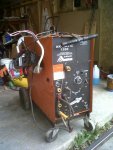
In the meantime, I have several projects on the go, like usual. I have managed to borrow a machine, and I just got it running. It had been sitting for three years, needing a new cable liner, and some other tune-up type stuff.

It's an Acklands AK-Matic 1200, and I don't know much about it other than the fact that it's a big heavy 230v unit. I have found hints that this is somehow related to Miller, but nothing solid yet. If anyone has further info, please clue a guy in. Since I haven't found any info, I had to seriously hack the cable liner repair. It's holding for now, but a new one would be a good idea! Thanks, y'all!

Oh- here's a pic-
 

Attachments

  • akmatic.jpg
    akmatic.jpg
    102.3 KB · Views: 40
Last edited:

Badot

New member
Messages
677
Reaction score
2
From my limited knowledge of welders, it sounds like you have a short somewhere in the transformer. At the very least it would explain the lower power.
 

T-man

New member
Messages
1,232
Reaction score
4
Location
Missoula,MT
hey toystory, that problem sounds familier. I had a problem like that years ago with an old power supply for ham radio.
The problem was the electrolitic capaciters in the power supply section.
If the die-electric material is going bad ( rare ) then it can effect the bridge rectifier. Most of the time if/when caps go bad then its because they get to hot from an outside source, like transformer being to close or anything that puts off a lot of heat. Capaciters should not put out much heat at all.
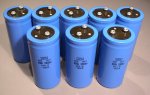
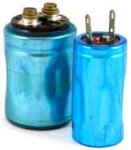
Here are some pictures of some capaciters that would most likely be in a welder.
 

Attachments

  • high-voltage-electrolytic-capacitors-400v-o.jpg
    high-voltage-electrolytic-capacitors-400v-o.jpg
    37.3 KB · Views: 4
  • electrolytic-capacitors.jpg
    electrolytic-capacitors.jpg
    6.3 KB · Views: 8

B man

Tecumseh FTW!
Messages
2,490
Reaction score
3
Location
Oliver springs,Tn
hey toystory, that problem sounds familier. I had a problem like that years ago with an old power supply for ham radio.
The problem was the electrolitic capaciters in the power supply section.
If the die-electric material is going bad ( rare ) then it can effect the bridge rectifier. Most of the time if/when caps go bad then its because they get to hot from an outside source, like transformer being to close or anything that puts off a lot of heat. Capacitors should not put out much heat at all.
Here are some pictures of some capaciters that would most likely be in a welder.

And dont forget to check your flux capacitors!
 

machinist@large

Active member
Messages
2,865
Reaction score
33
Location
West Michigan, 49331
A quick look thru my Forney welding manual's trouble shooting section agrees to start with checking the capaciter-s. I know that some mig welders run more than one which could explain the loss of power, but the unit still runs (albeit poorly).

I'm not familiar with the brand of the other welder; does it have any separate brand markings on the torch? (Tweco,etc?) Even a lot of factory machines run guns that are compatible with the independent manufacturers because that's what their customers demanded. Hope this was of help. Pat
 

Doc Sprocket

*********
Messages
15,677
Reaction score
152
Location
Ontario, Canada
When I have some time to crack it open, I'll start with the obvious, looking (and smelling) for burnt components.

I was finally able to figure out the other machine- It's a re-branded Millermatic 200. I downloaded a manual for it late last night...
 

Bluethunder3320

New member
Messages
5,677
Reaction score
39
now imagine if a chinese welder can last that long.

im sure youll be able to fix it.

and i bet that machines been to hell and back and seen the dinosaurs.

EDIT: like b-man said check the flux capacitor :)
 

Doc Sprocket

*********
Messages
15,677
Reaction score
152
Location
Ontario, Canada
and i bet that machines been to hell and back and seen the dinosaurs.

Oh man, that ain't the half of it. Back when I worked for that company, we ( okay, "I") ran the daylights out of that machine. The nature of the job boiled down to deliberately far exceeding the duty cycle, welding through satin coat, rust, grease, snow, moisture. I used to do the exhaust hoods and ductwork for commercial kitchens. Since it was all field work, we relied on the size and weight of the lunchboxes for portability. I had to weld on the exhaust hoods, up inside accoustical ceilings, up the outside walls of buildings (by hanging the welder from the roof by a rope), and up on rooftops. Since I literally had to spend all day welding these exhaust systems together, the duty cycle was ignored- Da Bawse knew full good and well that these Lincolns could tolerate the abuse for 3-5 years, and at $500-$700 each, they owed him nothing at the end. Buy a new one, get a new warranty, press on...

I remember the day this one failed- I was up on top of an exhaust hood making a duct connection on a middle eastern restaurant in downtown Toronto. Like now, I lined up a weld, hit the trigger, and BWWAAAAAAAA! Really loud hum, very low output power. After unsuccessfully trying to remedy the situation, I went and got my backup machine.

I had my boss pick this one up and bring it to a repair shop. Even though he had a habit of just buying a new one, I wanted to know if it was worth repair. Several weeks went by (I guess the shop was busy), and the boss presented me with a sparkling NIB machine. He decided to go new after all. Then he says "you wanted your own personal machine, right?" Well, DUH!!! The only reason I didn't own one yet is that they are kind of expensive for a guy that 1)wasn't doing a ton of welding on his own time, and 2)Had full access to several machines, anyway!)

Anyways, he told me a diode had gone out on this machine and if I paid the repair bill, I'd own it. $75 and a few days later, I owned it.

Needless to say, once it became my baby, I treated her a lot better- no pressure to get huge jobs done in unrealistic time frames. Either way, it had already seem several years of hard abuse, so I did expect this at some point. Still hurts, though.
 

T-man

New member
Messages
1,232
Reaction score
4
Location
Missoula,MT
I agree with blue, If its a sudden thing then its probably the bridge rectifier, if its a problem that was happening slowly and getting worst then it could be the cap.

:devil2:... oh! hold on a sec. .... it could be the fluid in the fuse box, when that runs low that can cause all sorts of problems :devil2:
 

Doc Sprocket

*********
Messages
15,677
Reaction score
152
Location
Ontario, Canada
Thanks for the tips, T! I won't be able to crack into it for about a week and a half, though. I'm going up north on a fishing trip. Way north...

I just read the tread you linked to- between that, and my previous experience, I'm really becoming convinced that the rectifier is the problem...
 

Doc Sprocket

*********
Messages
15,677
Reaction score
152
Location
Ontario, Canada
Okay-

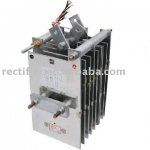
I took the lid off, had a look at the wiring diagram, and then stared at the internals for awhile. It would appear that this machine uses four separate rectifier diodes instead of a unit.

I am a little rusty on my electronics, but here's what I think-

To test them, I need to isolate them from the circuit. I can use my multimeter on the continuity check setting. Diodes allow current to pass in one direction only, so a good diode should show continuity with the leads one way, but no continuity with the leads reversed.

Can somebody tell me if this is all correct?

Thanks!
 

Badot

New member
Messages
677
Reaction score
2
This may help:


If your rectifier is set up like this, and if I'm not having a major brain fart, you should just be able to test them individually with a ohmmeter by just tagging either side of them with them still all hooked up.

I'm not exactly sure how a diode would go about failing though. If it were to break down after a certain voltage/amperage/heat, that test probably wouldn't show it.
 

Doc Sprocket

*********
Messages
15,677
Reaction score
152
Location
Ontario, Canada
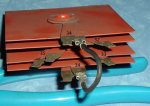
It does not use a bridge rectifier, it four individual diodes. One side (negative?) of each diode is bolted (and electrically bonded to) a heatsink. Two diodes each share a heat sink.

As for how they fail- dunno. But it does happen (whether it is true THIS time remains in question).

Even when cold, the machine is NFG, so it's not like it's failing past a certain point. This is why I think I can test them at anytime and get a reliable result. I want to make sure my test method is accurate before I get into it, as the machine must be pretty severely disassembled to get at them. There is only one of the four I can reach with the DMM while in place. With it still connected to it's circuitry, it shows continuity in both directions- this means either 1)It's the bad one 2)The fact that it is still connected is fouling the test, or 3)test method not correct. Thoughts?
 

the-cyborg

New member
Messages
476
Reaction score
6
Location
Spring, Texas
It does not use a bridge rectifier, it four individual diodes. One side (negative?) of each diode is bolted (and electrically bonded to) a heatsink. Two diodes each share a heat sink.

As for how they fail- dunno. But it does happen (whether it is true THIS time remains in question).

Even when cold, the machine is NFG, so it's not like it's failing past a certain point. This is why I think I can test them at anytime and get a reliable result. I want to make sure my test method is accurate before I get into it, as the machine must be pretty severely disassembled to get at them. There is only one of the four I can reach with the DMM while in place. With it still connected to it's circuitry, it shows continuity in both directions- this means either 1)It's the bad one 2)The fact that it is still connected is fouling the test, or 3)test method not correct. Thoughts?

Any time you are converting AC current to DC current you are rectifying it.
What you have from the description is a solid state bridge rectifier. which will consist of 4 diodes wired in series, at 2 points you should have primary AC voltage going in. at the other 2 points you should have your raw secondary DC voltage coming out, at this point it should go threw capacitors to smooth out the DC voltage to insure it remains constant and not fluctuate due to the Alternating Current input on the primary. from there it will most likely feed into either a step up or step down transformer to either step up or step down the output current or Amp draw.
In short if you have correct primary AC entering the rectifier, but do not have correct output DC voltage one or more of your diodes have blown.
That being said almost all diodes are a one way gate, and unless you have meters, and equipment strong enough you push those gates open you'll have no way of being able to test them. FYI most end user multimeter's will not have enough power to push those gates unless you happen to own an old Simpson 260 or 270 laying around.
If it were me knowing how pragmatic I am I would gather as much info I could from the diodes, scrounge around the internet, and solider in 4 new diodes, and replace all the capacitors. to me it would be worth the minimal and time.
Your probably at between $5.00 and $15.00 worth of diodes and capacitors, verses $200-$1500 for a new welder of compatible quality.
This is just my $.02
 

T-man

New member
Messages
1,232
Reaction score
4
Location
Missoula,MT
:iagree: with cyborg. I wouldn't wast time trying to find the "ONE" . just replace them all. That looks like a great welder, try to keep it going.
 

Doc Sprocket

*********
Messages
15,677
Reaction score
152
Location
Ontario, Canada
Dang! If I can't test them, that means I'm really tossing the dice. Order 4 new ones and HOPE that they're the problem? Ouch. And they seem to be $15-20 each (M9661-39).

Maybe I am better off sending it to a shop?

There has GOT to be a way to test these things! What if I were to isolate one, apply 120v to one side of it, and put my meter on the other side (with the other meter lead on the other pole of the 120v) with the meter set for ACV- would I not get a reading one way, and then invert the diode and not get a reading the other way? Or something? If I have to take all 4 out and unsolder them to do this, so be it.
 
Status
Not open for further replies.
Top