Thanks! Will do once I get this issue sorted.An (unrelated) quick tip:
Remove the three screws holding the recoil starter assembly onto the engine. Remove the recoil starter and "clock it" to where the T-handle is pointing to the rear of the kart (instead of to the back of the seat). I think 9 or 10 o'clock is the position but the screw holes will only allow a few options. Re-install the recoil starter, line up the holes, install the screws and voilà.
This permits you to pull the starter rope at an ideal angle and prevents chafing the rope with that hairpin turn you're making it do. It also puts you or your hands conveniently at the rear of the engine where all the rest of the controls are instead of reaching around all strange-like. This means the way-cool "212cc" decal in the center will be upside down but it'll be cool. All of ours are, and we're cool.

You are using an out of date browser. It may not display this or other websites correctly.
You should upgrade or use an alternative browser.
You should upgrade or use an alternative browser.
Predator 212 with 30 series TC, rpms too high?
- Thread starter Falken
- Start date
Thank you for this. I will check everything!Sounds like a vacuum leak then. That means extra air is bypassing the carburetor somewhere and making the engine race on its own. You must verify that the carburetor-to-intake manifold gasket is sealing properly and not defective, like with a gap or crack in it instead of it being completely flat and conformal (like it should be), and also ensure that the two nuts holding the air cleaner assembly (and the whole carburetor) onto the engine are snug and tight. The nuts may have been installed only finger-tight at the factory (hey it's China not Japan) or they may have backed-off from shipment vibrations (the slow freighter from China) or from just sitting there being started over and over again. This happens a lot with high vibration machinery--just a fact of life.
When you release the choke lever to the run position, you are leaning it out back to a normal air-fuel mixture (the way it should be) but with a vacuum leak already "in play", the choke was allowing it to run a lot better, essentially correcting the air-fuel mixture imbalance. In other words, ideally, the engine really shouldn't run at all on choke. It should START but not sit there and idle. Before the EPA era, most single cylinder industrial engines would start but not continue to run on choke and you had to be quick to turn off the choke before the engine died....
.....
Nowadays with the Green Earth whackos in charge, most carburetors are set to run very lean from the factory and so they will run with the choke turned on. They won't accelerate or make any power, but they will sit there and go chuggeta-chuggeta happily along belching out black smoke for quite some time. Strange Days.
Yes, brand spanking new engine. I just want to make sure it's and engine issue, and not a torque converter issue. If I was using a regular centrifugal clutch, maybe this wouldn't be an issue?Yes. Should just be two 10mils.
Is this a brand new engine? Any chance of an exchange because you should be able to put it on the kart (or whatever equipment) and not have to worry about this. Shouldnt have to buy an engine and troubleshoot it before using.

Edwin Spangler
Well-known member
- Messages
- 1,030
- Reaction score
- 1,027
Show the TC actuating as you manipulate the choke but in the video, it does sound like its revving up.
I'll take a video of this, and some extra pictures of the carb setup, and post it. I'm going to double check hoses and make sure everything is tightened too, the symptoms behind a possible vacuum leak has me thinking.Show the TC actuating as you manipulate the choke but in the video, it does sound like its revving up.
Thanks!

Hellion
Murderator
- Messages
- 9,139
- Reaction score
- 4,119
Pay attention to 6:33 on this video. It shows the idle speed screw. It needs to be turned out, counter-clockwise to a point where the engine idles but does not die. There may have been confusion earlier in the thread equating the throttle lever stop screw (on the top of the engine) with the idle speed screw.
The clutch engagement (a torque converter still has/is a clutch) has nothing to do with it. It's engaging because it's revving too high.
I just want to make sure it's an engine issue, and not a torque converter issue. If I was using a regular centrifugal clutch, maybe this wouldn't be an issue?
The clutch engagement (a torque converter still has/is a clutch) has nothing to do with it. It's engaging because it's revving too high.
Great video, thank you.Pay attention to 6:33 on this video. It shows the idle speed screw. It needs to be turned out, counter-clockwise to a point where the engine idles but does not die. There may have been confusion earlier in the thread equating the throttle lever stop screw (on the top of the engine) with the idle speed screw.
The clutch engagement (a torque converter still has/is a clutch) has nothing to do with it. It's engaging because it's revving too high.
Yes, I've adjusted the idle screw to the point that the engine just barely runs when choked. It's lowered the overall rpms when idling, but the TC is still engaging before I even get a chance to use the throttle. Just like his, I do not have the fuel mixture screw.
One possible thought that I had, was buying stronger garter springs for the TC drive pulley, that way it can't activate until the engine reaches a higher rpm, but am I barking up the wrong tree with that?
Definitely going to make sure and tighten everything, and check for vacuum leaks.
Thank you for all your help.
Hellion
Murderator
- Messages
- 9,139
- Reaction score
- 4,119
...but the TC is still engaging before I even get a chance to use the throttle
Is the idle RPM still way high and/or are the wheels on the ground when you do this?
Just so you know, slight wheel movement happens to mini bikes and go karts that have a proper idle speed. Anything rotating has a tendency to make everything else rotate, from the engine sprocket, to the chain, the axle and finally the wheels. They start to free-wheel on their own well before the clutch shoes engage just from rotational force, rotational drag or excess friction. The trick is to put the wheels on the ground and if this rotational force makes the kart start moving with a force you cannot easily overcome, you still have an RPM problem.
Some go karts have a parking brake that overcomes the issue.
If I have the choke on, it will idle just fine, and the kart won't move when on the the ground.Is the idle RPM still way high and/or are the wheels on the ground when you do this?
When I open the choke, and set it to RUN, the kart will take off like a bat out of hell even with a 120 lb rider.
Denny
Canned Monster
You need to adjust the idle speed screw with the choke off. There’s your problem.
panchothedog
Well-known member
- Messages
- 2,913
- Reaction score
- 3,947
I still think that your problem is carburater linkage . BUT, since you mentioned garter springs and weights ( lots of people don't know what they are ) you can buy stiffer garter springs ( they have about 7 different strengths ) and or lighter weights. Stock engagement is supposed to be around 1400 to 1600 rpm. On highly modified ungoverned engines I can get it up to 4000 rpm. With a governed engine you don't want that. Two tension sizes up would buy you a couple of hundred rpm. Most kart supply shop websites have a chart that shows what each one does. I would take the engine back and ask for a new one if I were you. I have purchased several predator engines over the past few years and have Never had the problem you are describing.
Hellion
Murderator
- Messages
- 9,139
- Reaction score
- 4,119
Returning it to the store is definitely an option like Pancho said. They likely won't take it unless all the fluids are drained so keep that in mind.
The video didn't help me much. It was just proof that some issue exists. Be interesting to see an entire cold start sequence and turning off the choke slowly (no need to rapidly switch the choke on and off) and a closeup of what the throttle linkage is doing. Something is way off here.
The video didn't help me much. It was just proof that some issue exists. Be interesting to see an entire cold start sequence and turning off the choke slowly (no need to rapidly switch the choke on and off) and a closeup of what the throttle linkage is doing. Something is way off here.
Denny
Canned Monster
He said he set the idle with the choke on. He needs to set the idle with the engine warmed up and the choke off.
Hellion
Murderator
- Messages
- 9,139
- Reaction score
- 4,119
Thanks, I didn't catch it until now.He said he set the idle with the choke on. He needs to set the idle with the engine warmed up and the choke off.
And boom, the smoking gunYes, I've adjusted the idle screw to the point that the engine just barely runs when choked.

The CHOKE is just for starting
The CHOKE is just for starting
The CHOKE is just for starting
The CHOKE is just for starting
Don't make adjustments with the CHOKE on.
Idle screw was set when the choke was set to RUN. The entire idle screw is backed out completely from the flange that it screws into. The "idle linkage" is resting flush against the flange. There is no more "reducing" the idle speed using the idle adjustment screw.He said he set the idle with the choke on. He needs to set the idle with the engine warmed up and the choke off.
palate board atv
New member
- Messages
- 13
- Reaction score
- 10
having made an oops disconnecting the governor . i had to open up the case and clean out lot of ground up plastic that had jammed the compression release. i then removed all of the parts of the governor and the low oil float. after the runaway the carb linkage was reworked .rens fine now and throttle response is better.Man, nothing gets by you! You should go read his "tire pressure" thread.
Have you made any modifications to the engine?
Edwin Spangler
Well-known member
- Messages
- 1,030
- Reaction score
- 1,027
You dont happen to have pictures, do you??had to open up the case and clean out lot of ground up plastic

bob58o
SuckSqueezeBangBlow
Did we ever do this?Did you loosen the 10mm pivot nut 1/2-1 full turn?
Utility engines are designed to run at 3600 rpm. This nut holds the throttle pivot in place. When you switch a snowblower to “run” it goes. Unless you loosen this, when you switch your engine to run, it’ll go too.
da yellow one…
And add an extra return spring to make sure this lever returns when not on the throttle.

Hellion
Murderator
- Messages
- 9,139
- Reaction score
- 4,119
Thought I would add to Bob58o's wonderful drawing...
YELLOW: 10mm pivot nut
GREEN: Wire swivel stop
BLUE: Throttle cable
RED: Cable conduit clamp
Blue [plus the extra Red and Green] just shows the two areas you can connect a throttle cable to. The rear location may have more aesthetic appeal going under the engine and may have less chance of snagging on brush, twigs and thorns...
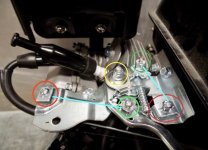
Hope you get it/got it sorted. Something is wildly wrong with your engine.
YELLOW: 10mm pivot nut
GREEN: Wire swivel stop
BLUE: Throttle cable
RED: Cable conduit clamp
Blue [plus the extra Red and Green] just shows the two areas you can connect a throttle cable to. The rear location may have more aesthetic appeal going under the engine and may have less chance of snagging on brush, twigs and thorns...
Idle screw was set when the choke was set to RUN. The entire idle screw is backed out completely from the flange that it screws into. The "idle linkage" is resting flush against the flange. There is no more "reducing" the idle speed using the idle adjustment screw.
Hope you get it/got it sorted. Something is wildly wrong with your engine.
palate board atv
New member
- Messages
- 13
- Reaction score
- 10
no i did not any pics . too busy kicking myself.You dont happen to have pictures, do you??