Performance question

AlienBoy

New member
Messages
5
Reaction score
2
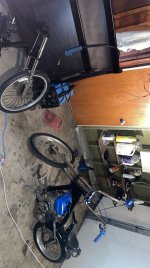
I have a 208cc powerfist the crank resembles a tillitson it’s got a crank journal of 1.180” and wrist pin is .716” also comes with a flattop piston stock.

Currently everything I have:
-0.10 head gasket
-18LB springs
-Mod 2 Cam
-Cast Aluminum flywheel
-billet rod
-94 octane fuel

I’m curious if anyone knows roughly how many RPMS this set up should be making? What else would one recommend for more power?

Also what sprocket sizes are recommended on these 20” rear chopper wheels?
 

Attachments

  • 7DB43D2A-AF9A-4D1E-9E7D-402B09AB35FC.jpeg
    7DB43D2A-AF9A-4D1E-9E7D-402B09AB35FC.jpeg
    549.2 KB · Views: 9

BrownStainRacing

Well-known member
Messages
1,367
Reaction score
1,486
The mod 2 cam is over-rated and under powered. Not a good choice for big tires, and you will be very disappointed.

It's a gokart RACE cam used for lift rules without duration checks. Needs 10.5:1 compession ratio minimum, 13" or smaller tires, 4500+ stall, big ridiculous gearing, and won't pull a greasy string out of a cats a$$ til 5000 rpm.
You will be much better off with the stock cam, 1.3:1 stamped steel rocker arms with matching guide plate, and 22# valve springs. This will out pull the mod2 up til 5500 rpm, and you won't need stupid gearing to do it.

A much BETTER choice is the isky racing, black mamba jr cam 26# springs, stock rockers, and pushrods. Or 1 of his smaller custom cams on a 104 LSA. Isky's smallest custom, 220/.260/104 will hit 5500 rpm with stock carb and a header.

Isky cams close the intake valve much sooner then any other comparable sized cams. This compresses the air/fuel mixture more, resulting in BIG POWER TORQ at lower rpm, in other words, it gets weight moving sooner, and don't need unnecessary gear as a crutch for over cammed, underpowered small blocks.

Before you add that .010" thick head gasket, how far down in the cylinder is the piston at TDC??? You need a minimum of .030" between the piston and bottom of the head, including head gasket thickness.

You mention 94 octane.
Did you calculate the compression ratio, and set ignition timing??
 

BrownStainRacing

Well-known member
Messages
1,367
Reaction score
1,486
Isky might know a thing or 2 about cams.
 

redflash

Well-known member
Messages
650
Reaction score
625
you also do not mention anything about the carb......is it stock ? is it jetted, what size jet......the carb is the front door on power. For all those other things to give their maximum ability to the motor.....you must have enough fuel to utilize the potential of those other parts.. achieving full capable power is a delicate balance of coordinated and matched parts. too big a cam will kill power if all other things are not balanced.....too big a carb will kill power unless all other components are balanced.. It/s a dance to achieve maximum power per cubic inch.

Da redflash
 

AlienBoy

New member
Messages
5
Reaction score
2
The mod 2 cam is over-rated and under powered. Not a good choice for big tires, and you will be very disappointed.

It's a gokart RACE cam used for lift rules without duration checks. Needs 10.5:1 compession ratio minimum, 13" or smaller tires, 4500+ stall, big ridiculous gearing, and won't pull a greasy string out of a cats a$$ til 5000 rpm.
You will be much better off with the stock cam, 1.3:1 stamped steel rocker arms with matching guide plate, and 22# valve springs. This will out pull the mod2 up til 5500 rpm, and you won't need stupid gearing to do it.

A much BETTER choice is the isky racing, black mamba jr cam 26# springs, stock rockers, and pushrods. Or 1 of his smaller custom cams on a 104 LSA. Isky's smallest custom, 220/.260/104 will hit 5500 rpm with stock carb and a header.

Isky cams close the intake valve much sooner then any other comparable sized cams. This compresses the air/fuel mixture more, resulting in BIG POWER TORQ at lower rpm, in other words, it gets weight moving sooner, and don't need unnecessary gear as a crutch for over cammed, underpowered small blocks.

Before you add that .010" thick head gasket, how far down in the cylinder is the piston at TDC??? You need a minimum of .030" between the piston and bottom of the head, including head gasket thickness.

You mention 94 octane.
Did you calculate the compression ratio, and set ignition timing??
Hey wow thanks for the detailed reply. You’ve made me realize how much more I still need to learn haha. Also I have a PZ 27mm carb from amazon and a header pipe.

First off, what is 4500+ Stall mean?

How can I calculate my compression ratio? Is it as simple as taking my digital callipers and measuring from TDC to the deck and adding gasket thickness?

What is a 104 LSA?

In terms of the fuel, I run the 94 because it’s the only gas in town that has 0% ethanol.

I put on the new flywheel and decided to shave the key about 7 or 8 degrees to advance it. I’m not sure how to measure ignition timing? What fuel do you recommend?
Thanks again
 

BrownStainRacing

Well-known member
Messages
1,367
Reaction score
1,486
Here's a CR calculator use. I choose cams that keep the DCR in the 7.7:1 - 8.1:1 range, for running 87 octane, and 28-29 degrees of ignition timing. I dont mind running ethanol, it actually keeps carbon build up down.

Stall, is engagement of the clutch or driver. Stock is usally around 2200 rpm stall/engagement. Big cams that close the intake valve late, loose a ton of bottom end power/ torq, so to get them to move, you have to stall the engagement of the clutch/ driver. If not, it will take forever to get it up in the rpm range the cam was designed for. Even a bone stock low CR engine will benefit from a 2500-2800 stall. It puts it up on the power/torq sooner and will get that weight moving faster.

Yes, you can use your digital calipers, jus measure on both sides above the wrist pin. You will get 2 measurements, these are not the most precise blocks.
I perfer to use a big Allen wrench across the top of the piston along the wrist pin, and use feelers gauges to find the thinnest area. This is also a measurement you need to calculate CR.

LSA = lobe separation angle. All cams have a lsa. This is important when picking the right cam for a particular build.

I find cams with 104 lsa, build torq quick in these lil turd motors. I have NEVER been disappointed in a isky cam, they are pricey, they are worth every penny, IMHO.

Is that the cast aluminum flywheel that comes stock on the tilly 212r????
If so, it doesn't come with a timing mark from the factory. You will need a piston stop, and stock key to find where to mark it.

Read and learn about CR and DRC. It's the fastest, easiest, way to power, IMHO

 
Last edited:

AlienBoy

New member
Messages
5
Reaction score
2
Here's a CR calculator use. I choose cams that keep the DCR in the 7.7:1 - 8.1:1 range, for running 87 octane, and 28-29 degrees of ignition timing. I dont mind running ethanol, it actually keeps carbon build up down.

Stall, is engagement of the clutch or driver. Stock is usally around 2200 rpm stall/engagement. Big cams that close the intake valve late, loose a ton of bottom end power/ torq, so to get them to move, you have to stall the engagement of the clutch/ driver. If not, it will take forever to get it up in the rpm range the cam was designed for. Even a bone stock low CR engine will benefit from a 2500-2800 stall. It puts it up on the power/torq sooner and will get that weight moving faster.

Yes, you can use your digital calipers, jus measure on both sides above the wrist pin. You will get 2 measurements, these are not the most precise blocks.
I perfer to use a big Allen wrench across the top of the piston along the wrist pin, and use feelers gauges to find the thinnest area. This is also a measurement you need to calculate CR.

LSA = lobe separation angle. All cams have a lsa. This is important when picking the right cam for a particular build.

I find cams with 104 lsa, build torq quick in these lil turd motors. I have NEVER been disappointed in a isky cam, they are pricey, they are worth every penny, IMHO.

Is that the cast aluminum flywheel that comes stock on the tilly 212r????
If so, it doesn't come with a timing mark from the factory. You will need a piston stop, and stock key to find where to mark it.

Read and learn about CR and DRC. It's the fastest, easiest, way to power, IMHO

Makes sense. great info. Yes it is the one that comes with the tilly 212r. I’m not sure what you mean about timing mark? I’ve never heard that.

I’m wondering about carbs. I have a 27mm but I notice a lot of builders use 22-24mm. I have a 115 jet in mine but I can’t tell if it’s lean/rich. What variables to consider when picking carb size?

Cheers
 

BrownStainRacing

Well-known member
Messages
1,367
Reaction score
1,486
Makes sense. great info. Yes it is the one that comes with the tilly 212r. I’m not sure what you mean about timing mark? I’ve never heard that.

I’m wondering about carbs. I have a 27mm but I notice a lot of builders use 22-24mm. I have a 115 jet in mine but I can’t tell if it’s lean/rich. What variables to consider when picking carb size?

Cheers
I'm not a fan of slide carbs on these engines. I perfer bored stock appearing carbs, so I can run the stock air box and filter.

Bored SA carbs can turn 8500 rpm with the right combo of parts, so there's really no need for myself to use the slide carbs.

Smaller carbs will accelerate faster for a neighborhood cruiser, daily driver, hill climbing, mud hole stomping, type builds.

Now for full blown drag racing types, yes the bigger the better, but don't expect it to be a very good on/off throttle, fast acceleration carb.

I'm sure some of the slide carb guys can help you with tuning your carb, and answer your questions.

As for as the timing marks, arc and pvl flywheels have a mark built into them, making it easier to set and adjust the ignition timing.

That 212r flywheel does not have a mark. You can find it with a piston stop, then use a degree wheel, pointer, and dial indicator to set the ignition timing.

The keyway on the crankshafts are never cut the same. This makes no 2 engines have the same timing.

I've found them to be 18-27 degrees BTDC right outta the box. Most are close to that 24 stock mark, but some are just too far away. This makes it hard to dial in a good tune when people start upgrading parts looking for more power.
Too little or too much ignition timing, will seem like all the upgrades have done absolutely nothing for performance.
This is the main reason I don't use flywheel keys and set timing myself.

That 212r flywheel has 4 degrees retard built in it.

So let's say your crank is at 20, take away 4 for flywheel, add the 7 from your filed down key and you end up 23 degrees BTDC.

That's 1 less then a low CR bone stock engine should come with.

Let's say your crank is at 26, take away 4 from flywheel, add the 7 from key, now you have 29. This is much better for a slightly modified engine like yours.

That 6 degree difference is huge when it comes to CR bump, cam timing (valve events), more air/fuel mixture.

You need to know where you are at, so you will know which direction you need to go. 👍

Also, stock coils start retarding ignition timing around 5k rpm. As much as 6-8 around 6k.

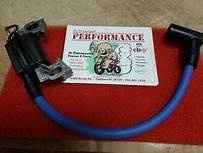
Dover power has some really good coils if you need to run over 5k rpm and still make power.
 

redflash

Well-known member
Messages
650
Reaction score
625
Hey brown got a question....I've tried to research "holy Moses carbs" give me a complete tutorial as to what you know about them please !

Da redflash
 

BrownStainRacing

Well-known member
Messages
1,367
Reaction score
1,486
Hey brown got a question....I've tried to research "holy Moses carbs" give me a complete tutorial as to what you know about them please !

Da redflash
I don't have 1 myself. A good friend of mine, we help each other out with testing and tuning, he's got a holy Moses .640" with choke and its most definitely 1 hellava carb right outta the box. I have a raceproquip .670" and I'm fairly certain, stans .640" is a better carb.

I'm not sure how, or what makes them so much better, but the throttle blade, screw, and air bleeds are very noticeably different on the holy Moses carb. There's no signs of any epoxy on the inside, like theyve cut into and reshaped. I'm sure theres more to them then that, but I wouldn't know where to start when making a bored SA carb. There's more to it then jus running a reamer down the throat of 1, I would think.

They seem to be popular in the race scene for carb restrictions, plate engines, and outlaws. But race and back yard fun are 2 totally different worlds.
 

karl

Well-known member
Messages
2,448
Reaction score
716
Location
North east Ohio
I'm not a fan of slide carbs on these engines. I perfer bored stock appearing carbs, so I can run the stock air box and filter.

Bored SA carbs can turn 8500 rpm with the right combo of parts, so there's really no need for myself to use the slide carbs.

I must ask, what is the advantage of a bored stock carb over an appropriately sized slide carb, that lets just say
flows the exact same cfm? As in performance, not just being able to bolt the stock airbox back on the engine.
Smaller carbs will accelerate faster for a neighborhood cruiser, daily driver, hill climbing, mud hole stomping, type builds.
Yeah totally , but why does the smaller carb being stock type matter?
 

BrownStainRacing

Well-known member
Messages
1,367
Reaction score
1,486
I must ask, what is the advantage of a bored stock carb over an appropriately sized slide carb, that lets just say
flows the exact same cfm? As in performance, not just being able to bolt the stock airbox back on the engine.

Yeah totally , but why does the smaller carb being stock type matter?
I'm not sure if there would be any advantage, I've ran really good vm22's. I switched back over to stock because of the gravel dust getting in the cylinder, and no need for me to be turning 7000+ rpm, jus not enough straight aways here for that kinda speed.

Smaller stock or slide, will have more velocity ( air/fuel speed), not more air/ fuel, but faster thur the runner. Im not 100% sure how all this happens. They won't turn as high rpm, but the throttle response in the low and mid is very noticeable for jus playing around with. I see the same results going from a 27mm intake valve to the smaller 25mm intake valve. They are a difference in the low to mid rpm range, 3k-5k.

I put a pz16 on a 196, jus for giggles, after some fine tuning, it was much more snappier then the chikuni 22. Without a tach, no one would ever notice the 500-600 rpm fall off on a small tire live axle yard kart.

If you ever get a chance to try 1 of those tiny carbs (50cc atv), give it a go.

Check out these builds from ec. Notice how they start out a with slide carbs, then go to a bored stock, then the big walbro. I just can't imagine how that .680" carb would outperform a 24mm slide at that kinda rpm. I don't understand it.
 
Top