Out of AFRICA

Status
Not open for further replies.

wbos

New member
Messages
22
Reaction score
0
Location
Cape Town, South Africa
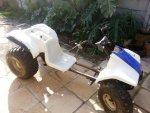
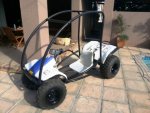
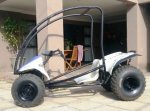
Hello, I am building a pipe buggy from a old quad bike. I call it Project :”Out of AFRICA”

I was given am old Yamaha BREEZE quad bike a few years ago. The quad was missing its engine. At the time my work were looking at designing our own marine suspension seats and we thought it would be wise to start by analysing the suspension dynamics of a dirt bike. I then bought two stripped down DT175 dirt bikes that came from a police auction. The work kept the frames and I bought over the one engine.

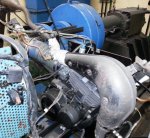
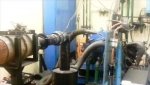
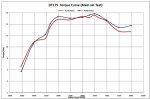
I never got around installing the DT175CC engine into the quad. A year ago we were asked to develop an affordable AUV plane engine. We needed a two stroke engine for in-cylinder combustion measurements. My engine has been on the Dynamometer for the last year or so and I now have access to high speed in-cylinder and exhaust pressure pulse data, as well as accurate power and torque curves with intake air flow and fuel consumption data over the whole speed range.

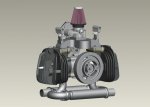
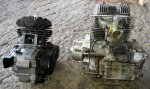
The CAD pic is our two cylinder two stroke boxer engine for a UAV. It will use donor parts from a Yamaha DT200.

I am currently designing a new tuned exhaust for the DT175 engine. I will be testing it on the dynamometer and comparing its performance with the OEM’s exhaust. My aim is to widen the power band to a lower RPM.
Am I on the right track, is low down torque, or high RPM power better for an off-road buggy?
 

Attachments

  • 20130801_143813.jpg
    20130801_143813.jpg
    307.2 KB · Views: 24
  • Dyno test 2.jpg
    Dyno test 2.jpg
    30.3 KB · Views: 21
  • engine_assy_flywheel_1.jpg
    engine_assy_flywheel_1.jpg
    46.7 KB · Views: 30
Last edited:

wbos

New member
Messages
22
Reaction score
0
Location
Cape Town, South Africa
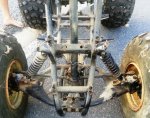
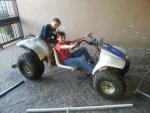
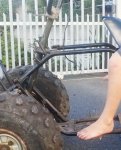
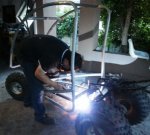
To build my pipe kart I used a Yamaha Breeze as a donor vehicle. I cut it in two and stretched it to the appropriate length. It is a bit longer than what I would have preferred because my foot pedals must be behind the front wheels and suspension of the old quad, unlike other go karts where the foot pedals can be in line with the front of the front wheels. I welded square tubing onto the existing quad frame to lengthen the quad.
 

Attachments

  • 20130622_163654.jpg
    20130622_163654.jpg
    404.8 KB · Views: 25
  • 20130630_141056.jpg
    20130630_141056.jpg
    97.1 KB · Views: 22
  • 20130629_173115.jpg
    20130629_173115.jpg
    98.1 KB · Views: 33

wbos

New member
Messages
22
Reaction score
0
Location
Cape Town, South Africa
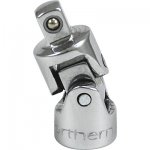
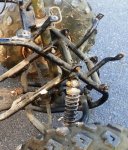
Once the quad was stretched I needed to change the angle of the steering column. I did not want to modify the original quad’s steering set-up to much. I decided to change the angle of the steering column by cutting the steering column at the lower end, just above the tie-rod mounts and welding in a universal adaptor joint from a socket spanner set. I then moved the upper steering column bearing to the opposite side of the pipe it was originally mounted onto.

I hope that the universal adaptor joint from a socket spanner set will be strong enough.

I will not be able to mount a steering wheel onto the steering column, it is still to vertical. The new steering position if acceptable with the original handle bars on the modified less vertical steering column.
 

Attachments

  • socket universal joint.jpg
    socket universal joint.jpg
    16.9 KB · Views: 13
  • steering.jpg
    steering.jpg
    158.6 KB · Views: 14
  • steering1.jpg
    steering1.jpg
    109.8 KB · Views: 17
  • steering2.jpg
    steering2.jpg
    100.8 KB · Views: 16
Last edited:

Desertduler

Active member
Messages
1,736
Reaction score
14
In off road applications you need low to midrange torque more than you need high RPM peaky power you will end up slipping the clutch alot to keep the engine on its narrow powerband if you tune the engine for high RPM power such as porting and expansion chamber design.
Check and correct the squish band in the combustion chamber and cut the head to the minimum so to enhance low end power to do this one can find information on the web for the minimum squish band clearence for your cylinder bore and how to check it on the web it is not rocket science also when you build a pipe as you may know allready you must measure the port durations of the transfer and exhaust ports and their shapes in order to build a pipe correctly you must have computer software to do so along with a slip roller to roll the cones for the pipe now building a pipe for a two stroke is rocket science LOL! look at software such as build and click if you don't have software allready it is an excellent program and you can build a pipe for that 175 to enhance the low to midrange in that engine along with getting the squish band down to a minimum it will make a big difference in power!
 

Desertduler

Active member
Messages
1,736
Reaction score
14
wbos,
Is that a water brake Dyno or electric Dynamo Dyno that your engine is hooked up to? I ran a Clayton Dyno for years that I test ran all the engines both Diesel and Gas that I rebuilt to break them in on.
You learn alot when you have an engine and chassis Dyno on hand they do not lie and you can tell if you have made progress in your tuning and modifications and break your engines in the correct way so some yeahoo don't ruin them for ya!
 

wbos

New member
Messages
22
Reaction score
0
Location
Cape Town, South Africa
wbos,
Is that a water brake Dyno or electric Dynamo Dyno that your engine is hooked up to? I ran a Clayton Dyno for years that I test ran all the engines both Diesel and Gas that I rebuilt to break them in on.
You learn alot when you have an engine and chassis Dyno on hand they do not lie and you can tell if you have made progress in your tuning and modifications and break your engines in the correct way so some yeahoo don't ruin them for ya!

It is a Froude Eddy-current absorption dynamometer upgraded with a series mount Siemens AC motor that allow for braking & motoring type tests such as gear change simulation or complex exhaust emission test cycles.
 

wbos

New member
Messages
22
Reaction score
0
Location
Cape Town, South Africa
You could gear it really low so that it uses the rpms in the powerband. That's how I plan on using the small bike motor for my next eventual project.

The quad has a much smaller back wheel than the original DT175 donor bike. I think that will already give me an overall reduction in gearing. I am not sure about the size of the original DT175 donor bike’s back sprocket.
 

Desertduler

Active member
Messages
1,736
Reaction score
14
It is a Froude Eddy-current absorption dynamometer upgraded with a series mount Siemens AC motor that allow for braking & motoring type tests such as gear change simulation or complex exhaust emission test cycles.

Cool:thumbsup:
 

wbos

New member
Messages
22
Reaction score
0
Location
Cape Town, South Africa
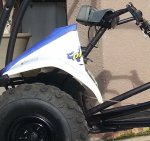
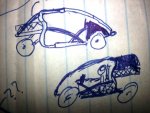
I was wondering how to make the cage of my pipe buggy less edged and a bit curvier. Then I recalled the set of old trampoline pipes laying in my back yard. I made some rough hand sketches, trying to utilise the trampoline pipe sections without modifying them to much.
I was worried about welding the galvanised, thin walled trampoline pipes together. But it all worked out OK. The finished cage came out very robust. I am planning to cover the side openings of the cage with nylon nets to protest the limbs of my young kids in the event of accidental roll over.
 

Attachments

  • 80% done 2.jpg
    80% done 2.jpg
    86.6 KB · Views: 24
  • 80% done.jpg
    80% done.jpg
    85.2 KB · Views: 20
  • JumpSport-trampoline-frame.jpg
    JumpSport-trampoline-frame.jpg
    73.5 KB · Views: 17
  • weld2.jpg
    weld2.jpg
    73.4 KB · Views: 11
  • design.jpg
    design.jpg
    85 KB · Views: 13

wbos

New member
Messages
22
Reaction score
0
Location
Cape Town, South Africa
Gear ratio problems

Thanks for the warning about the potential gear ratio problems. I decided to look into it before I finalise the Engine transplant.

I studied the reduction gear ratios and wheel sizes of the original Yamaha Breeze, the Donor DT175 and the combination of the two (The DT175 engine and the Breeze chassis while keeping the standard sprockets).
I considered the Engine RPM. Torque curve, Primary Reduction System ratios, Transmissions ratios, Secondary Reduction System (Chain drive) ratios as well as the tyre circumferences for all three scenarios.
I graphed the results and realised that the buggy’s minimum crawling speed will be too high for extreme off road driving. The engine Torque also drops dramatically below 3000 RPM. If I use the existing two sprockets then the chain ratio will be 2 to 1 (Front 16 tooth, Back 32 tooth).This is to low. I will try to change the front sprocket to a 12 tooth and the rear tooth to a 49 tooth sprocket to give me a 4.1 to 1 ratio. Will this Work?
 

Attachments

  • DT175 Torque.pdf
    35.6 KB · Views: 9
  • DT175 Power.pdf
    37.3 KB · Views: 7
  • Buggy chain ratio 2.pdf
    33.1 KB · Views: 7
  • Buggy chain ratio 4.1.pdf
    32.9 KB · Views: 3
  • 5000RPM.pdf
    33.4 KB · Views: 8
  • Ratio Data.pdf
    29.1 KB · Views: 3

wbos

New member
Messages
22
Reaction score
0
Location
Cape Town, South Africa
Total Reduction Ratio

After some more thinking and calculations, my latest gear ratio decision is:
Engine sprocket = 10 tooth
Wheel sprocket = 32 tooth (current sprocket on the quad)
Secondary Reduction Ratio (Chain drive ratio) = (10/32) 3.2
Total Reduction Ratio 1st gear = 32.8
Total Reduction Ratio 6st gear = 8.67
 

Attachments

  • Torque curve.jpg
    Torque curve.jpg
    62.6 KB · Views: 7
  • gear change.jpg
    gear change.jpg
    94.9 KB · Views: 8

wbos

New member
Messages
22
Reaction score
0
Location
Cape Town, South Africa
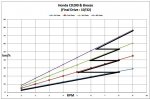
I have not been able to install the DT175 engine into the Buggy. By employer asked me to sell the DT175 engine to our compony. We want to do more research on two stroke engines for our UAV project. And my engine is already installed on the Dynamometer. My employer will pay for any other donor engine that I can find.

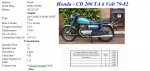
One of my co-workers had a Honda CD200 bike for sale for R1500 (150$ US). I decided to take the CD200 because it has about the same power as the DT175 but with a lot more usable Torque than the DT175 in the lower RPM range. Other advantages are that it is a four stroke engine with electrical starter.

Now I need to re-design all the engine mounting brackets and possibly also have to extend the rear suspension swing arm.
 

Attachments

  • Honda CD200.jpg
    Honda CD200.jpg
    68.9 KB · Views: 12
  • cd200 all gears2.jpg
    cd200 all gears2.jpg
    81.9 KB · Views: 7

powerking

New member
Messages
15
Reaction score
0
Location
durham n.c
****. Well I guess you like your work. In order to be willing to redo all that work. But it sounds like it will be worth it in the end if you can get a beter moter for it. Best of luck my frie:auto:nd.
 

wbos

New member
Messages
22
Reaction score
0
Location
Cape Town, South Africa
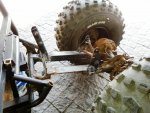
The Honda CD200 is too big to fit between the rear wheels. I was forced to extend the rear swing arms, and to fit the engine in front of the rear wheels. I was also able to make use of the engine brackets from the CD200 bike’s frame.
 

Attachments

  • new swing arm.jpg
    new swing arm.jpg
    109.1 KB · Views: 7
Status
Not open for further replies.
Top