
SacramentoNathan
New member
- Messages
- 2
- Reaction score
- 0
Hello Everyone, I am new here and hoping to get some advice on a couple of topics:
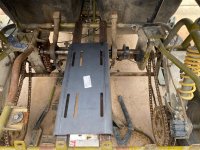
I bought a custom heavy duty go cart that had an arctic cat 440 motor in it that was not running. I am replacing the engine with a predator 420cc from Harbor Freight. I cut out the old engine mounts and am installing new cross bars with an engine mounting plate (see pic below(
I am using a Series 40 torque convertor and plan on connecting the #40 chain 10T sprocket from the torque convertor to the jack shaft that the original snow mobile torque convertor was connected to. The jackshaft has an end with multiple small groves (see pic below and ignore the sprocket currently sitting there)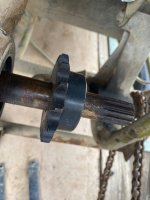 It looks like a motorcycle front sprocket may fit onto it and my first question is are motorcycle front sprockets universal in terms of the groove pattern that slides over the axle shaft? Also do they sell front motorcycle sprockets that are a #40 chain size that will match the 10T sprocket on the series 40 torque convertor?
My next questions is about gearing as this cart has the following sprockets/gears:
10T on the series 40 Torque convertor that goes to the Jack shaft
I am not sure how many teeth to put on the Jackshaft axle, maybe 13T (this is a variable as I have not bought one yet)
The jackshaft has a sprocket on the other end with 11 teeth that feeds into the Gear Box (not in the picture as I removed the jackshaft)
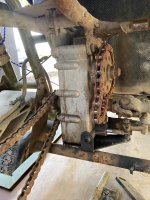
The Gear box has a receiving sprocket with 21 teeth on it and the output sprocket from the gear box to the drive axle as 11 teeth on it (does this mean that I can ignore the 21 tooth sprocket in my calculations as the Jackshaft has an 11 tooth sprocket going to the gear box and an 11 tooth sprocket coming out of the gear box?See pic below)
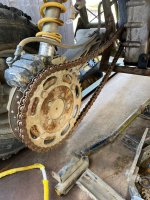
Finally the Rear Axle Sprocket has 41 teeth:
So my big question is how do I calculate my gear ratio? The Arctic cat engine had about 50 HP and revved around 6,000 RPM. The predator motor has 13 hp, maybe a little more if I bypass the governor, but will only rev around 3,600 - 4,000 so I am pretty sure I am going to need to change my gear ratio. As mentioned above, can I ignore the 21 tooth sprocket at the gear box in my calculations?
If so I found this calculator that I can use: https://www.gokartguide.com/gear-ratio-chart-speed-calculator/
I assume that the input jackshaft input sprocket is the one coming from the Torque convertor and the jackshaft output sprocket is going to the wheels, is this correct?
Also any advice on where to buy sprockets and chains would be appreciated,
Thank you and Have A Great Day!
Nathan
Any advice that anyone can give regarding what the formula is would be very helpful, or even as simple as what is the impact of changing the receiving jackshaft axle sprocket larger or smaller.
I bought a custom heavy duty go cart that had an arctic cat 440 motor in it that was not running. I am replacing the engine with a predator 420cc from Harbor Freight. I cut out the old engine mounts and am installing new cross bars with an engine mounting plate (see pic below(
I am using a Series 40 torque convertor and plan on connecting the #40 chain 10T sprocket from the torque convertor to the jack shaft that the original snow mobile torque convertor was connected to. The jackshaft has an end with multiple small groves (see pic below and ignore the sprocket currently sitting there)
It looks like a motorcycle front sprocket may fit onto it and my first question is are motorcycle front sprockets universal in terms of the groove pattern that slides over the axle shaft? Also do they sell front motorcycle sprockets that are a #40 chain size that will match the 10T sprocket on the series 40 torque convertor?My next questions is about gearing as this cart has the following sprockets/gears:
10T on the series 40 Torque convertor that goes to the Jack shaft
I am not sure how many teeth to put on the Jackshaft axle, maybe 13T (this is a variable as I have not bought one yet)
The jackshaft has a sprocket on the other end with 11 teeth that feeds into the Gear Box (not in the picture as I removed the jackshaft)
The Gear box has a receiving sprocket with 21 teeth on it and the output sprocket from the gear box to the drive axle as 11 teeth on it (does this mean that I can ignore the 21 tooth sprocket in my calculations as the Jackshaft has an 11 tooth sprocket going to the gear box and an 11 tooth sprocket coming out of the gear box?See pic below)
Finally the Rear Axle Sprocket has 41 teeth:
So my big question is how do I calculate my gear ratio? The Arctic cat engine had about 50 HP and revved around 6,000 RPM. The predator motor has 13 hp, maybe a little more if I bypass the governor, but will only rev around 3,600 - 4,000 so I am pretty sure I am going to need to change my gear ratio. As mentioned above, can I ignore the 21 tooth sprocket at the gear box in my calculations?
If so I found this calculator that I can use: https://www.gokartguide.com/gear-ratio-chart-speed-calculator/
I assume that the input jackshaft input sprocket is the one coming from the Torque convertor and the jackshaft output sprocket is going to the wheels, is this correct?
Also any advice on where to buy sprockets and chains would be appreciated,
Thank you and Have A Great Day!
Nathan
Any advice that anyone can give regarding what the formula is would be very helpful, or even as simple as what is the impact of changing the receiving jackshaft axle sprocket larger or smaller.


