
florin
New member
Few weeks ago I bought an old rusty racing go kart for $150.
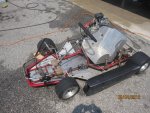
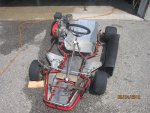
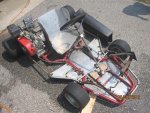
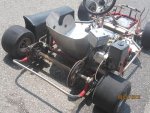
It has a Honda GX140, Enginetics hydraulic brakes, a home-made seat and it doesn't work (engine is missing the pull starter, the carb is full of rust, the brake line is broken and the caliper is seized).
My plan was to convert it to electric power for my 8 years old son, so all I was interested in, was a strong chassis, good wheels and good steering.
I removed the brakes (the line was broken and the caliper was stuck) and the motor and I installed an Ametek 72V DC motor (I have few of them laying around), a 60 Amp key switch, a 30A fuse and two Lithium Polymer 22V 4Ah in series, for 44V, 4Ah (from my remote controlled airplanes).
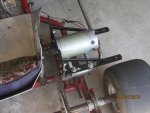
The motor was attached to a piece of plywood using a U clamp and a bungee cord - works better than expected. This is just an initial set-up, to test gears and different motors. After choosing the optimum set-up, I'll build some better metal brackets.
The initial test was with a 12V Pb battery - the kart was moving too slow. I used then a 22V LiPo battery and the kart started to move faster. Now I am using 2x22V in series for 44V, 4Ah that gives a top speed of 15Km/h (about 10mph) and almost 1 Hr of driving. It is above my expectations. I was hoping for 15km/h, but I did not even dare to think of 1 hr driving per charge - for a 8 years old kid.
I was afraid the go kart won't start from a still position, but when the kid is turning the key, it starts really well. It does make a "bang" and probably it's stressing the chain/sproket/engine...but it is a test set up.
I ordered a speed controller from eBay for $35 and a hall effect sensor that will make a nice throttle device. I have to install a magnet on the throttle pedal that will generate a signal in the Hall Effect sensor that will transmit the signal to the speed controller. The hall effect sensor is replacing the potentiometer that comes with the speed controller. Well, I hope it will work, otherwise I have to find a way to move the potentiometer with the throttle pedal.
I purchased a relay ($4 for the relay and $4 for the socket and wires) that will be activated by a switch on the brake pedal. When the relay is not energized, it will provide power from the battery to the motor, but when the brake pedal gets pushed, the switch will activate the relay and the relay will cut the power from the battery and short the motor terminals for an electric brake. I tested the short terminals brake and it seems very strong. If it is too strong, I will add a resistor in series to lower the short current or even more resistors in different steps/ positions of the brake pedal.
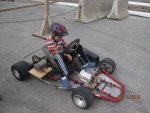
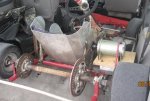
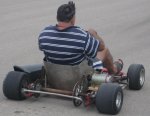
Below are some pictures and videos of the go kart I bought and the first electric set-up (battery/motor, fuse and switch).
Video1
Video 2
Video 3
http://www.youtube.com/watch?v=Ovv6Vyd7wEY&feature=autoplay&list=ULvNeI2BF1lng&playnext=2
It has a Honda GX140, Enginetics hydraulic brakes, a home-made seat and it doesn't work (engine is missing the pull starter, the carb is full of rust, the brake line is broken and the caliper is seized).
My plan was to convert it to electric power for my 8 years old son, so all I was interested in, was a strong chassis, good wheels and good steering.
I removed the brakes (the line was broken and the caliper was stuck) and the motor and I installed an Ametek 72V DC motor (I have few of them laying around), a 60 Amp key switch, a 30A fuse and two Lithium Polymer 22V 4Ah in series, for 44V, 4Ah (from my remote controlled airplanes).
The motor was attached to a piece of plywood using a U clamp and a bungee cord - works better than expected. This is just an initial set-up, to test gears and different motors. After choosing the optimum set-up, I'll build some better metal brackets.
The initial test was with a 12V Pb battery - the kart was moving too slow. I used then a 22V LiPo battery and the kart started to move faster. Now I am using 2x22V in series for 44V, 4Ah that gives a top speed of 15Km/h (about 10mph) and almost 1 Hr of driving. It is above my expectations. I was hoping for 15km/h, but I did not even dare to think of 1 hr driving per charge - for a 8 years old kid.
I was afraid the go kart won't start from a still position, but when the kid is turning the key, it starts really well. It does make a "bang" and probably it's stressing the chain/sproket/engine...but it is a test set up.
I ordered a speed controller from eBay for $35 and a hall effect sensor that will make a nice throttle device. I have to install a magnet on the throttle pedal that will generate a signal in the Hall Effect sensor that will transmit the signal to the speed controller. The hall effect sensor is replacing the potentiometer that comes with the speed controller. Well, I hope it will work, otherwise I have to find a way to move the potentiometer with the throttle pedal.
I purchased a relay ($4 for the relay and $4 for the socket and wires) that will be activated by a switch on the brake pedal. When the relay is not energized, it will provide power from the battery to the motor, but when the brake pedal gets pushed, the switch will activate the relay and the relay will cut the power from the battery and short the motor terminals for an electric brake. I tested the short terminals brake and it seems very strong. If it is too strong, I will add a resistor in series to lower the short current or even more resistors in different steps/ positions of the brake pedal.
Below are some pictures and videos of the go kart I bought and the first electric set-up (battery/motor, fuse and switch).
Video1
Video 2
Video 3
http://www.youtube.com/watch?v=Ovv6Vyd7wEY&feature=autoplay&list=ULvNeI2BF1lng&playnext=2
Attachments
-
 1.jpg174.7 KB · Views: 51
 -
 2.jpg169.3 KB · Views: 46
 -
 3.jpg175.7 KB · Views: 49
 -
 4.jpg163.4 KB · Views: 52
 -
 5.jpg121.5 KB · Views: 48
 -
 8.jpg97 KB · Views: 71
 -
 7.JPG254 KB · Views: 40
 -
 6.jpg78.6 KB · Views: 41



 You have something special going on here florin!