Motorized drift trike build

Status
Not open for further replies.

James.Ait.2013

The Village Idiot
Messages
48
Reaction score
0
Location
South-West Victoria, Australia
If you aren't getting into the new craze called 'drift triking' you are missing out!

http://i1299.photobucket.com/albums/ag71/NetworkFart/photo-778742_zps094ea166.jpg

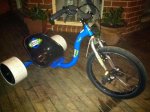
The original drift trike looks like this. it all started out with this idea. the huffy slider then quickly went viral and this is what has come of it.

http://youtu.be/R9K-MzMN2w4

my design is to just use a racing tarmac go kart axle. and so the whole thing will slide or 'drift' there is a trick to the whole operation. you deflate the tires, then slip some Pvc pipe or PE pipe over the tires. then you re inflate them so they expand and hold the pipe in place. in theory you dont need more power to drift. you just need less grip.

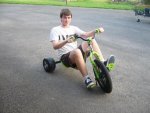
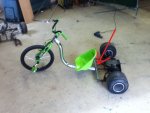
and this is where i start. i have bought my huffy slider.

http://i1299.photobucket.com/albums/ag71/NetworkFart/P1070091_zps8c608c32.jpg

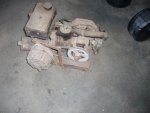
and this is the victa motor i want to put on it. it started life on a victa 160cc lawnmower. and the found its way onto our home made battery charger that the engine runs a alternater to charge a 12v battery for when we go camping.

http://i1299.photobucket.com/albums/ag71/NetworkFart/P1070095_zps02eb611c.jpg

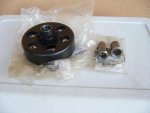
I have bought a shaft adapter and a Max Torque clutch through my work for my project.

[http://i1299.photobucket.com/albums/ag71/NetworkFart/P1070101_zps735fc397.jpg

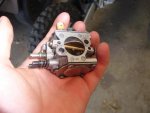
i have a Walbro chainsaw carb to put on the victa to fire it up a bit. its got an inlet of just below an inch, the old local fellow that used to race victa go karts told me that you need a chainsaw carb that has an intake of around an inch. anything smaller you will increase torque and the bigger you go the more HP. and with a higher revving engine= more speed. and this is why we build these things isnt it?

http://i1299.photobucket.com/albums/ag71/NetworkFart/P1070096_zps51513ab8.jpg

so my main concern right now is to buy a set of racing hubs and wheels. ill be sure to keep you posted as i go. any help with info on go kart axle with sizes and places to purchase them would be great. thanks.
 

Attachments

  • photo-778742_zps094ea166.jpg
    photo-778742_zps094ea166.jpg
    98.3 KB · Views: 23
  • P1070091_zps8c608c32.jpg
    P1070091_zps8c608c32.jpg
    115.7 KB · Views: 20
  • P1070095_zps02eb611c.jpg
    P1070095_zps02eb611c.jpg
    77.8 KB · Views: 31
  • P1070101_zps735fc397.jpg
    P1070101_zps735fc397.jpg
    96.1 KB · Views: 22
  • P1070096_zps51513ab8.jpg
    P1070096_zps51513ab8.jpg
    57.8 KB · Views: 20
Last edited by a moderator:

Arkyhunter

New member
Messages
88
Reaction score
0
Location
Benton Ar.
Where did you get your shaft adapter. Do they have a 3/4 to 1.
Thanks. Arky

Sent from my e1101_v73_jbl1ctp_a515 using Tapatalk 2
 

James.Ait.2013

The Village Idiot
Messages
48
Reaction score
0
Location
South-West Victoria, Australia
I have completely re-designed my ideas. i have bought a go-kart for $200 AUD off someone locally. it has a 5hp honda engine with a centrifugal 2:1 reduction box.

the go kart:


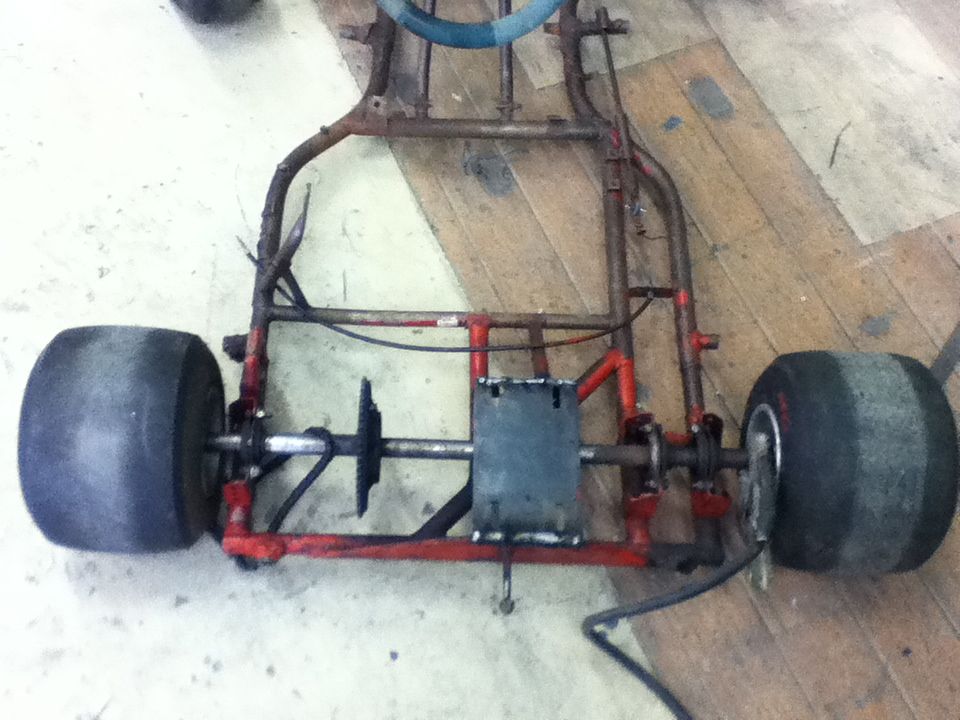
I'm using the entire rear of the frame, so i don't have to create axle mounts or mount the engine.

The rear end I'm using:

[/url]

I'm planing to just bolt on the rear of the go-kart to the slider so i can go back to downhill whenever i want to.

the slider:

url=http://s1299.photobucket.com/user/NetworkFart/media/IMG_2692_zps92fc0ce0.jpg.html]
[/url]

And finally my engine. the pull starter says 6.5hp, but that's only because the pull starter on the engine was broken

Engine:


got my rear cut off to weld in a new bar to strengthen it, as the bar that was there was only 20mm in diameter when it needed to be 35mm to bolt on.


and now its done! :cheers2:


landuse

Moderator
Staff member
Messages
18,741
Reaction score
507
Location
Pietermaritzburg, South Africa
WOW. I would NEVER have cut that kart frame up. What was wrong with it?

Post some pics of where you bolted the rear end on. I have gotta see what that looks like
 

mysteryboy28

New member
Messages
1,582
Reaction score
10
Location
Lansing, MI
one good bump and that thing is gonna crack right here.

do you have to pedal really fast to keep up with the motor? or just lift your feet up in the air so you don't get attacked by the pedals? lol.
 

Attachments

  • IMG_2746_zps470e0f20.jpg
    IMG_2746_zps470e0f20.jpg
    203.9 KB · Views: 22

souperman000

New member
Messages
2,466
Reaction score
10
Location
Westlake Village, CA
:iagree: with Landuse and Mysteryboy. that's a major stress point. You could add 2 tubes on either side to make a stronger triangle shape, but that may hinder your removable idea.
 

mysteryboy28

New member
Messages
1,582
Reaction score
10
Location
Lansing, MI
structurally "removable" is a BAD idea in the place you want it to be. rethink your design, and plan to make it permanent and STRONG. or stock up on bandaids and really good insurance. lol.
 

James.Ait.2013

The Village Idiot
Messages
48
Reaction score
0
Location
South-West Victoria, Australia
To answer some questions and dig up my own thread. the pedals free wheel, just like all new bikes the pedals don't turn when I ride forward. also, the reason I cut up the frame was it has been shortened for someone around 5' tall and I'm 6-6'1 so I didn't fit at all. the frame was very dodgy welded and rusty as all hell. it would never see a track again so I found a new use for it. the rear bolts on for ease of transport. as now it fits in the boot of a car so I can take up to my local school oval, or my local park where I can ride it on some flat smooth grassed ground. it was never meant to be strong as I am now going to sell the stock huffy slider to recoup some costs to build my kart.
 

James.Ait.2013

The Village Idiot
Messages
48
Reaction score
0
Location
South-West Victoria, Australia
That doesn't make sense. As RPM x torque = hp, more torque means more hp

as I understand it, torque is shown as acceleration and horsepower is your top speed as it is measured how fast you can achieve with your max RPM.

As a great person said, under steer is when you hit the wall with the front of your kart. over steer is when you hit the wall with the back of the kart. Horsepower is how fast you hit the wall, and torque is how far you manage to drag the wall with you.
 

OzFab

Well-known member
Messages
15,615
Reaction score
66
Location
Warwick Qld, Australia
As a great person said, under steer is when you hit the wall with the front of your kart. over steer is when you hit the wall with the back of the kart. Horsepower is how fast you hit the wall, and torque is how far you manage to drag the wall with you.

That's all true but, I think you've been slightly misinformed...

as I understand it, torque is shown as acceleration and horsepower is your top speed as it is measured how fast you can achieve with your max RPM.

Not quite: Correct, torque is represented by the amount of acceleration but, top speed is determined by the RPM at the top end of the torque curve, horsepower is the combined result...

Just because an engine will rev higher than the top of the torque range doesn't mean it's providing more horsepower, in fact, it's providing less
 

sideways

Unfinished projects king.
Messages
1,501
Reaction score
2
Location
Perth, Western Australia
That doesn't make sense. As RPM x torque = hp, more torque means more hp

Actually, HP = (torque (in ft lbs) X RPM) / 5252

You may have noticed how on dyno charts the HP and torque curves cross at 5252 rpm. Basically, if max horsepower occurs below 5252 the engine will make more torque than horsepower and vice versa.

A small carb gives greater performance at part throttle and low rpms, a big carb results in greater performance at higher RPMs. You can potentially make greater torque with a big carb than a small carb (provided the engine can support this) but it will favor high RPMs.

Constant velocity carbs such as SUs or any of the better motorbike carbs give the best of both worlds.
 

OzFab

Well-known member
Messages
15,615
Reaction score
66
Location
Warwick Qld, Australia
Actually, HP = (torque (in ft lbs) X RPM) / 5252

You may have noticed how on dyno charts the HP and torque curves cross at 5252 rpm. Basically, if max horsepower occurs below 5252 the engine will make more torque than horsepower and vice versa.

Don't you mean that the torque reading will be higher than the hp reading? For instance, a honda gx200 produces 9.1 lb-ft (12.4 Nm) of torque @ 2,500 rpm & 5.5 HP (4.1 kW) @ 3,600 rpm.

Since torque is only one component of hp, wouldn't it be impossible to create more torque than hp
 

sideways

Unfinished projects king.
Messages
1,501
Reaction score
2
Location
Perth, Western Australia
Don't you mean that the torque reading will be higher than the hp reading? For instance, a honda gx200 produces 9.1 lb-ft (12.4 Nm) of torque @ 2,500 rpm & 5.5 HP (4.1 kW) @ 3,600 rpm.

Since torque is only one component of hp, wouldn't it be impossible to create more torque than hp

Yes sorry, I had a brain fade. If a given rpm is under 5252 the torque value will be higher than the horsepower value.

As for the second part, certainly not. Your example proves it! :) Lets take a look at the formula.

HP=(torque x rpm) / 5252

Substituting torque for X and RPM fro Y, this can be simplified as HP= (XY)/5252

Lets give X a value of 5, thus giving a formula of HP=(5Y)/5252. If we make Y 5252rpm, Y will be cancelled out by the constant 5252 simplifying the equation to HP=5. This result proves that at 5252rpm HP is equal to torque, as proved by every accurate dyno graph ever.

Moving up in the rev range, lets say we've got an engine that makes 5 ft lbs(X) at 8000rpm(Y), giving the equation HP= (5*8000)/5252 which equals 7.62HP.

Going down, if we have an engine that makes 5 ft lbs (X) at 2000rpm (X) we get HP=(5*2000)/5252 which equals a measly 1.90hp

A different way of looking at this equation is to find the ratio of Y to 5252. For example 8000/5252=1.523. This means 8000 is 1.52 larger than 5252. If we then take X and multiply it by this value then we get the HP. Eg 5x1.523=7.62hp just like above.

As can be seen, if Y is less than 5252 then X will be greater than HP. Inversely if Y is greater than 5252, X will be less than HP.

As for your statement (Which I meant to reply to in my above post but I forgot :oops: ).....

more torque means more hp

This is 100% true. It's a common misconception that to get greater power, you have to trade torque. Since HP is simply a function of torque, for a given rpm if you increase one you increase the other. This stems from people not really understanding what torque is and mistaking low down power for torque. Torque is simply a force exerted by the engine, horsepower is the rate at which an engine puts out that force.
 

itsid

Moderator
Staff member
Messages
11,563
Reaction score
239
Location
Ruhrpott [Germany]
Well.. you lost me at 5252 ;)

From what I learned at school (a while ago)
The constant value is 2Pi (~6.2832)

Allow me to use metric values not Imperial, since that's what I grew up with.

Power (W) = 2Pi * Torque (Nm) * rounds per second (1/s)
one Nm is exactly 1Ws (Watt second)
So you end up with Watts for the Power.
So 12.4Nm @ 2500 rpm (~42rps) gives you 3272 Watts (3.27 kW eq. 4.45 HP)
The other way around:
4100 Ws / 120Pi = 10.8Nm

'sid
 

OzFab

Well-known member
Messages
15,615
Reaction score
66
Location
Warwick Qld, Australia
Yes sorry, I had a brain fade. If a given rpm is under 5252 the torque value will be higher than the horsepower value.

As for the second part, certainly not. Your example proves it! :) Lets take a look at the formula.

HP=(torque x rpm) / 5252

Substituting torque for X and RPM fro Y, this can be simplified as HP= (XY)/5252

Lets give X a value of 5, thus giving a formula of HP=(5Y)/5252. If we make Y 5252rpm, Y will be cancelled out by the constant 5252 simplifying the equation to HP=5. This result proves that at 5252rpm HP is equal to torque, as proved by every accurate dyno graph ever.

Moving up in the rev range, lets say we've got an engine that makes 5 ft lbs(X) at 8000rpm(Y), giving the equation HP= (5*8000)/5252 which equals 7.62HP.

Going down, if we have an engine that makes 5 ft lbs (X) at 2000rpm (X) we get HP=(5*2000)/5252 which equals a measly 1.90hp

A different way of looking at this equation is to find the ratio of Y to 5252. For example 8000/5252=1.523. This means 8000 is 1.52 larger than 5252. If we then take X and multiply it by this value then we get the HP. Eg 5x1.523=7.62hp just like above.

As can be seen, if Y is less than 5252 then X will be greater than HP. Inversely if Y is greater than 5252, X will be less than HP.

As for your statement (Which I meant to reply to in my above post but I forgot :oops: ).....


This is 100% true. It's a common misconception that to get greater power, you have to trade torque. Since HP is simply a function of torque, for a given rpm if you increase one you increase the other. This stems from people not really understanding what torque is and mistaking low down power for torque. Torque is simply a force exerted by the engine, horsepower is the rate at which an engine puts out that force.

Well, thanks for the mechanical engineering lesson but, I was dumbing it down for the noobs :lolgoku:

As for said lesson, the way I read it, your first & third points prove my point; Torque is merely one component of horsepower, torque can exist without horsepower but horsepower cannot exist without torque, the deciding factor is RPM...

Wait, did I just contradict myself? Now I'm confused :huh:

Well.. you lost me at 5252 ;)

From what I learned at school (a while ago)
The constant value is 2Pi (~6.2832)

Allow me to use metric values not Imperial, since that's what I grew up with.

Power (W) = 2Pi * Torque (Nm) * rounds per second (1/s)
one Nm is exactly 1Ws (Watt second)
So you end up with Watts for the Power.
So 12.4Nm @ 2500 rpm (~42rps) gives you 3272 Watts (3.27 kW eq. 4.45 HP)
The other way around:
4100 Ws / 120Pi = 10.8Nm

'sid

TBH, I wasn't clear on the 5252 part until a couple of years ago, your 2Pi is new to me. It could be that that constant is used for metric; have you tried it with imperial values?
 

itsid

Moderator
Staff member
Messages
11,563
Reaction score
239
Location
Ruhrpott [Germany]
Well no.
I can't get used to your odd system (sorry it IS ODD)

Oh wait you defined HP as 33,000 ft·lbf/min
so no wattage there too...
Ha... I found your 5252!

33000 / 2Pi = 5252.1131 <--- there's my 2pi, your Horsepowers and the strange 5252 ;)

Thank god, I was afraid I had to actually calculate something ;)

'sid
 

sideways

Unfinished projects king.
Messages
1,501
Reaction score
2
Location
Perth, Western Australia
Well, thanks for the mechanical engineering lesson but, I was dumbing it down for the noobs :lolgoku:

As was I, all that wasn't directed at you. :) As you say, it was just a mechanical engineering lesson for the forum.

As for said lesson, the way I read it, your first & third points prove my point; Torque is merely one component of horsepower, torque can exist without horsepower but horsepower cannot exist without torque, the deciding factor is RPM...

Torque can indeed exist without horsepower, provided there's no movement. As soon as something moves we can calculate HP. It's certainly very possible to create more ft lbs of torque than HP though.

Itsid, we use the proper units here in Australia too. I tend to use imperial units on this forum though. :D
 

itsid

Moderator
Staff member
Messages
11,563
Reaction score
239
Location
Ruhrpott [Germany]
Oh.. science :D
No torque cannot exist without horsepower.
Since Horsepower is power as in "you can call it Watt"
(1HP =~ 735.5 W)
And Torque is measured in Nm or Wattseconds or Joule or even calories if you want...
Anyways if you apply Watts you apply Horsepower if you apply Watts over a specific time you end up with Wattseconds (1Ws == 1Nm == 1Joule =~ 0.23 calories) thus Torque.
No way of having one without the other.

'sid

PS Wisenheimer finally left the building ;)
 
Status
Not open for further replies.
Top