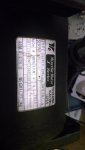
large servo motor?

Status
Not open for further replies.

dcastillo

New member
Messages
319
Reaction score
0
Location
Tampa Florida, USA
I dont know to much about these guys, but htis thing is huge and looks pretty powerful


heres the only spec sheet I could find on it
http://http://www.yaskawa.com/site/dmservo.nsf/aa8198da5462fcbe86256c59004e4bcb/86256ec30069fdef86256de2005a6834/$FILE/KAE-C240-0H.pdf

its on pg 6
says it has 107 kg/cm torque (i think thats pretty good right?)

I cant seem to find any info on how to wire it though to see if it works... its got 4 wires coming out (red/black/green and maybe white, cant remember)

thoughts?
Danny
 

Attachments

  • IMG_20131017_111023910.jpg
    IMG_20131017_111023910.jpg
    45.9 KB · Views: 8
Last edited by a moderator:

itsid

Moderator
Staff member
Messages
11,563
Reaction score
247
Location
Ruhrpott [Germany]
that IS pretty good indeed (10.5Nm or 7.74 lb-ft)

But why a servo, I think that's going to be pretty slow;
turnout speeds on high torque servos are generally really slow (or the servo will be as expensive as a complete kart) becuause they're heavily geared down inside.

A servo motor is superp if it comes to precision (that is you want the motor to turn exactly 11.31° for example, but rather useless if you want it to turn 300 rpm ;)

Great motor (from the spec shet) for any robotic application, as an actuator for CNC machines, as a joint on a robotic arm.. etc;
but for a kart motor?
I don't know I think that's going to be really expensive and pretty much useless.

'sid


PS you need a controller to run a servo correctly, dependig on the internal it's either a serial com or a simple dc/pot connector.
 

mckutzy

Well-known member
Messages
8,353
Reaction score
110
Location
bc, canada
It needs a controller for it to be used. Just applying power will damage the windings, it also has a resolver that interacts with the controller to maintain speed and to ascertain position.

It mainly won't work on "regular power" cause it needs to run on a specific frequency on it, it will(the controller) also change the frequency to vary the speed.

One of my last job I worked at dealt with these, it is hard to explain as I'm not fully understanding all of it. But that is kinda what's happening.

Oh that's not really that big, worked one that weighed about 120lbs, 2'long, rotor was about 25lbs and basically a solid magnet. Very dangerous to work with as those magnets are super strong. We needed 6 people to hold and a chain pulley to separate the parts.
 

dcastillo

New member
Messages
319
Reaction score
0
Location
Tampa Florida, USA
Thanks for all the insight, was only asking cause it would be free, found it in the dumpster at work.... :) its crazy some of the stuff they throw out at my job.
So it sounds like i can't just connect a straight voltage to it then huh... Guess it's going back to the dumpster then.
Thanks for the info guys
Danny
 

dcastillo

New member
Messages
319
Reaction score
0
Location
Tampa Florida, USA
bringing this back up :)

I finally got around to bringing a battery into work to see what happens...

I first opened up the top electric box on the motor where the 4 main wires come from..
turns out two are about 10-12awg and two are 18awg. I think the thinner ones are some type of rough positional feedback (0-360 deg) from what Ive read. The large two had about a 2.5 ohm resistance between them...
I connected the 12v battery and it turns :) , might I add with a good amount of torque... could barely stop it with one hand. Im guessing if I hit it with 48V it would kill my treadmill motors raw power.

considering the rated rpm is 1000 at 112V, I was only spinning at about 100rpm or so...
I have an idea my sprocket sizes might be reversed...

sooooooo, now I want to give this thing a try, just need to figure out how to mount it and hope it doesnt break the frame :)
 

machinist@large

Active member
Messages
2,865
Reaction score
32
Location
West Michigan, 49331
bringing this back up :)

I finally got around to bringing a battery into work to see what happens...

I first opened up the top electric box on the motor where the 4 main wires come from..
turns out two are about 10-12awg and two are 18awg. I think the thinner ones are some type of rough positional feedback (0-360 deg) from what Ive read. The large two had about a 2.5 ohm resistance between them...
I connected the 12v battery and it turns :) , might I add with a good amount of torque... could barely stop it with one hand. Im guessing if I hit it with 48V it would kill my treadmill motors raw power.

considering the rated rpm is 1000 at 112V, I was only spinning at about 100rpm or so...
I have an idea my sprocket sizes might be reversed...

sooooooo, now I want to give this thing a try, just need to figure out how to mount it and hope it doesnt break the frame :)

I'm taking a stab at this semi blind because the link you tried to post is only a text in your thread....

Magnet appears to be listed as permanent; combined with what appears to be a date tag from somewhere in the early '80's, I'm guessing it's not a DC servo motor. What's clouding the issue is the 112V rating. Most CNC servo's from that generation operated on 24 or 48 volts; however, if this is indeed a 112V unit, it might not be a servo motor, but instead be a stand alone variable speed motor.

I'm dredging the memory banks here; my now comatose CNC has DC servo's from the late 1980's; I had to pull one of the axis motor's because it ate a bearing. I was supprized to only find six wires; 4 heavy, 2 light. Took it to my motor shop for repair. While there I asked a bunch of questions (when you hear the quoted price, swallow deeply, and sign the repair order, most industrial contractors are more than happy to answer your questions...).

The answer I was given about my motor was; 4 heavy wires- power supply for the windings. Basically the servo's on my mill are slightly fancier than most stepper motors; the 2 light gauge wires were for the rotary tachometer, which was there to tell the CNC control what direction the motor was spinning. My machine didn't need rotary encoders because it came standard with linear glass scales for the feedback loop to provide the actual fine position coordinates. This is what has me guessing that you have a DC variable speed motor instead...

I think I could add to this, but I'm just to worn out at the moment..... Pat
 

itsid

Moderator
Staff member
Messages
11,563
Reaction score
247
Location
Ruhrpott [Germany]
I'm taking a stab at this semi blind because the link you tried to post is only a text in your thread....

Magnet appears to be listed as permanent; combined with what appears to be a date tag from somewhere in the early '80's, I'm guessing it's not a DC servo motor. What's clouding the issue is the 112V rating. Most CNC servo's from that generation operated on 24 or 48 volts; however, if this is indeed a 112V unit, it might not be a servo motor, but instead be a stand alone variable speed motor.
...

Well it IS a servo motor and it WAs used on heavy duty CNC machines..
for example the
MATSUURA MC-1000VS

if the encoder is still working, there would have been no reason to trash this (used ~$600 worth without encoder) motor ;)
So my best guess is, the internal encoder is fried, making it nothing but a motor.

I don't know if it's meant to be a DC or a rare AC Servo,
since I don't find any specsheet for it.

What I would do is measure the resistance of the smaller wires turning the motor by hand, and see if there are any changes.
if there are, the encoder might still be in working condition;
in that case:
sell it !

You don't need a servo to run a kart, and you can have a more powerfull new motor for the price you'll get selling this beast.
(example: http://www.cncgalore.com/yaskawa-minertia-motor-ugjmed-80m-a20f-no-encoder)

'sid
 

dcastillo

New member
Messages
319
Reaction score
0
Location
Tampa Florida, USA
trust me, i thought of selling it...
but that might be crossing a line since i got it out of the trash at work and technically we arent supposed to get stuff out of the trash :)

So either I use it or it goes back into the trash, my conscience will only allow so much (though it was very tempting)

an added bonus, it already has a hub of some type mounted on the shaft with a 3 1/8th bolt pattern on it :)
 

machinist@large

Active member
Messages
2,865
Reaction score
32
Location
West Michigan, 49331
Well it IS a servo motor and it WAs used on heavy duty CNC machines..
for example the
MATSUURA MC-1000VS

if the encoder is still working, there would have been no reason to trash this (used ~$600 worth without encoder) motor ;)
So my best guess is, the internal encoder is fried, making it nothing but a motor.

I don't know if it's meant to be a DC or a rare AC Servo,
since I don't find any specsheet for it.

What I would do is measure the resistance of the smaller wires turning the motor by hand, and see if there are any changes.
if there are, the encoder might still be in working condition;
in that case:
sell it !

You don't need a servo to run a kart, and you can have a more powerfull new motor for the price you'll get selling this beast.
(example: http://www.cncgalore.com/yaskawa-minertia-motor-ugjmed-80m-a20f-no-encoder)

'sid

After getting some sleep, I remembered that I had a book on the really basic layout and design of a home made CNC; it covers the more common types of stepper motors and their wiring. After a brief look, I think you're right 'sid, that it's a basic stepper type servo motor of some sort, but that it used some form of independent system (glass or magnetic scales of some kind) for the positioning feedback side of the system. I'm still thinking the two light gauge wires are for a tachometer of some sort so that the drive amplifier can tell if the motor is moving. A really basic stepper drive without the rotary feedback can be stalled out due to overload, and the control system wouldn't be able to tell, hence loosing position.

I don't think this motor has/ had a true rotary encoder; the ones I familiar with usually have at least six wires for the encoder alone because they are reading the inputs from at least four photo cells in the reader head; they pick up the light being transmitted from their respective infrared diode that is on the opposite side of the vernier grid etched/ painted on a glass scale or disk. The alternating pulses being read by each channel of the system is what the controller uses to determine it's location as it moves. If you've ever used a set of vernier calipers (not digital), then you would have the basic theory of how these work; optical encoders are just a very accurate, high tech form of them.

This is what little I know about the inner workings of the electronics side; I've never claimed to be an expert, I've just picked up a little of this stuff along the way.

:thumbsup::cheers2::popcorn: Pat
 

itsid

Moderator
Staff member
Messages
11,563
Reaction score
247
Location
Ruhrpott [Germany]
steppers are a completely different type of motor ;)
servos turn under voltage and report their shaft angle back to the controller, which then lowers the voltage, to stop the turn.

a steper is powered by all the wires in different modes, apply voltage to a certain coil in a certain direction and it makes one step (mostly 1/200th of a turn);
Industry grade steppers can be had with 800steps per rev. but common is 200 for desktop cncs;
printers scanners and so on have even lower steps per revolution...
anyways,
you power this coil and it makes just this one step, and stays there until you power the other coil for the next step.

Servos are more precise, since given a precise encoder, it will stay at that angle no matter what.
steppers can loose a step if the controller is running to fast for the motor for example,
servos can't.

And yes, the two leads might be a basic poti setup (as in say rc cars) or it's in fact just a connector for a powersupply of the additional encoder.
I don't know to judge I would have to see the complete motor, not just the plate.

But fact is: yaskawa lists this thing as being a servo motor, and I think they know a little about this motor ;)

'sid
 

machinist@large

Active member
Messages
2,865
Reaction score
32
Location
West Michigan, 49331
steppers are a completely different type of motor ;)
servos turn under voltage and report their shaft angle back to the controller, which then lowers the voltage, to stop the turn.

a steper is powered by all the wires in different modes, apply voltage to a certain coil in a certain direction and it makes one step (mostly 1/200th of a turn);
Industry grade steppers can be had with 800steps per rev. but common is 200 for desktop cncs;
printers scanners and so on have even lower steps per revolution...
anyways,
you power this coil and it makes just this one step, and stays there until you power the other coil for the next step.

Servos are more precise, since given a precise encoder, it will stay at that angle no matter what.
steppers can loose a step if the controller is running to fast for the motor for example,
servos can't.

And yes, the two leads might be a basic poti setup (as in say rc cars) or it's in fact just a connector for a powersupply of the additional encoder.
I don't know to judge I would have to see the complete motor, not just the plate.

But fact is: yaskawa lists this thing as being a servo motor, and I think they know a little about this motor ;)

'sid

I stand corrected; that's also why I stated that I was making a semi educated guess about the motor in question...

Yaskawa has a real high standing in the US market for servo motors and drives; I've only seen and worked with/ around their current AC units, so I really don't have, or claim to have knowledge of their older hardware. The DC servo's I've dealt with were either Baldor or Gettys brand units, and they look very different; as for older Japanese CNC's, the ones I've seen in the field usually got sidelined not because they were necessarily totally worn out, but because the OEM quit supporting them after 10 years or so, which is why the used market for these things is so expensive. The US OEM's are better, but they're starting to trend that way as well, dang it.

Ah well, what do you do....:surrender: Pat
 
Status
Not open for further replies.
Top