
Knobby
New member
Hi All,
I've introduced myself in the appropriate thread so I thought I'd just follow up in here, hopefully I'm in the right place.
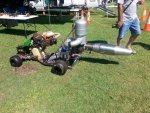
I have a Jet powered go kart which is basically a Garrett 6041 turbo-charger and has been converted into a full after-burning jet engine...the wheels are "not" driven and as such she is thrust driven. At present the engine produces approx 210-220lbs of static thrust ...most normal piston engine go-karts will eat it alive off the line but it will certainly do most karts over for top-end speed.
Am happy to answer any and all questions etc...
Cheers,
Smithy.
I've introduced myself in the appropriate thread so I thought I'd just follow up in here, hopefully I'm in the right place.
I have a Jet powered go kart which is basically a Garrett 6041 turbo-charger and has been converted into a full after-burning jet engine...the wheels are "not" driven and as such she is thrust driven. At present the engine produces approx 210-220lbs of static thrust ...most normal piston engine go-karts will eat it alive off the line but it will certainly do most karts over for top-end speed.
Am happy to answer any and all questions etc...
Cheers,
Smithy.
Attachments
-
 20150208_104951.jpg220.6 KB · Views: 38

 Most turbine go-karts are made from small T-03/T04 type car or small truck turbos, the turbo in my kart is rather large and is similar to the ones fitted to those big yellow mining trucks.


 Static thrust with A/B is ~215lbs @20C and sea level conditions.

