ISO: Source for custom hubs/flanges

Status
Not open for further replies.

SkyWlf77

New member
Messages
8
Reaction score
0
Location
Central Illinois
Hi all...

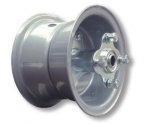
Due to the nature of my reverse-trike go-kart build, I am in need of hubs with flanges that no one seems to sell. Therefore, I am looking for a source, whether it be retail or fabrication, that can provide me with the items I need. They would be similar to those found on this page:

https://www.ombwarehouse.com/steel-wheel-hub-3-4-ball-bearing-for-5-6-with-flange.html

...However, I need them with 1" diameter bearings, a 5-bolt pattern on the hub side (to mount up my 12" lawn tractor wheels) and flanges without bolts pre-installed so that I can use my own length bolts.

If anyone can provide information, I would be very appreciative.

-Jason
 

itsid

Moderator
Staff member
Messages
11,563
Reaction score
245
Location
Ruhrpott [Germany]
DIY?

a tube and two nicely welded plates, two bearings and a nicely cut spacer...
some well aligned holes and weld on nuts (or a threading die)...
done
1" bearing is doable..
http://www.bmikarts.com/Double-Flan...Circle-1-Bore-with-Roller-Bearing_p_3235.html

5 bolt pattern unlikely (and even more unlikely that it matches your BHC in the end)

check google for "five lug hub kart" and you'll be presented with some trailer hubs that are five bolt and take a 1" axle.. but all single flange as far as I can see..

so yeah... DIY!

'sid
 

Joe-405

Enjoying New Projects
Messages
2,673
Reaction score
97
Location
U.S.A.
Got a pic of a wheel by chance ? And how big is the bolt pattern. Only 5 lug I know of off a lawn tractor is John Deere ??????
 

SkyWlf77

New member
Messages
8
Reaction score
0
Location
Central Illinois
itsid said:
DIY?

a tube and two nicely welded plates, two bearings and a nicely cut spacer...
some well aligned holes and weld on nuts (or a threading die)...
done

That's an option, but I'd really rather have an experienced fabricator do the work...

I assume the spacer goes inside the tube in between the bearings to hold them at the ends?

Any recommendations regarding bearings? A Google search only served to confuse me more as I was presented with so many different types available, very little information from the manufacturers on listings and such that I have no idea anymore what I'm looking for. I know I need 1" ID and high-speed bearings (kart max speed = 38mph), but that's about the extent of it.

Joe-405 said:
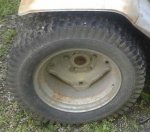
Got a pic of a wheel by chance ? And how big is the bolt pattern. Only 5 lug I know of off a lawn tractor is John Deere ??????

Only pic I have at the moment is the one I saved from the listing I saw the lawn tractor in. I haven't picked it up yet. I'm grabbing it because the rear wheels/tires are the size I want and it comes with a perfectly running 11HP horizontal shaft B&S engine. It's a Sears/Craftsman GT 11 lawn tractor. According to online PDF Manuals, this machine was built between 1978 and 1982 (although the name continued on in a revamped model in later years).
 

Attachments

  • Sears Craftsman GT 11 Mower (Rear Wheel).jpg
    Sears Craftsman GT 11 Mower (Rear Wheel).jpg
    44.6 KB · Views: 4

SkyWlf77

New member
Messages
8
Reaction score
0
Location
Central Illinois
The hub isn't exactly what I was looking for, mckutzy, but I may be able to make that work...

mckutzy said:
Im not totally sure what you getting at with you complete driveline.....

Basically, I am mounting those lawn tractor wheels back-to-back with the brake and sprocket squished in between (just enough room for the brake cable and chain in between the tires) and mounted in the center of the rear of the kart.

Essentially, picture a live axle setup with the axle between the wheels cut out.

Or, look at this pic and simply picture the sprocket and brake mounted between the rear tires instead of on the outside (although I plan to use a band brake rather than a disc):


mckutzy

Well-known member
Messages
8,353
Reaction score
108
Location
bc, canada
Mounting the brake between the tires isn't going to give you any room to mount the bracketry for the band to be held firmly...
The brake above is pictured outboard mounted, as to give a good amount of room for sprocket and to mount the caliper properly.

Equally speaking how do you intend to drive the wheel(s) without said type of hub to engage the axle?..
 

SkyWlf77

New member
Messages
8
Reaction score
0
Location
Central Illinois
Mounting the brake between the tires isn't going to give you any room to mount the bracketry for the band to be held firmly...
The brake above is pictured outboard mounted, as to give a good amount of room for sprocket and to mount the caliper properly.

You have a point there. I have some thought to give to mounting the band in this scenario. I think I have an idea, but I have no idea how to explain it, so I'm going to have to stress my drawing skills to the max and see if I can put it on paper...

Equally speaking how do you intend to drive the wheel(s) without said type of hub to engage the axle?..

Let's see if I can explain this without resorting to some crude diagram that'll look like chicken scratch:

The wheels, back to back, mounted to flanged hubs with the drive sprocket in between the flanges. So, you'd end up with:

Wheel-hub-flange-sprocket-flange-hub-wheel

In this manner, the wheels/sprocket would be powered and rotate on a non-moving axle. It's similar in concept to mounting a sprocket to a non-drive wheel.

Picture facing two of these units flange-to-flange and sandwiching a sprocket in between them (image copyright: gokartsupply.com):
 

Attachments

  • Drive Wheel with Flange.jpg
    Drive Wheel with Flange.jpg
    12.3 KB · Views: 36
Last edited:

mckutzy

Well-known member
Messages
8,353
Reaction score
108
Location
bc, canada
For the length of the hub for the tires ect x2 longitudinally of the fixed shaft, you would be better and cheaper for going with a live axle instead of dead... Cost alone to make/get made a set of hubs to fix a brake and sprocket bearings... Not worth it..
Already off the shelf stuff present and no special work to get it there... With a live axle setup... Look at my ride... That's what I did... And at the time, I had a full machine shop at my disposal...
 

SkyWlf77

New member
Messages
8
Reaction score
0
Location
Central Illinois
I'm not entirely opposed to using a live axle-type setup. However, I honestly just don't understand how they work. I see axles with keyways that are indented (https://www.princessauto.com/en/detail/1-in-x-3-ft-keyed-shaft/A-p8079758e) and hubs (like the one you linked) that are also indented.

To my logic-based brain, one should be indented and one should have the keyway jutted outwards to lock into the indented one. How do you lock the two together? How does the axle get mounted to the frame in such a way that it spins? Wouldn't that indented keyway cause issues with the bearing it rides inside of?

I've been unable to find a diagram or "how to" page that explains this system, so I defaulted to the non-keyed version I described above because I understand the way that system works and there are diagrams to help available.

About the only thing I'm not really sure of with my current system idea is how to keep the wheels centered from "floating" side-to-side on the axle, but I'm sure I'll figure that out eventually. The keyway system just has me stumped...

By the way, I have a fully equipped machine shop available to me. Its owned by friends of the family who are more than willing to help as long as I can tell them what I want done and what materials I need ordered to do it the way I want. If a keyway style would be cheaper, that would always be welcome, but unless I can learn the system design in detail and understand how I need to modify it to make a reverse-trike system work, I have to go with what I do understand and can make a parts list for...
 

mckutzy

Well-known member
Messages
8,353
Reaction score
108
Location
bc, canada
A live axle, with all the running gear, spins on bearings mounted at the ends of the shaft.
A keyed shaft has a keyway milled in its length and a hub/sprocket/driven item has the same. There is a short piece of material called a key, and it allows the transmission from shaft to hub.

A good example of all this is on my thread, as I use a number of these pillow blocks and have a live axle setup with good pics to show all associated elements...
 

SkyWlf77

New member
Messages
8
Reaction score
0
Location
Central Illinois
Ok, I perused your thread and found some photos I think helped me a bit. I saved them to my hard drive, so I could use my photo processing software to blow them up and enhance them to better see details. I see the keyed axle and the pillow block. I found 1/4-inch "key stock" online that is apparently the "key" you refer to:

https://www.mscdirect.com/webapp/wcs/stores/servlet/product/details/06061162

So, I slide the hubs, with wheels, sprocket and brakes mounted to them, onto the axle and then line up the keyways and insert this stock into the hole? That brings up a couple of questions:

1) I assume the key stock can be cut to fit?

2) How does the key stock get held in place to keep vibrations from slowly sliding its way out of its intended location? Do I run the keystock the entire length of the axle from pillow block to pillow block? Or do I cut it to just what I need and weld it in place?

3) I see a black ring on the end of your axle on the outside of the pillow block that seems to be holding the axle in place, but I'm not sure how. Is this some kind of set screw-operated bushing? If so, could I also use said bushing on each side of my wheels to keep them in the center of the axle where I want them located to ensure they do not "float?" (This floating issue has been perplexing me and this could be a wonderful solution to that problem if so!)

4) On a slightly unrelated note that your pictures brought up: I see that you mounted your pillow blocks vertically, instead of horizontally. I love the way this looks. However, every thread I've read on building a go-kart frame says that there should be bumpers in the front and back in case of impacts. Most motorcycles and minibikes, however, don't have bumpers and are set up like your bike. Is a rear bumper actually necessary or could I set up the back of my kart like your bike and be OK?

Sorry to bombard you with questions. Honestly, if I didn't like the "wide dual-wheel" look so much and need the rear traction, I'd probably just buy a used motorcycle, cut the frame and mount the rear of it to the go-kart and be done with it. However, I'm not real fond of the way that looks and I'm not sure that one (fairly narrow in comparison) motorcycle tire would be enough traction as the roads this kart will be ridden on are mostly gravel...
 

mckutzy

Well-known member
Messages
8,353
Reaction score
108
Location
bc, canada
The pillow block I use have an eccentric locking collar on the inner race, they lock down with a set screw...

Every sprocket has a hub in which there is 2 setcscrews, industry standard, also, yes a bit of key for each sprocket. No need full length. Cut to length needed..
With 2 setscrews, one locks to the shaft and the other locks the key in the keyway within the hub/shaft...... Do not weld anything onto an axle. It's simply not nessisary...
I have also doubled up on security, I use lock collars aswell. A ring with a setscrew to hold in place the rear end.

As for the mounting of the pillowblocks, any angle will do. Mine are for a specific look(and later my bane of immense engineering challenge)...

I'm not too sure what you mean on bumpers...
 
Status
Not open for further replies.
Top