How to use a highoutput alternator as an emergency welder - DIY

Status
Not open for further replies.

yachtwork

New member
Messages
6
Reaction score
0
This is a link to an article on how to use an alternator as an emergency welder. The same system can be used to run most power tools. The conversion can be done in the field with local parts available in most worksites, boats, or general field situations.

If done correctly the alternator can be re-configured to original and used to charge batteries again. This system can also be used with a lawnmower engine powering any old alternator as a portable welder.

The article was written for boats, but the system is the same and in use on many 4x4's and boats. If you do a web search you'll see there are kits that sell for upward of 1000 dollars, but this article shows how to make the conversion for less than ten dollars of spare bits.

The link is
http://www.tongacharter.com/report-welder.htm
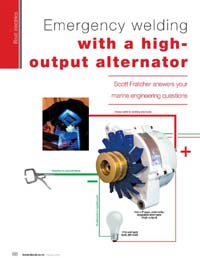


Hope this helps spark some ideas.

Scott
 

Kenny_McCormic

Kartless....
Messages
4,537
Reaction score
11
Location
Michigan Troll
You can actually make a quite sophisticated portable welder with a good alternator. If you are REALLY smart you could add HF start and build a TIG that ran on gasoline. The best part is all alternators have a 100% duty cycle.
 

sideways

Unfinished projects king.
Messages
1,501
Reaction score
2
Location
Perth, Western Australia
A better way is to get 3 car batteries, wire them in series, put one of the clamps from a set of jumper leads on the negative terminal on the 1st battery and the other on the positive terminal on the 3rd. Clamp one of the clamps to what you welding and put an arc rod in the other and your away!

Hayden
 

yachtwork

New member
Messages
6
Reaction score
0
Batteries vs alternator welder

Sorry about the double post. I just went and looked to try and remove the second post but could not find it. Maybe it's already been taken down.

A while back we had a discussion about welding with batteries and I wrote a little blurb about it that I'll paste here. It was not a response to the comments here, just more a warning about the danger of welding with batts.

Thanks again.

Scott


Batteries vs alternator welder

Thank you for your comment. If I understand correctly you say a better weld would be made in an emergency by linking batteries than by using an alternator welder.


I disagree for three reasons.

1. The alternator welder mimics the open and closed voltage of a stick welding machine very nicely. Open voltage is about 80v and welding voltage is about 18v. Both are pretty close the open/closed voltages of the old Lincoln transformer welders.

The open voltage allows easy arc starting because the 80 volts wants to jump the gap and start an arc.

A battery pack is inferior to an alternator welder as the arc starting voltage arc is lower thus starting an arc can be difficult.

2. With an alternator welder the current to the weld can be precisely controlled through the alternator field. I have set the field and welded with a steady 80 amps showing on an AC/DC clamp amp. I have welded this way for hours and the amperage remained steady. The stable amp flow allows the welder to lay a predictable and thus stronger weld.

A battery is inferior to an alternator welder because a battery does not have an easy and accurate way to control amps.

3. In a direct short of the welding leads the current potential of the alternator is about 120 amps while a battery bank might be capable of 800 amps. It is simply safer to work with a smaller maximum potential as the possible ramifications are lessened.

For example in the event of a direct short with an alternator welder the worst that may happen is the alternator overheats and is ruined. A direct short in a battery can cause the battery itself to explode with resultant blinding battery acid sprayed around the work zone.

For these reasons, if faced with an emergency I'll try welding with an alternator before a stack of batteries.
 

sideways

Unfinished projects king.
Messages
1,501
Reaction score
2
Location
Perth, Western Australia
Sorry about the double post. I just went and looked to try and remove the second post but could not find it. Maybe it's already been taken down.

A while back we had a discussion about welding with batteries and I wrote a little blurb about it that I'll paste here. It was not a response to the comments here, just more a warning about the danger of welding with batts.

Thanks again.

Scott


Batteries vs alternator welder

Thank you for your comment. If I understand correctly you say a better weld would be made in an emergency by linking batteries than by using an alternator welder.


I disagree for three reasons.

1. The alternator welder mimics the open and closed voltage of a stick welding machine very nicely. Open voltage is about 80v and welding voltage is about 18v. Both are pretty close the open/closed voltages of the old Lincoln transformer welders.

The open voltage allows easy arc starting because the 80 volts wants to jump the gap and start an arc.

A battery pack is inferior to an alternator welder as the arc starting voltage arc is lower thus starting an arc can be difficult.

2. With an alternator welder the current to the weld can be precisely controlled through the alternator field. I have set the field and welded with a steady 80 amps showing on an AC/DC clamp amp. I have welded this way for hours and the amperage remained steady. The stable amp flow allows the welder to lay a predictable and thus stronger weld.

A battery is inferior to an alternator welder because a battery does not have an easy and accurate way to control amps.

3. In a direct short of the welding leads the current potential of the alternator is about 120 amps while a battery bank might be capable of 800 amps. It is simply safer to work with a smaller maximum potential as the possible ramifications are lessened.

For example in the event of a direct short with an alternator welder the worst that may happen is the alternator overheats and is ruined. A direct short in a battery can cause the battery itself to explode with resultant blinding battery acid sprayed around the work zone.

For these reasons, if faced with an emergency I'll try welding with an alternator before a stack of batteries.

I meant easier lol but anyways, I have seen people law down some pretty nice welds with the battery type, never seen the alternater kind before though.

Hayden
 

sideways

Unfinished projects king.
Messages
1,501
Reaction score
2
Location
Perth, Western Australia
Sorry about the double post. I just went and looked to try and remove the second post but could not find it. Maybe it's already been taken down.

A while back we had a discussion about welding with batteries and I wrote a little blurb about it that I'll paste here. It was not a response to the comments here, just more a warning about the danger of welding with batts.

Thanks again.

Scott


Batteries vs alternator welder

Thank you for your comment. If I understand correctly you say a better weld would be made in an emergency by linking batteries than by using an alternator welder.


I disagree for three reasons.

1. The alternator welder mimics the open and closed voltage of a stick welding machine very nicely. Open voltage is about 80v and welding voltage is about 18v. Both are pretty close the open/closed voltages of the old Lincoln transformer welders.

The open voltage allows easy arc starting because the 80 volts wants to jump the gap and start an arc.

A battery pack is inferior to an alternator welder as the arc starting voltage arc is lower thus starting an arc can be difficult.

2. With an alternator welder the current to the weld can be precisely controlled through the alternator field. I have set the field and welded with a steady 80 amps showing on an AC/DC clamp amp. I have welded this way for hours and the amperage remained steady. The stable amp flow allows the welder to lay a predictable and thus stronger weld.

A battery is inferior to an alternator welder because a battery does not have an easy and accurate way to control amps.

3. In a direct short of the welding leads the current potential of the alternator is about 120 amps while a battery bank might be capable of 800 amps. It is simply safer to work with a smaller maximum potential as the possible ramifications are lessened.

For example in the event of a direct short with an alternator welder the worst that may happen is the alternator overheats and is ruined. A direct short in a battery can cause the battery itself to explode with resultant blinding battery acid sprayed around the work zone.

For these reasons, if faced with an emergency I'll try welding with an alternator before a stack of batteries.

I meant easier lol but anyways, I have seen people law down some pretty nice welds with the battery type, never seen the alternater kind before though.

Hayden
 
Status
Not open for further replies.
Top