How much does over volting increase RPMs by

Status
Not open for further replies.

Gn4life

New member
Messages
18
Reaction score
0
Hi

I have an Ebay brushless motor and speed controller kit.
The listing says these are the specs

RPM speed : 4500-5200 RPM
48 volt
1800 watts
I know these Chinese items typically have inflated specs to get you to purchase them. And I see alot of people on here with similar set ups say they think those specs are way overrated.

I was wondering if I overvolt this setup with a 60 volt Lithium tool Battery set....
What would this increase the RPMs to???? Any close estimates????
Thanks
 

950speed

New member
Messages
421
Reaction score
9
Location
Texas
Is this for a go kart, or an rc or what. Explain what it’s going on so we can know what your after.
 

Gn4life

New member
Messages
18
Reaction score
0
Is this for a go kart, or an rc or what. Explain what it’s going on so we can know what your after.
Hi.

Its going on a Razor E300s goped scooter. I saw some threads where many members here were using the same or similar motor and controller on their karts, quads, pocket bikes, mini bikes, and other razor products.

Here is the link to my introduction thread. It kind of explains my project, basic goals, and parts list.
http://www.diygokarts.com/vb/showthread.php?t=39678

Thanks
 

Gn4life

New member
Messages
18
Reaction score
0
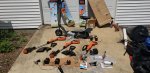
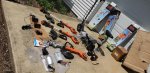
Attached pics too
 

Attachments

  • 20180725_140001.jpg
    20180725_140001.jpg
    375.3 KB · Views: 11
  • 20180725_140015.jpg
    20180725_140015.jpg
    432.6 KB · Views: 5

Functional Artist

Well-known member
Messages
5,650
Reaction score
3,281
Location
Toledo, Ohio
To answer "theoretically" your question
...maybe 10% - 20% increase in RPM's
...probably ~30% increase in power consumption
…& & 50% increase in heating (overheating)

But, that's usually when your talking about
...overvolting the motor "itself" (not the speed controller)
…& brushed motors (not brushless)

Motors are "power convertors" - electrical power to mechanical power
...they "usually" consume what voltage their fed (if they can handle it is another story)

Speed controllers are "voltage specific" (except the "higher end" configurable ones)

Because, most 12V lead acid batteries are ~13.3V when fully charged (13.3V x 2 = 26.6V)

So, a 24V speed controller is preset to function in a range of ~20V thru ~26.5V
... & it should cut-off (shut the system down) @ ~20V
(that's how they protect the batteries from being drained too low)
...48V speed controller voltage range ~40V thru ~53.2V
...60V speed controller voltage range ~ 50V thru ~66.5V

So, 9 times out of 10
...if you apply 60V to a 48V brushless speed controller

Your gonna "POP" it :ack2:
…& your dealing with lithium batteries too which have their own specs.

I kinda like the quick switch battery while others are charging concept
...but, most power tool batteries are only ~2AH, maybe 4AH
...which would only be ~ 5 - 10 min of run time :smiley_omg:
 

Gn4life

New member
Messages
18
Reaction score
0
To answer "theoretically" your question
...maybe 10% - 20% increase in RPM's
...probably ~30% increase in power consumption
…& & 50% increase in heating (overheating)

But, that's usually when your talking about
...overvolting the motor "itself" (not the speed controller)
…& brushed motors (not brushless)

Motors are "power convertors" - electrical power to mechanical power
...they "usually" consume what voltage their fed (if they can handle it is another story)

Speed controllers are "voltage specific" (except the "higher end" configurable ones)

Because, most 12V lead acid batteries are ~13.3V when fully charged (13.3V x 2 = 26.6V)

So, a 24V speed controller is preset to function in a range of ~20V thru ~26.5V
... & it should cut-off (shut the system down) @ ~20V
(that's how they protect the batteries from being drained too low)
...48V speed controller voltage range ~40V thru ~53.2V
...60V speed controller voltage range ~ 50V thru ~66.5V

So, 9 times out of 10
...if you apply 60V to a 48V brushless speed controller

Your gonna "POP" it :ack2:
…& your dealing with lithium batteries too which have their own specs.

I kinda like the quick switch battery while others are charging concept
...but, most power tool batteries are only ~2AH, maybe 4AH
...which would only be ~ 5 - 10 min of run time :smiley_omg:
Thanks for the reply.... I really appreciate it!

interesting. What happens if the capacitors inside the controller say 63 volts? Will that make it a little safer or give it a better chance to survive????? I've seen people mention that in forums and on YouTube.. any truth to that?

Yeah that run time sucks. Didnt think it would he that bad. But I guess i could always upgrade packs later on. Guess I have to stsrt somewhere.

I have 1.5 Ah 20 volt and 60 volt set and a 2.0 AH 20 volt and 60 volt set.


Is it possible to wire the matching AH in serious to get 60 volts and than wire the other 2 pharrell off of them to get 60 volts at 3.5 AH????
Or does it not work like that?
 

Functional Artist

Well-known member
Messages
5,650
Reaction score
3,281
Location
Toledo, Ohio
Thanks for the reply.... I really appreciate it!

interesting. What happens if the capacitors inside the controller say 63 volts? Will that make it a little safer or give it a better chance to survive????? I've seen people mention that in forums and on YouTube.. any truth to that?

Yeah that run time sucks. Didnt think it would he that bad. But I guess i could always upgrade packs later on. Guess I have to stsrt somewhere.

I have 1.5 Ah 20 volt and 60 volt set and a 2.0 AH 20 volt and 60 volt set.


Is it possible to wire the matching AH in serious to get 60 volts and than wire the other 2 pharrell off of them to get 60 volts at 3.5 AH????
Or does it not work like that?

I don't know about the cap's???
...it's up to you (I wouldn't apply 60V to a speed controller labeled 48V) :cheers2:

Here is some "over volting" I played around with/tested last summer
...but, I was using "brushed" motors
…& only "overvolting" the motor
...brushless & overvolting is a whole other situation
http://www.diygokarts.com/vb/showthread.php?t=36894

As far as run time

I have run many small karts with 48V 1,000W motors
...using (4) 12V 12AH SLA (sealed lead acid) batteries
…& run 'em ~30 - 45 min. (~2-4 hour recharge time)

12V 12AH SLA's usually cost ~$ 25.00 ea. (4 x $25.00 = $100.00)
...but, they weigh ~10 lbs. ea. (4 = ~40 lbs.)

60V batteries are going to put out 60V
...if you connect them in series you will increase the voltage (60V x 2 = 120V)
...if you connect them in parallel you will increase the AH (2AH x 2 = 4AH)

* Mixing batteries (different voltages or AH) ain't a good idea either :smiley_omg:
 

Gn4life

New member
Messages
18
Reaction score
0
I don't know about the cap's???
...it's up to you (I wouldn't apply 60V to a speed controller labeled 48V) :cheers2:

Here is some "over volting" I played around with/tested last summer
...but, I was using "brushed" motors
…& only "overvolting" the motor
...brushless & overvolting is a whole other situation
http://www.diygokarts.com/vb/showthread.php?t=36894

As far as run time

I have run many small karts with 48V 1,000W motors
...using (4) 12V 12AH SLA (sealed lead acid) batteries
…& run 'em ~30 - 45 min. (~2-4 hour recharge time)

12V 12AH SLA's usually cost ~$ 25.00 ea. (4 x $25.00 = $100.00)
...but, they weigh ~10 lbs. ea. (4 = ~40 lbs.)

60V batteries are going to put out 60V
...if you connect them in series you will increase the voltage (60V x 2 = 120V)
...if you connect them in parallel you will increase the AH (2AH x 2 = 4AH)

* Mixing batteries (different voltages or AH) ain't a good idea either :smiley_omg:
Thanks again.

I will try to look at your over volting info today.

Maybe I can have a separate lead acid 5 pack for long trips.

I think I get why its bad to combine different AH packs.

But why is not a good Idea to combine different Volt packs in series that have the same AH???
 

Functional Artist

Well-known member
Messages
5,650
Reaction score
3,281
Location
Toledo, Ohio
Thanks again.

I will try to look at your over volting info today.

Maybe I can have a separate lead acid 5 pack for long trips.

I think I get why its bad to combine different AH packs.

But why is not a good Idea to combine different Volt packs in series that have the same AH???

From what I understand, evenly balanced battery packs function best
...with all of the cells acting, thinking & performing as (1) unit

Matching (resistances) of battery's/cells, connectors & even connections is very important too :cheers2:

* Think of each cell, in a battery pack, as a 2" piece of tube
…& the resistance, of each cell, is the diameter of the tube

Kinda like this
1 Ohm = 1/4" x 2" tube
10 Ohm = 5/16" x 2" tube
50 Ohm = 3/8" x 2" tube
100 Ohm = 7/16" x 2" tube
150 Ohm = 1/2" x 2" tube
200 Ohm = 9/16" x 2" tube
250 Ohm = 5/8" x 2" tube ….etc.


So, if cell #1 has lets say a 10 Ohm resistance (2" x 5/16" tube)
…cell #2 has a 150 Ohm resistance (2" x 2" tube)
...cell #3 has a 1 Ohm resistance (2" x 1/4" tube)
...cell #4 is another one with a 10 Ohm resistance (2" x 5/16" tube)
...cell #5 has a 200 Ohm resistance (2" x 9/16" tube)
...ect...ect...ect. (x 100)

Then, the connectors (wires or bus bars) & even the connections (welds or friction clips) have their own resistances

See the situation?

In this analogy, if someone connected (100) tubes together of varying diameters
…with a bunch of different sized connectors

How well would "water" flow thru it?

Think of a battery pack as (1) unit kinda like a radiator
...you want the water to flow "nice-n-smooth"
...from the beginning spout (positive terminal) all of the way to the outlet spout (negative terminal)

* Worst case scenario, from what I understand, is to explode or "gass out" & it's usually when charging
...if a few (or even 1) of the cells are "out of balance" the charger can over charge a few (or even 1) of the cells to a point where it "lets go"

Then, adjacent cells start joinin' in & then you got a "real" mess

Ya, balanced is best :thumbsup:
 

Gn4life

New member
Messages
18
Reaction score
0
From what I understand, evenly balanced battery packs function best
...with all of the cells acting, thinking & performing as (1) unit

Matching (resistances) of battery's/cells, connectors & even connections is very important too :cheers2:

* Think of each cell, in a battery pack, as a 2" piece of tube
…& the resistance, of each cell, is the diameter of the tube

Kinda like this
1 Ohm = 1/4" x 2" tube
10 Ohm = 5/16" x 2" tube
50 Ohm = 3/8" x 2" tube
100 Ohm = 7/16" x 2" tube
150 Ohm = 1/2" x 2" tube
200 Ohm = 9/16" x 2" tube
250 Ohm = 5/8" x 2" tube ….etc.


So, if cell #1 has lets say a 10 Ohm resistance (2" x 5/16" tube)
…cell #2 has a 150 Ohm resistance (2" x 2" tube)
...cell #3 has a 1 Ohm resistance (2" x 1/4" tube)
...cell #4 is another one with a 10 Ohm resistance (2" x 5/16" tube)
...cell #5 has a 200 Ohm resistance (2" x 9/16" tube)
...ect...ect...ect. (x 100)

Then, the connectors (wires or bus bars) & even the connections (welds or friction clips) have their own resistances

See the situation?

In this analogy, if someone connected (100) tubes together of varying diameters
…with a bunch of different sized connectors

How well would "water" flow thru it?

Think of a battery pack as (1) unit kinda like a radiator
...you want the water to flow "nice-n-smooth"
...from the beginning spout (positive terminal) all of the way to the outlet spout (negative terminal)

* Worst case scenario, from what I understand, is to explode or "gass out" & it's usually when charging
...if a few (or even 1) of the cells are "out of balance" the charger can over charge a few (or even 1) of the cells to a point where it "lets go"

Then, adjacent cells start joinin' in & then you got a "real" mess

Ya, balanced is best :thumbsup:
Makes a little more sense to me now. Thanks for explaining all of that.

Maybe Ill try to find a new 60 volt solution before I put it under load

I bench tested it last night and got the motor working. Thanks to your post in another thread about these speed controller kits and the wiring. I had everything right except the e lock. Just had to jump it or put it on a switch like you said in that thread.

I just dont get the 3 speed settings. Open with no wire jumped seemed to be the fastest . Is there a way to ensure that open is the fastest speed with tjis controller???? Blue to black slowed it down.

The eye test says its a little underwhelming especially considering its over volted.

The controller stays cool

The motor got warm quick. Not to hot to where you cant touch it. But definitely warmer than I thought. I think you called this

Also, like you said it burns the Batteries out fast. Good thing I have an indicator on it. Like you said 5-10 mins. And thats the 2 AH pack.
 

Gn4life

New member
Messages
18
Reaction score
0
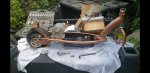
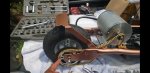
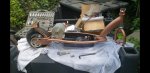
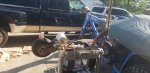
Well got it painted kind of
Went with a cool cheap Copper metallic color

Got most of the fabrication done
-grinded done the frame
-cut off some brackets
-mounted engine and made new mouning holes
-machined a 47 tooth pocket bike sprocket to attach to the stock sprocket. So I can switch back and forth by just putting on a new chain and sliding over the engine some
-made a new chain tensioner

Got most of the wiring done too


20180731_205047.jpg

20180801_183143.jpg

Screenshot_20180806-202444_Video Player.jpg

Screenshot_20180806-202406_Video Player.jpg
 

Gn4life

New member
Messages
18
Reaction score
0
20180804_215403.jpg

20180804_215421.jpg

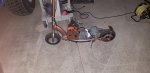
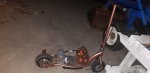
So it was ready to ride. Didnt want to Secure the Battery pack because they are just for testing and need to go with a longer AH pack. So i just put them in a metal box i had laying around.

WOW..... the torque for this thing is unreal. It wheelies and wants to come from out and under you. Its acceleration is crazy. Im glad I changed both sprockets for top speed instead of acceleration. It would be impossible to ride with anymore torque or acceleration from the stock larger sprockets and stock smaller motor sprocket.

Even though it takes off like a rocket. It hits 23- 25 mph and kind of stuck there. A little disappointed in that. But I am 6'1 and weighed 219 pounds at the time of testing.
But it climbs hills better than the 35cc hipo Moby Z power board scooter I have.

Also Battery life is a joke. Maybe 2 to 3 full pulls and batteries are down to one bar.

Im going to get taller tires.

Maybe change the motor sprocket

New 5-7 amp hour 60 volt pack

Secure the handle bars

Needs brakes. Have no brakes at moment.


Is 25 MPH with a 219 pound rider good?????????? Not going to lie very dissapointed
 

Gn4life

New member
Messages
18
Reaction score
0
Nice job! :thumbsup:

WOW! :smiley_omg:
...200+ lbs. on that little scooter

Yup, IMO
...25 MPH is pretty good :cheers2:
Thanks and thanks for the info.

Ok I dont feel as bad now.
Plus a larger motor sprocket and taller tires should help some with the MPH.


What do you think about the battery from this drill???
Do you think those specs for the battery???
Do you think its bogus???

https://www.ebay.com/itm/360n-m-68V-Rechargeable-Brushless-Electric-Impact-Wrench-Cordless-7800Ah-Battery/222940735523?_trkparms=aid%3D111001%26algo%3DREC.SEED%26ao%3D1%26asc%3D53470%26meid%3D9c29789a62bd4b7684cfa513be634a4c%26pid%3D100675%26rk%3D1%26rkt%3D15%26sd%3D222940735523%26itm%3D222940735523&_trksid=p2481888.c100675.m4236&_trkparms=pageci%3A9c4d95d1-99e9-11e8-ab44-74dbd180cbd6%7Cparentrq%3A12371c571650ab64221d312ffffed8de%7Ciid%3A1
 
Status
Not open for further replies.
Top