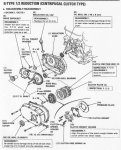
Honda Reduction Chutch Adjustment

Status
Not open for further replies.

wb72

New member
Messages
18
Reaction score
0
Fellas,
I obtained an ex- Race kart that has a GX200 with 2:1 gear reduction clutch on it.

When I bought it, the rear wheels needed to be raised in order for the engine to start, when it started and engine warm, the kart was placed back on the ground, and it did not move. my thoughts were that the clutch was not set properly and would be an easy fix, so I bought it.

I'm the type of guy that needs to double check everything, so I pulled apart the entire Engine and gear reduction. refreshed the engine with gaskets and clean carburetor. the oil in the reduction unit had a smell of burnt clutch disks, I cleaned it out and reinstalled the clutch disks with fresh oil. upon firing up the engine on the bench, it started well, and after the carburetor tuning, I noticed that the clutch disengaged at idle, but locked up just off idle. This makes it hard to start since the flywheel can not freewheel upon startup.

My question is if there is a modification to allow the clutch to engage at a higher engine speed? i would like this engine / clutch combo to be more useful on a regular farm kart.

Thanks
 

firemanjim

Just kartin' around....
Messages
5,247
Reaction score
83
Location
Houston Texas
Yeah, different weights, but I don't think that is the problem.... Maybe try to idle down so you have more rpm freeplay before clutch engages.
I THINK that clutch starts to engage at 2200-2400 rpms.... You should idle around 1800 .....
 

wb72

New member
Messages
18
Reaction score
0
I am estimating that it is idling around 1500 rpm. It will stall out when I turn down much more. If this is the case, I estemate the clutch will lock up around 1700 rpm but has tension on the plates at 1500.

Can I remove one or more of the weights from each bank (there are 12 weights per bank) rather than replace with new weights? I haven't been able to source out a supplier that has optional weights for this clutch. Honda can only supply stock ones since they are based on a part number system.
 

wb72

New member
Messages
18
Reaction score
0
Are there any specs showing the spring tension or the amount of weights for a stock unit?
I would hate to buy oem at dealership prices to find out that is not the problem.

Thanks for the ongoing advise.
 

wb72

New member
Messages
18
Reaction score
0
Thanks for the diagram.
So, if anyone else has the same issues, this is what I did so far.

I removed 3 of the 12 weights per bank, I replaced the weights with tiny washers as spacers. They do not interfere with the movement of the weights. When I reassembled and tested it, I noticed a small difference, but not enough for my liking. I would estimate a 50 rpm change.

Again I disassembled the clutch and thought I would strengthen the springs, I removed the clips and springs and added a spacer beneath the spring and reassembled it before another test. This changed the engagement by another 50 rpm.

The combined change will work for me, I believe the real issue is weak springs. Without buying upgraded springs, and not being able to fit another spacer under the spring, I will live with the slight drag at idle. At least it has changed in the right direction.
 

mckutzy

Well-known member
Messages
8,353
Reaction score
107
Location
bc, canada
I'm curious..... Why keep the redux on there in the fist place...
Why not just get a regular clutch and forget this?.... You won't need to compensate for the ratio "loss".
 

chancer

ɔ ɥ ɐ u ɔ ǝ ɹ
Messages
9,358
Reaction score
82
Location
COMFORT, TEXAS
I'm curious..... Why keep the redux on there in the fist place...
Why not just get a regular clutch and forget this?.... You won't need to compensate for the ratio "loss".

According toFMJim reliability. The wet clutches last forever and are virtually maintenance free.
 

wb72

New member
Messages
18
Reaction score
0
I'm curious..... Why keep the redux on there in the fist place...
Why not just get a regular clutch and forget this?.... You won't need to compensate for the ratio "loss".

The main reason is durability.

Most of the racers have them, and it allows them to run a smaller rear sprocket which in turn allows the kart to be close to the ground.

There is a slight loss of power, but it will have more torque.

This will be my first reduction, I may not like it, but I think I will.
 
Status
Not open for further replies.
Top