"Too steep" when referring to gearing means the first number in the ratio is too low. It's also called "tall" gearing or "long" gearing. Makes for potentially higher max speed, but that's if the system can actually get itself moving without frying clutches or belts.
An 84/14 combo with 18" tires would get you to the magic 6:1 ratio and would max you out at about 32 mph. That said, there needs to be something to transfer the power from a rotating engine to a stationary axle. That something is a clutch or torque converter which has to absorb the difference in rotating speed. That's what they're made for, but the more weight you're pushing around equals more resistance to movement. The more power you add means more power pushing on that weight. Therefore, the more weight and/or power a kart has, the harder the job is for the clutch/TC. Proper gearing helps a lot, but it doesn't solve the problem completely.
Oh, and the diameter of an 84-tooth sprocket might be a problem with ground clearance, too. Check that before committing. A 10/60 combo would net you the same ratio but with a smaller driven sprocket. That said, I'd still get a torque converter.
The eBay TC might work, but it's highly likely to be a cheap Chinese import trying to sound like an actual Comet setup. BMI has the cheap ones and legit Comet ones. Unfortunately a genuine Comet 40-series driver/driven combo will run you about $300.
The jackshaft you linked to will probably work as long as the exposed shaft is long enough for both the driven clutch and a sprocket. 5/8" diameter seems a little light to me, but I don't have experience with that stuff yet. Just seems to me the engine's output shaft is 1" for a reason.
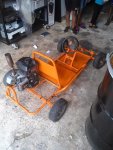
I'm building a heavy kart with a 13 hp engine and am in the process of putting in a 40-series converter, so I feel your pain. The sheer cost of a Comet TC and jackshaft setup put my project on hold for a couple years, but hopefully I'll get it done over the next month or so.
In case this isn't all clear, the order of power output is the TC's driver clutch is on the engine's output shaft, which transmits power via a belt to the driven clutch, which is mounted on a jackshaft, which then rotates, which then spins the 10-tooth sprocket that's mounted to it, which then transmits the power via a chain to the axle sprocket, which is mounted to the axle (or wheel if it's one-wheel-drive rather than a live axle).