Hello. New to this site. Sure could use some help. I bought this cart three months ago and the engine runs like a top. Still does. When driving the other day it just stopped going in forward gear. No loud pop or anything. Just seemed like it slipped out of gear. Engine was running fine. Couldn’t get it to shift into forward or reverse. Thought it was the reverse gearbox or the cable, since it was always hard to put it in reverse and back into forward since I got it. Used to have to turn key off after shifting into reverse to get it to go back into forward. So I replaced the cable and took the reverse gear box apart. Everything looked perfect. Gears were fine and spring for reverse gear shift yoke is fine. So greased it up and put it back on. Since the cvt still spun the box I assumed the belt was fine. So checked out the cvt and it’s perfect. Variator is fine. Rollers have no flat spots. The clutch is fine. Spring is strong and it’s moving with the engine. I have attached a link to a video that shows what it’s doing. Any help would be so appreciated. When I roll the cart the axle and chain gears move with the gearbox. I thought maybe the gear attached to the reverse gearbox may be shot. But it doesn’t seem like that’s the case either.

You are using an out of date browser. It may not display this or other websites correctly.
You should upgrade or use an alternative browser.
You should upgrade or use an alternative browser.
Hammerhead Twister 150 won’t move in forward or reverse
- Thread starter Mike1423
- Start date

Rat
Well-known member
Did you check for sheared keys?
Doesn't matter if the variator is working properly if the key or keyway let go the power stops there.
I worked on a Hamerhead LE-150 a while back and it had a nasty hard shift issue, but that was idle speed related.
That doesn't change the fact that the hard shift jarring the driveline will damage the transaxle (where equiped), shear keys into shrapnel, and deform keyways so bad they'll never hold a key.
The vid shows the engine, variator, and gearbox are functioning fine, but it also shows the primary gear not turning the chain which is no doubt in itself a cut and dry painfully obvious blown key.
Last edited:
panchothedog
Well-known member
- Messages
- 2,958
- Reaction score
- 4,007
Rat. I really think you nailed it. Watching that video with the shaft freewheeling inside the drive sprocket just screams broken key. Mr. Mike 1423, I think you know what you have to do. Remove the sprocket ( probably a fair amount of work ) and figure out which part of the setup is broken. Slot in sprocket, slot in shaft, or the key itself.
I am eternally grateful for your gentlemen’s response’s. I have been searching the bowels of the internet for days and have not come across this solution. I have dropped the chain and taken the forward/reverse gear off once already and saw no problems. All parts in the diagram seemed to be there when reassembling. Pancho when you say slot in sprocket, shaft, or the key itself can you point me to where they would be? Sorry for sounding dumb. First time working on these. I can turn a wrench, but that doesn’t mean I know what I’m doing. Lol. The sprocket seemed fine when I had it off but I’m not sure if what I would be looking for. Where would the key be?
Rat
Well-known member
A keyway is a groove cut in the shaft and/or sprocket, sprocket carrier, or other object to be held in a fixed position upon a rotating shaft.I am eternally grateful for your gentlemen’s response’s. I have been searching the bowels of the internet for days and have not come across this solution. I have dropped the chain and taken the forward/reverse gear off once already and saw no problems. All parts in the diagram seemed to be there when reassembling. Pancho when you say slot in sprocket, shaft, or the key itself can you point me to where they would be? Sorry for sounding dumb. First time working on these. I can turn a wrench, but that doesn’t mean I know what I’m doing. Lol. The sprocket seemed fine when I had it off but I’m not sure if what I would be looking for. Where would the key be?
There are various forms of key, in your situation it is most likely a ¼" x ¼" x 2" square steel bar (possibly 6mm x 6mm x 40mm metric) and they are sneaky bastards about falling out unseen when parts are being removed.
Woodruff aka half rounds are more common in flywheel applications... especially on Lawn engines.
Some sprockets have the key formed into their bore and the entire part has to be replaced if key damage occurs, and while it is quite difficult to nearly impossible... it is still possible to shear the key off them.
You need to look at the shaft close, the keyway being a cut groove that absolutely cannot be missed; in fact it is so obvious even a blind man can "see" it as well as tell you if its damaged.
You need to look at the sprocket bore where it rides the shaft and if there is a matching keyway, or a spot that is not as smooth as the rest of its bore or if there is a different color of metal stripe.
It is entirely possible for those keys to fly out if the sprocket was not torqued to spec and there was no washer under the shaft nut covering the keyway to hold it back.
It's also (albeit exceedingly rare) possible for them to disintegrate without causing damage, or even more rare and unlikely popped in half so clean its smeared almost invisibly into the keyways. That happens most often when some numb nuts idiot uses an aluminum key where steel is required.
panchothedog
Well-known member
- Messages
- 2,958
- Reaction score
- 4,007
Not good with pictures. ( technology challenged ). Rat is good with that stuff.
The shaft the sprocket sits on should have a slot ( key way ) 3/16" wide by
3 /32" deep. The inside bore of the sprocket should have a corresponding slot
the exact same size. Into this hallow void is inserted the key. A square piece of steel 3/16" X 3 /16" of the appropriate length ( so it doesn't wander ) side to side that locks the shaft and sprocket together as one unit. Remove the sprocket completely off of the shaft, and it should become obvious.
Rat
Well-known member
For the shaft size and torque loads expected I'm pretty sure it's a 1/4" key shaft.Not good with pictures. ( technology challenged ). Rat is good with that stuff.
The shaft the sprocket sits on should have a slot ( key way ) 3/16" wide by
3 /32" deep. The inside bore of the sprocket should have a corresponding slot
the exact same size. Into this hallow void is inserted the key. A square piece of steel 3/16" X 3 /16" of the appropriate length ( so it doesn't wander ) side to side that locks the shaft and sprocket together as one unit. Remove the sprocket completely off of the shaft, and it should become obvious.
I'm not going to the garage just to yank apart something for pics of key ways and a key at this hour. Besides anyone with any GOFO can figure out if they are looking at a keyway or not.
My guess is the key disintegrated from all that hard shift abuse And fell out one shard and chip at a time. He needs to turn the idle down at least 500rpm and if it stalls instead of holding he'll need to clean the carb and most likely unplug the exhaust.
On that LE-150 I cut the stock muffler open at the inlet end, cut 5-6" of the pipe past the end plate off the header to remove the unnecessarily restrictive "dB buster" style catalytic (still have it somewhere) and welded the cabinet back together.
It wasn't any louder (just lower pitch with more rumble) than stock but it picked up a lot of acceleration, could idle low enough not to grind or hard shift, and gained 10mph up top
Last edited:
Oh man you guys are blowing my naive mind. Could this key just give out when driving and cause this problem? I 100% did not know anything about shafts to this extent when reassembling the forward/reverse gearbox to make sure I lined up the sprocket with the key shaft or even if the key you guys are referring to was intact so I definitely may have not reassembled correctly. But it would have to be that this key sheared when driving since this problem happened when I was driving it correct? I will take it off first thing tomorrow and see if I could find this key. I really wish I could find what you guys are referring to in a parts diagram. I understand I should see when looking at the shaft and the sprocket like Pancho described for the corresponding slots. But this key thing is blowing my mind. Would it not be in a parts diagram? There seems to be no 1/4” key near the sprocket in any diagrams I could find.
Rat
Well-known member
I did some light digging since I have not had my hands on or in the specific GY6 engine based machine in question.
From what I can tell what we see turning is not a variator but the external reverse gear unit... which has a bolted on sprocket.
It would seem someone sheared off all the bolts?
A few fell out and a few sheared?
Idk I am damn good at figuring things out in general, but this requires more info or hands on the machine personally.
I'll stick to kicking my Mule
From what I can tell what we see turning is not a variator but the external reverse gear unit... which has a bolted on sprocket.
It would seem someone sheared off all the bolts?
A few fell out and a few sheared?
Idk I am damn good at figuring things out in general, but this requires more info or hands on the machine personally.
I'll stick to kicking my Mule
Yes that is the forward/reverse gear assembly that is shown spinning in the video. I mentioned the variator in my original post just to knock things off the checklist that might have been causing this issue. Sorry about that.I did some light digging since I have not had my hands on or in the specific GY6 engine based machine in question.
From what I can tell what we see turning is not a variator but the external reverse gear unit... which has a bolted on sprocket.
It would seem someone sheared off all the bolts?
A few fell out and a few sheared?
Idk I am damn good at figuring things out in general, but this requires more info or hands on the machine personally.
I'll stick to kicking my Mule
View attachment 147721
Rat
Well-known member
Not really, and larger actuallyLike this on a smaller scale?
Light blue letters in a post means an embedded link, you click and are magically taken to another place on the webs.
It occurred to me that being a GY6 engine it has a splined output not keyed.
Splined can still get flattened or ripped out of hubs. They especially love to just shatter or twist off entirely
Like this but in a smaller scale? I did not notice when taking the sprocket off.

 youtube.com
Setting the Key Into the Sprocket—Tips and Ticks from Insulation Machines
It’s easy to install the key into the keyway of the sprocket and shaft on an in-line reducer or gearbox. We sell the Cool Machine brand of insulation blowers...
youtube.com
Sorry that was the wrong video link I was trying to send. I thought that might be the case when I took off the gear the first time. But the splines all seemed fine and there was no sign of metal shavings or flattened areas. I’ll take a better look tomorrow.Not really, and larger actually
Light blue letters in a post means an embedded link, you click and are magically taken to another place on the webs.
It occurred to me that being a GY6 engine it has a splined output not keyed.
Splined can still get flattened or ripped out of hubs. They especially love to just shatter or twist off entirely
Rat
Well-known member
The bottom line is whatever makes the sprocket turn isn't... check that embedded link. I do know that the year matters because Polaris bought out Hammerhead in 2015/2016 and changed a few things up here and there within the assemblies.Sorry that was the wrong video link I was trying to send. I thought that might be the case when I took off the gear the first time. But the splines all seemed fine and there was no sign of metal shavings or flattened areas. I’ll take a better look tomorrow.
2009-2015 150 powered machines are subject to recall due to a faulty fuel tank assembly that cracks, leaks and potentially causes the machine to burst into flames.
panchothedog
Well-known member
- Messages
- 2,958
- Reaction score
- 4,007
The video you posted is exactly what we are talking about. Two slots and a square.metal key. Weather it's 3/16" 1 /4" or 6 mms is irrelevant . What is important ( if it's a key and not a spline ) that you replace it with the same size.
Close enough is not close enough. 3/16" is . 187" 1 /4" is . 250" and 6 mm is
. 236". If you don't have one, go to harbor freight and buy a pair of dial indicator calipers. About $15. These are measurement that you CAN'T do accurately with a tape measure or even a machinest scale. If it sheared off the key, you might have to dress up the edges of the key way a little with a small file or some course sandpaper. You should be able to buy key stock at a well supplied hardware store. Lowe's or Home Depot probably won't have it.
Well you guys did it. This site has an incredible wealth of knowledge and good people who share it. That “bolted on” sprocket is just on there freewheeling. I must have sheared all four bolts off the reverse gear. It is no longer attached. Now that I look at now it seems so obvious. I guess I was in denial about a $200 part. Thought I could fix it. But you can’t fix sheared off bolts. I guess I’ll be ordering a new reverse gear unit. Thanks for the help and steering me in the right direction! I will come back and post after the part comes in and hopefully I get the kart going.
Denny
Canned Monster
Yes you can fix it!! Quite easily and cheaply infact! There are several things to try first before shelling out that kind of money.
1. Reverse twist drill bits will sometime back out a sheared bolt.
2. EZ-OUTs. Drill a hole through the broken bolt, tap in the ez-out and remove bolt.
3. For the really stubborn ones just drill out the broken bolt and re tap the threads.
All the methods are way cheaper than replacing the reverser. Even if you have to buy a cheap reversible drill!
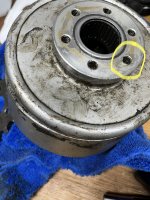
Wow I was just coming here to comment what I found and you messaged this. I just took a closer look and it seems none of the bolts have sheared off. Not one of the 6. All six thread holes are clear as day, with the exception of the one circled. That one seems like it might not accept a bolt. Is it even possible that all 6 bolts backed themselves out? That seems insane to me.Yes you can fix it!! Quite easily and cheaply infact! There are several things to try first before shelling out that kind of money.
1. Reverse twist drill bits will sometime back out a sheared bolt.
2. EZ-OUTs. Drill a hole through the broken bolt, tap in the ez-out and remove bolt.
3. For the really stubborn ones just drill out the broken bolt and re tap the threads.
All the methods are way cheaper than replacing the reverser. Even if you have to buy a cheap reversible drill!
Attachments
-
 IMG_1594.jpeg1.1 MB · Views: 8
Rat
Well-known member
If you removed them personally, and did not use locktite on the threads ABSOLUTELY!Is it even possible that all 6 bolts backed themselves out? That seems insane to me.
IF you didn't disturb them, but someone before you did, and failed to use locktite when reinstalling them ABSOLUTELY!
If someone replaced them with random hardware store bolts for let's say rounded off heads and did not use locktite on the threads, ABSOLUTELY!
The one that got the threads chewed up was 1100% no doubt the last one to let go... that's just what they do on any machine.
Like Denny said you don't need to replace the whole part (you actually got kinda lucky with them being missing not sheared.
Take the hub with you to the hardware store to make absolutely certain you get the correct length, diameter, and pitch bolts to replace the missing ones with. I suspect that one mauled one may hold just fine, they usually only do enough damage to the upper threads to be a cross thread risk.
It is most probably M8-1.25, but if it's metric, your best bet is to tap it to the nearest standard size (5/16) bonus, if it's aluminum you can just slowly run them in. This will essentially forge the threads (moving and compressing the material) without a tap instead of cutting (removes material/ not as strong) the same way a lot of bolt threads are rolled on, even spokes for bicycles and motorcycles are rolled for strength instead of cut.
What ever you do just make sure you get locktite thread locker and follow the directions to prevent a repeat occurrence.
Last edited:
Affirmative! I had the locktite ready to go after witnessing what those bolts did. My son and I were wondering how many bolts were on when we bought it. I ordered the exact bolts from hammerhead with keepers, which seems to be their type of lock nut. I’m sure those were probably missing also. They were M6x25. I wanted to make sure to get the exact bolts. Thanks again for opening my eyes to what I couldn’t see. When I hopefully get this kart going again I’ll make sure to report back how it went.If you removed them personally, and did not use locktite on the threads ABSOLUTELY!
IF you didn't disturb them, but someone before you did, and failed to use locktite when reinstalling them ABSOLUTELY!
If someone replaced them with random hardware store bolts for let's say rounded off heads and did not use locktite on the threads, ABSOLUTELY!
The one that got the threads chewed up was 1100% no doubt the last one to let go... that's just what they do on any machine.
Like Denny said you don't need to replace the whole part (you actually got kinda lucky with them being missing not sheared.
Take the hub with you to the hardware store to make absolutely certain you get the correct length, diameter, and pitch bolts to replace the missing ones with. I suspect that one mauled one may hold just fine, they usually only do enough damage to the upper threads to be a cross thread risk.
It is most probably M8-1.25, but if it's metric, your best bet is to tap it to the nearest standard size (5/16) bonus, if it's aluminum you can just slowly run them in. This will essentially forge the threads (moving and compressing the material) without a tap instead of cutting (removes material/ not as strong) the same way a lot of bolt threads are rolled on, even spokes for bicycles and motorcycles are rolled for strength instead of cut.
What ever you do just make sure you get locktite thread locker and follow the directions to prevent a repeat occurrence.