TheInspiredFool
Member
- Messages
- 143
- Reaction score
- 10
Ok, as far as how air flowing through the engines ports effects cooling the cylinder goes I suppose I wasn't explaining myself and the effects of it very well. All airflow matters especially cold outside air...relative to the hot engine.
So as you were saying about the engine heating up at idle as the airflow decreases we need to consider the combustion cycle has decreased and energy output of the engine has decreased as well, thereby decreasing heat output. Does it make a drastic impact on upper cylinder temperatures? Who knows. The fuel mixture really makes a difference though. You can make a little more power by running a bit lean at the cost of higher head temps and also you can run a little richer and drop your head temps at the cost of a minute amount of power. That's pretty much a proven fact.
Is it negligible with these small engines? Yeah, who cares I guess. I think you could measure the effect with the right equipment though.
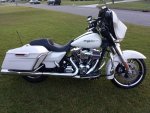
Some engineer decided to implement a rear cylinder shutoff on Harley Davidson air cooled engines when outside air temp exceeds a certain temp. It just moves air through the cylinder in an effort to cool the entire engine when you're sitting at idle. Does it work? Yeah, it's annoying sitting on the vibrating thing...but whatever works.
Thanks for going into it more. I understand.
---------- Post added at 06:26 PM ---------- Previous post was at 05:44 PM ----------
They still apply. Be leery of the overly simplified formulas you might find in places like Hot Rod magazine or something. They often round-off numbers, shorten decimal places, make assumptions about the engine, and then condense it into some constant where all that monkey business is not visible. The more variables you have to plug in, the better.
If you can make the port smaller with the same or better flow, then the engine should make more power under the curve.
You probably won't get noticeably better throttle response without lighter parts and/or a pumper carb. Singles have the disadvantage of 720° firing. At low rpm, response to a throttle snap is delayed until the next intake stroke comes around. Then there's going to be a lean AFR spike as fuel starts moving and the port walls get wetted.
Incidentally, a throttle chop causes the AFR to rock bottom briefly as that fuel is pulled off the ports under low airflow. Fortunately it seldom affects driveability.
No, they're affected the same way. It's less noticeable the less power an engine makes. There again, most people trying to get more power out of these engines are also spinning them a lot higher.
If you're not after actual flow numbers, then a simple flow bench that provides only comparative results would be simpler and easier to build. Dynos can be done that way too, but the only real difference is the data collection. Might as well make it spit out real numbers.
That's to keep the hotter rear cylinder from overheating though(and by extension, the rider sitting over it); it doesn't cool the front one.
Thanks for the response and info ShelbyClone.
They still apply. Be leery of the overly simplified formulas you might find in places like Hot Rod magazine or something. They often round-off numbers, shorten decimal places, make assumptions about the engine, and then condense it into some constant where all that monkey business is not visible. The more variables you have to plug in, the better.
If you can make the port smaller with the same or better flow, then the engine should make more power under the curve.
That's what I figured. I was wondering why I have not seen others address this on near stock applications.
I agree. I am very leery of over simplified formulas. I long hand all of my own formulas out, go to the 4th decimal place and run various scenarios with various inputs for the variables that are specific to what my application could see. Then I take the best guessed scenarios and tune the average with all of the other corresponding formulas and build a chart with all of the differing variables to get the best picture of scenarios. Then I tune for the best average in consideration of the compromises involved. I don't do well just going with the short-cut formulas or "rule-of-thumb stuff. I get as exact and accurate as necessary.
You probably won't get noticeably better throttle response without lighter parts and/or a pumper carb. Singles have the disadvantage of 720° firing. At low rpm, response to a throttle snap is delayed until the next intake stroke comes around. Then there's going to be a lean AFR spike as fuel starts moving and the port walls get wetted.
Incidentally, a throttle chop causes the AFR to rock bottom briefly as that fuel is pulled off the ports under low airflow. Fortunately it seldom affects driveability.
I understand the long legged stumble with the 720 degree firing but I figure that the uptake in velocity, quicker ability for the de-pressurization to afftect up stream movement quicker and ability to fill the cylinder more effectively and efficiently would accompany the rider with better responsiveness, especially where efficiency on the low to mid valve lift events are more critical.
No, they're affected the same way. It's less noticeable the less power an engine makes. There again, most people trying to get more power out of these engines are also spinning them a lot higher.
That's what my thinking was as well but I am open to the fact that I can be wrong so I seconded guess myself and opened up to learn something new. I guess the few people that leave the internals mostely stock but work the ports without going to top rpm just either don't care or don't think it's worth the time and effort to try to dial them in. Or they just don't know.
If you're not after actual flow numbers, then a simple flow bench that provides only comparative results would be simpler and easier to build. Dynos can be done that way too, but the only real difference is the data collection. Might as well make it spit out real numbers.
Very true and I am on the verge of deciding to build a Flow comparison bench. I have already asked my wife to pick her favorite vaccum (since we have 4 or 5) in case I end up using 2 or 3 of the motors to build a flow bench. Lol The thing is that I have a couple of Arduino's and a RaspberryPI with a nice assortment of sensors laying around that I am always tempted into putting to good use and making my initial simple build into a much better but more complicated and time comsuming build. The same goes for the dyno. I could build a whole friggin performance tunning shop with those things! I just get too involved and can't help but build accuracy and testing variable number producing nerd machines once I try to build something simple. Lol Numbers, accuracy, testing, efficiency! I can't stop myself!