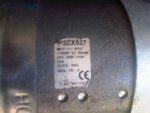
Found motor - need help

Status
Not open for further replies.

wifecallsmegrumpy

New member
Messages
2
Reaction score
0
Hi guys,

After recent success in turning a powered golf bag trolly into a cart for my 5yr old I would like to commence building a bigger one that will hold me and allow him to upgrade when he is older/ more experienced. So I found this motor out at the junkyard off a three wheel sweeper truck and I think the motor was used to drive the sweeper mechanism not the "drive wheel"

It's a 24 volt, 1100w motor (and it works, i checked) so it's about 1.5hp which doesn't sound like a lot. So questions if I may..

1. Is it worth proceeding with this motor as I want reasonable speed >20k/hr
2. Are there any other reasons I should ditch the motor
3. Could you tell me any thing else about it ? Is it brushed or brushless ?
4. Where do I get a controller from. I have searched far and wide and keep coming back to ebay controllers which seem to meet the specs but only have a pot control, where as I want a foot pedal hall effect throttle.

thanks so much for reading any comments appreciated :thumbsup:


here is the controller I was looking at
http://www.ebay.com.au/itm/Reversib...Electrical_Test_Equipment&hash=item257380b7ea
 

Attachments

  • motor.jpg
    motor.jpg
    52.3 KB · Views: 5
Last edited by a moderator:

Jon13523

New member
Messages
14
Reaction score
0
Location
Indiana
I work on industrial ac and dc motors if I could see the whole motor I might be able to help. As for as the speed control instead of a "pot" design have u looked at fork truck pedals or even an electric golf cart would have some sort of pot pedal control. How many post ate coming out of the motor 2 or 4
 

wifecallsmegrumpy

New member
Messages
2
Reaction score
0
Thanks for the reply Jon. I googled the motor number and found it's made by a company called Atas in Czech Rep. http://www.google.com.au/url?sa=t&r...hIGIDA&usg=AFQjCNGet4p7GHD0vL0-vVW9KDZyo0PvyQ

The good news is it's reversable, although it weighs 12kgs so it's heavier than I would like. Further research has led me to a Kelly controller KDS48100 24-48V 100A although there are two wiring diagrams that are starting to get beyond me a bit, specifically the use of precharged resistors.

Any advice welcome before I really kick off this project.
 

Jon13523

New member
Messages
14
Reaction score
0
Location
Indiana
I'm not to familiar with what u r talking about "precharged" resisters unless u are referring to capacitors. As far as being reversible all dc's are reversible. If your looking this Kelly switch u say it's 24 or 48 volts is that wiring diagram giving u trouble? All that is telling me is if your motor has 4 post coming out of it then it is a dual volt motor it's a matter of how u connect it. I will google this Kelly switch later and in the mean time tell me how many post yet motor has and I will draw u up the proper connection it is easier then u think
 

wifecallsmegrumpy

New member
Messages
2
Reaction score
0
Sorry I haven't taken a photo but it's not a dual post motor. It has a red and black set of cables coming out of it with no other connectors.
Really appreciate the connection drawing when you have time.
 

Jon13523

New member
Messages
14
Reaction score
0
Location
Indiana
I'm sorry man I've been busy working on my kart I'm building I promise I'll google this part and get back to u soon I promise
 

Iron John

New member
Messages
397
Reaction score
1
Location
NA
Personally, I don't see the need for infinitely adjustable speed control. Use a bank of relays (Ford starter somenoids) and resistors switched in series, parallel and direct to give you three speeds. Just like an old trolley car. Resistors can be cannibalized from old battery testers. Electronic speed controllers tend to be expensive whereas relays and resistors are cheap.
 

anderkart

Moderator
Messages
6,427
Reaction score
371
Location
Surprise Arizona USA
Personally, I don't see the need for infinitely adjustable speed control. Use a bank of relays (Ford starter somenoids) and resistors switched in series, parallel and direct to give you three speeds. Just like an old trolley car. Resistors can be cannibalized from old battery testers. Electronic speed controllers tend to be expensive whereas relays and resistors are cheap.

:iagree:

Except the Ford (SW3-type) starter solenoids are not designed for continuous duty use. The pull-in coils in those tend to overheat after a few minutes.

Dual-battery/RV-solenoids like these:--> http://www.americanrvcompany.com/To...lation-Solenoid-Trailer-RV-Camper_p_2543.html
look similar but are designed for continuous duty applications like your talking there. They work the same basic way but have hold-in coils that can be engaged for hours/days at a time without overheating.
 

Camn

New member
Messages
20
Reaction score
0
Personally, I don't see the need for infinitely adjustable speed control. Use a bank of relays (Ford starter somenoids) and resistors switched in series, parallel and direct to give you three speeds. Just like an old trolley car. Resistors can be cannibalized from old battery testers. Electronic speed controllers tend to be expensive whereas relays and resistors are cheap.

Resistors do not work as well as you think for controlling electric motors. First of all they limit current and voltage which makes the motor very weak at low speeds. And second of all the resistors will convert allot of energy into heat, which will waste a large amount of power. You would also need to find very high wattage resistors which are expensive. PWM controller pulses the motor at a certain cycle which allows for greater power and better efficiency.
 

Iron John

New member
Messages
397
Reaction score
1
Location
NA
Resistors do not work as well as you think for controlling electric motors. First of all they limit current and voltage which makes the motor very weak at low speeds. And second of all the resistors will convert allot of energy into heat, which will waste a large amount of power. You would also need to find very high wattage resistors which are expensive. PWM controller pulses the motor at a certain cycle which allows for greater power and better efficiency.

Actually, no.

Resistors work extremely well. Consider that every single subway car ever made for the past 105 years use resistors for speed control. Including the newest ones being manufactured today.

Yes, they will reduce the voltage. That's the point, right? Yes, they dissipate heat. So do PWM controllers, and PWM controllers are extremely expensive and are extremely fragile (easily burnt out).

Using relays, you can start in series, go to series-parallel: different combinations of ever-decreasing resistance. Three steps is plenty for a go-kart.

And of course we are talking about go-karts, not Mars rovers. It is not that using resistors would be low-tech, it would be right-sizing tech.

Resistor elements can easily be salvaged from battery testers, electric heaters, or even the elements from an electric range.
 

Camn

New member
Messages
20
Reaction score
0
Actually, no.

Resistors work extremely well. Consider that every single subway car ever made for the past 105 years use resistors for speed control. Including the newest ones being manufactured today.

Yes, they will reduce the voltage. That's the point, right? Yes, they dissipate heat. So do PWM controllers, and PWM controllers are extremely expensive and are extremely fragile (easily burnt out).

Using relays, you can start in series, go to series-parallel: different combinations of ever-decreasing resistance. Three steps is plenty for a go-kart.

And of course we are talking about go-karts, not Mars rovers. It is not that using resistors would be low-tech, it would be right-sizing tech.

Resistor elements can easily be salvaged from battery testers, electric heaters, or even the elements from an electric range.

Yes this is a fine method for street cars, they run off overhead AC power lines and use AC motors. In an application like this it doesn't really matter if some power is wasted.

But when you are running a DC motor on a vehicle with batteries you want to be as efficient as possible. And besides PWM controllers for scooters are fairly cheap and reliable.

Have you ever heard of any kind of EV with batteries using resistors? There is a reason for that.

I'm not just saying this, I have tried using resistors to control DC motors and they don't work very well, especially at lower speeds.

And you can buy a hall effect foot pedal that attaches directly to the motor controllers. I just bought one from TNC scooters for about $20.
 

Iron John

New member
Messages
397
Reaction score
1
Location
NA
Yes this is a fine method for street cars, they run off overhead AC power lines and use AC motors. In an application like this it doesn't really matter if some power is wasted.

But when you are running a DC motor on a vehicle with batteries you want to be as efficient as possible. And besides PWM controllers for scooters are fairly cheap and reliable.

Have you ever heard of any kind of EV with batteries using resistors? There is a reason for that.

I'm not just saying this, I have tried using resistors to control DC motors and they don't work very well, especially at lower speeds.

And you can buy a hall effect foot pedal that attaches directly to the motor controllers. I just bought one from TNC scooters for about $20.

Actually, no.

Subway cars run off 600 volts DC and most street cars ran 500 to 600 volts DC from the overhead wire. AC electric traction engines are, in general, more recent and became more practical upon the development of solid-state rectifiers.

I'm sorry that your experiments with resistor speed controls did not work out. What was the problem?

It does not change the fact that resistive DC speed control is well-established, practical and inexpensive. I'm not sure what kind of go-kart you run where you need infinitely adjustable speed control. Most go-carting I am familiar with is get going and get gone. :)

If you are running two electric motors, a very simple two-speed setup is to connect the motors in series for low speed, and then switch to parallel for high speed.

Add just one resistor bank and you get a four speed.

Center tap the resistor, and you have an eight speed.

As you see, a low parts count of surplus - often free - components can get you going very easily. Once you get the kart built, running and dialed in, I suppose you could convert to PWM if you felt it necessary.
 
Status
Not open for further replies.
Top