Electrical Sub-Panel Install

Status
Not open for further replies.

KartFab

Active member
Messages
3,381
Reaction score
59
Location
Dallas, TX
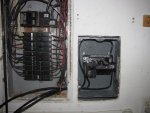
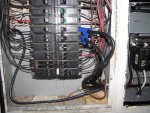
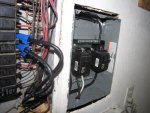
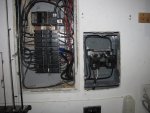
Sooo I got a welder last week, and its too big for any of the current breakers in my main panel...annnnd there are no extra slots in the main with all of the smaller breakers doubled up....So I put in a sub panel.

Now I just need to remove the 30 amp on the main, and replace it with my 100 amp to feed the sub panel, then reroute the wires that ran into the 30 amp into the sub panel from up top (not necessarily in that order).

I did this for future electrical expansion, and to get a 50 amp breaker in there for my welder. One more evening and ill have it complete, or my house will burn down, either one :) There is a reason why they say leave this to the pro's, but I am a little on the cheap side so I would rather do this with a little head scratching and research.
 

Attachments

  • IMG_2810.jpg
    IMG_2810.jpg
    94.2 KB · Views: 19
  • IMG_2815.jpg
    IMG_2815.jpg
    129.2 KB · Views: 17
  • IMG_2817.jpg
    IMG_2817.jpg
    109.7 KB · Views: 14
  • IMG_2816.jpg
    IMG_2816.jpg
    93.8 KB · Views: 18

danssoslow

Member
Messages
373
Reaction score
6
Location
Louisville, KY
It doesn't look bad, good job.

A couple things to be aware of.
-The neutral wire should be colored white, you can use white phase tape to mark it as such. I'm sure you are aware the wire doesn't care what color it is, and would work perfectly as it is; but it is a code requirement. Should anything, God forbid, bad ever happen, you don't want anyone to start pointing fingers back to you. In the same vein, the white wire under that breaker should be colored black. You can simply take a magic marker and color it.

-Also, and from what I can see in the pictures it looks good, but be certain that the neutral bus bar in the sub panel IS NOT bonded to the panel itself. The ground and neutral should be completely seperated within that sub panel.

-Since you used metal conduit to connect both panels, you should use fiber bushings to protect the wires from chafing as the enter and exit the conduit.

Trusting that you chose the right size wire for the load, I'd say you've done an excellent job. Better than a lot of people I've seen that get payed to do this for a living.
 

KartFab

Active member
Messages
3,381
Reaction score
59
Location
Dallas, TX
It doesn't look bad, good job.

A couple things to be aware of.
-The neutral wire should be colored white, you can use white phase tape to mark it as such. I'm sure you are aware the wire doesn't care what color it is, and would work perfectly as it is; but it is a code requirement. Should anything, God forbid, bad ever happen, you don't want anyone to start pointing fingers back to you. In the same vein, the white wire under that breaker should be colored black. You can simply take a magic marker and color it.

I was aware of that, thanks for reminding me!

-Also, and from what I can see in the pictures it looks good, but be certain that the neutral bus bar in the sub panel IS NOT bonded to the panel itself. The ground and neutral should be completely seperated within that sub panel.
The neutral bar in the sub is not grounded to the panel (the green screw is not installed. Thanks again!

-Since you used metal conduit to connect both panels, you should use fiber bushings to protect the wires from chafing as the enter and exit the conduit.
I was unaware of this, do these bushings somehow screw into the conduit? Looks like ill be making another stop at home depot at lunch today.
Trusting that you chose the right size wire for the load, I'd say you've done an excellent job. Better than a lot of people I've seen that get payed to do this for a living.
I sort of chose the right size wire for the load

from sub to welder protected by 50 amp is braided 6 awg with a solid 8 awg ground (6 exceeds req, 8 meets minimum req per millermatic 251 manual)

hots from sub to main are 3 awg protected by a 100 amp breaker, sub is also rated at 100 amps as well.

solid ground from sub to main is the biggest that would fit (#4 or #6?) i was told 8 would be good enough

neutral from sub to main is #4 braided (rated at 95 amp)... so this is the only one I was iffy on, but I figure that if i'm welding at max 50 amps and cooking at max 30 amps that only gives me 80 amps so I decided to cheat? That's the only one that make me think oh great this may not pass an inspection, but i didn't want to get a 60 amp breaker instead.

Also I will be tying into a junction box in the attic for the 30 amp oven breaker i will be replacing if the wire is too short, if not, I will be using the existing wire and coming through the top of the sub w the strain relief thingamajig.
 

danssoslow

Member
Messages
373
Reaction score
6
Location
Louisville, KY
That really isn't necessary, relocating & rerouting the oven's wire to the sub panel.
You can now, by code, use a panel as a junction box. To mean, you can simply extend the all the wires from the main panel into the sub panel; using THHN as you have for the sub panel's feeders. You will have to take ALL the wires across; if it is a 4 wire, take the ground and neutral into the sub panel, too.

I'd have to check to be absolutely sure; but I believe anything under a 200 amp service cannot have a derated (smaller) neutral wire. For the short length it is, I'd replace it with #3. Thing is, that neutral wire has the potential to carry MORE amperage that the sum of the hot wires. This will become prevalent as you begin to add 110v circuits into that panel. Once the load becomes unbalanced (more breakers on one phase than the other), when the load becomes unballanced, the neutral is no longer a nuetral (kind of a nickname, calling it a neutral wire, it is by definition a "grounded conductor"), and the load across the neutral is the additive of the loads, phase A and phase B.

Your intuition has served you well. Go ahead and change that wire out. I know it's a kick in The butt to have to eat the cost of that #4; but you can always use it as one of the conductors when you relocate the oven wire into the other panel.

The fiber bushing is a composite or plastic threaded "cap". It will screw onto the end of the connector, and there will be a rolled edge that covers the sharp end of the connector. Here's a pic of one.


To edit:
If you do extend the wires for the range inside the main panel, you don't have to buy individual pieces of THHN. You could buy a cut length of the correct Romex; just make sure you take all the conductors out of the outermost sheathing. Discard the sheathing and the paper.
 

machinist@large

Active member
Messages
2,865
Reaction score
33
Location
West Michigan, 49331
It looks like Dan has more knowledge than I on this one; all I can add is what the electrical team tried to beat into my head, way back in the day.

GROUND RODS ARE GOD. WHEN IN DOUBT, THE GROUND ( NEUTRAL) NEEDS TO BE THE LARGEST WIRE IN THE BOX!!!!! .

I've done my share of wiring since then; when in doubt, I take the max amp draw off the machine's MFR tag, and the most accurate length of the cable run I've got to deal with when I go to my supplier for breakers, wire, any conduit needed, etc.

When dealing with a three phase system, while not necessarily required, tracking and phasing each leg (three phase= three legs) so that any plug in connections all start all the motors in the correct direction, is a real important thing to know. Single phase motors are a little different, since the direction of rotation can be affected by the starting system, independent of the wiring.

:thumbsup::cheers2::popcorn: Pat
 

danssoslow

Member
Messages
373
Reaction score
6
Location
Louisville, KY
If the motor doesn't run, swap A and C. Words to live by! :D

Kentucky is full of 3 phase gems scattered about. Delta, Wye, wild leg; and all of these can be within the same business park. I've seen some seemingly brilliant minds pay less than enough attention, never test their work, walk away, and let the client have to deal with a burnt up piece of equipment. "It only costs a dollar more to go first class, and five more minutes to do it right." The saying is old (doller=1st class? When?!?), but those words still hold true today.
 

OzFab

Well-known member
Messages
15,615
Reaction score
70
Location
Warwick Qld, Australia
Are you guys allowed to do that? Over here, you need a licenced electrician to do even minor electrical stuff... something to do with safety & whatnot...
 

danssoslow

Member
Messages
373
Reaction score
6
Location
Louisville, KY
Legally, he should have pulled a homeowner's permit. By law, if you replace a fixture in your house, you should pull a homeowner's permit. Does it happen every time, of course not.

So no, in a home (not here in Kentucky at least), a licensed electrician doesn't have to perform the work. The permit is there (and the consequential inspection) to keep the homeowner safe. Matter of fact, if a licensed electrician were to perform the task under the homeowner's permit, they could be fined and/or loose their license. The contractor is supposed to pull their own permits.
 

fowler

New member
Messages
5,463
Reaction score
18
Location
Bullsbrook West Aus
really
theres no way u can touch 240v (mains power) over here

you are meant to call an electrician to change breakers and power points
let alone re wire stuff

i change broken power points and worn out switches but stop there

if there was ever any fire they will ask for all history on the electrical circuits
if u cant find prove electrician A fixed or fitted circuit Z then even if it was the gas or what ever that failed the home insurance company would just walk away on the grounds of unlicensed work performed

if u know the elecetrican wel enough
like my freind who does all mine
i run all the wires and fit all the boxes, plugs ect then he shows up and connects it all
 

danssoslow

Member
Messages
373
Reaction score
6
Location
Louisville, KY
I used to do a lot of HUD work here in Louisville. Housing and Urban Developement, it's like food stamps for your house. I cannot tell you haw many times I've been in houses that were on the verge of a fire because homeowners would do there own work.

I remember one, this old lady remodled her attic into this Cape Cod type room. She connected all the plugs up using lamp cord; which some of the runs came out from under the baseboard, above the carpet, then back under the baseboard and up to the next plug.
There were portions of this wire that has bare spots on both the hot and neutral side, right beside each other! Left alone, it lasted up until the point I showed up; but if anyone were to step on that spot with a bare foot? Bzzzt!

The hot wires hooked up to chassis bonding points on appliances, because the black wire in their car goes to ground. Bzzzt!

I fought Natural Selection for five years straight. The smell of dog urine and cockroaches running amok finally took their toll on me. Some of the best experience of my life though. It gave me the confidence to move on into commercial and industrial work.
 

OzFab

Well-known member
Messages
15,615
Reaction score
70
Location
Warwick Qld, Australia
I've seen more than my fair share of stuff like that in car repairs, the worst part is knowing the majority of it was done by trained professionals (always made me think "these guys are giving me a worse name than I already have")
 

danssoslow

Member
Messages
373
Reaction score
6
Location
Louisville, KY
I've seen more than my fair share of stuff like that in car repairs, the worst part is knowing the majority of it was done by trained professionals (always made me think "these guys are giving me a worse name than I already have")


And the choir says "amen!"

The butt kicker has been seeing these types of guys advance faster than me. I've never been a salesman or a smooth talker; and watching these jacklegs get ahead of me at a company because he smoozes with the boss, that kills me slowly inside. :(
 

fowler

New member
Messages
5,463
Reaction score
18
Location
Bullsbrook West Aus
ha u dont wanna get started on cars

we brought an ex police toyota hilux
it became my job to ditch all the cop wireing and fit mine spec stuff

i tryed to use as many existing harnesses as i could but they were so dodgy i had to start again

wires running with no conduit
the UHF ariel wire was no secured anywhere and had partially rubbed thought the fire wall groment

the spot light wire was cable tied to the injector lines

and the worst invention ever in automotive electrics
scotch plugs everywhere

if anyone gets caught using them its straight down the road for them
its got to be the stupidest creation thought up by a lazy bastard
 

danssoslow

Member
Messages
373
Reaction score
6
Location
Louisville, KY
and the worst invention ever in automotive electrics
scotch plugs everywhere

if anyone gets caught using them its straight down the road for them
its got to be the stupidest creation thought up by a lazy bastard

They actually have these for high voltage usage also. Imagine a paralleled line that was unmarked; oofers!

Commercial buildings are the worst for the very same reason. So many hands have stirred the pot; so many things added and never documented. It as nerve racking as it is dangerous.

It would seem that most people lack the respect, and know just enough to be dangerous. I can't count the times I've asked ALL the right questions, gotten a "no, that's never been touched as an answer", found that they were lying (at times with more than its fair share of sparks and fanfair), and then get told the "oh yeah, ...".
 

Doc Sprocket

*********
Messages
15,677
Reaction score
151
Location
Ontario, Canada
I used to do a lot of HUD work here in Louisville. Housing and Urban Developement, it's like food stamps for your house. I cannot tell you haw many times I've been in houses that were on the verge of a fire because homeowners would do there own work.

I remember one, this old lady remodled her attic into this Cape Cod type room. She connected all the plugs up using lamp cord; which some of the runs came out from under the baseboard, above the carpet, then back under the baseboard and up to the next plug.
There were portions of this wire that has bare spots on both the hot and neutral side, right beside each other! Left alone, it lasted up until the point I showed up; but if anyone were to step on that spot with a bare foot? Bzzzt!

The hot wires hooked up to chassis bonding points on appliances, because the black wire in their car goes to ground. Bzzzt!

I fought Natural Selection for five years straight. The smell of dog urine and cockroaches running amok finally took their toll on me. Some of the best experience of my life though. It gave me the confidence to move on into commercial and industrial work.

Amen, brother. I work for a restoration company, fed by the insurance biz. Flood, fire, wind, burglary etc. It happens to you, you call your insurance, they call us, we fix it.

I cannot even begin to tell you the sort of electrical horrors I have uncovered, opening up walls and ceilings for repairs. I am in no way an electrician, but I know enough to see a stab at a Darwin Award when I see it. So many times I have been just truly amazed that I was (for example) tending to flood damage when it shoulda been a fire. Really, a matter of timing. If that water pipe hadn't burst and caused the basement ceiling to be wrecked, the place surely would have burnt down sooner or later...

And then, of course- the homeowner gets upset that we legally have to have a licensed electrician re-wire the mess before we can enclose it again- at their own expense. Bummer. Shoulda done it right the first time. Consider yourself lucky you lived...
 

dragos28

Trouble Maker
Messages
94
Reaction score
0
Location
Bakersfield, CA
Nice Job!
When we built our house i did all the electrical wiring, from the ground up... it was a good experience and it all passed inspection the first time. Fortunately i picked up a commercial breaker panel and it has 30 slots.. so i've got tons of room for expansion :D
 

fowler

New member
Messages
5,463
Reaction score
18
Location
Bullsbrook West Aus
I wish I could do my own wiring

I always wire it like I wire a haul truck
So it's safer more durable than any high voltage sparky will do it
 

danssoslow

Member
Messages
373
Reaction score
6
Location
Louisville, KY
Sparky?!?
Oh snap!!!

:D

Automotive wiring scares the bejesus out of me. I would feel comfortable wiring a 1 million square foor facility by myself, than to trace down a circuirt in a car. And to think, I own a Chrysler as a project car!
 

machinist@large

Active member
Messages
2,865
Reaction score
33
Location
West Michigan, 49331
This got a little longer than I intended; it's basically as short a history as I can put together as to why we've never had any electrical failures on the family farm, even though probably 80% of the wiring was never independently inspected.....

Here in Michigan, if it's a farm building, the only thing we need pull if we're putting a shop up is the building permit. I'm guessing that the main reasons we've never had any electrical issues is that when both farmsteads were initially wired for electricity back in the 1930's (Rural Electrification Act) my grandfather and one of my five great uncles both worked for Consumers Electric (now Consumers Energy); my great uncle Emmet as an electrical engineer, my paternal grandfather as a shift foreman for new plant construction.

The second wave of electrical work really started when my parents bought the original land grant parcel from one of my other great uncles in the early 1970's. My dad spent four years in the US Navy as an IC electrician, then a another five years building small warships for the Defoe ship yard in Bay City MI, before the closed. (Minor foot note; one of the last contracts that they filled was for the Australasian Navy. It was a class of four destroyer escorts.). When the yard shut down, he went to work for DOW Chemical in Midland, MI as a systems operator in the clorobenzal (?) dept. Almost all of (at that time) DOW's production at the Midland plant was based on clorene products, derived from all the salt brine wells in the region.

The reason I went into all the above paragraph was to explain how my parents went into farming; shortly after I was born, dad got dosed with clorene gas because of a broken pipe; this was a pretty common occurrence as the plant was in war time production mode supporting the war in Vietnam. He wound up in the ICU ward of the plant hospital. A little over six months later, guess what. My dad say's that regaining consciousness in an oxygen tent for the second time, with my mom holding baby me while being 8 months along with my brother, was one of the hardest moments in his life. He walked away from a job paying $60,000.00 a year in 1970, to go into a field (HAH) where a good year might be as little as $15,000.00.

Needless to say, between his Navy training plus some of the civilian classes he took when he got to the farm, plus me taking some of those same classes when I grew up, as well as my industrial experience, well we've (so far) never had any electrical safety issues rear their heads. We've also saved ourselves a lot of expense and headache's because we put in what we need to, not what someone who doesn't have a clue about our environment thinks we need.

Again, I apologize for how long this got; it just came out as I tried to figure out how tho parse it down.....:surrender::oops:
 
Status
Not open for further replies.
Top