DIY Pressure Test Adaptor

Status
Not open for further replies.

Doc Sprocket

*********
Messages
15,677
Reaction score
151
Location
Ontario, Canada
Since I'm too cheap to buy one... :lolgoku:

Sometimes you want to apply compressed air to a cylinder. It can:

*Keep the piston/recip assembly from moving when you need to hold it still

*Keep the valves shut and held firmly while you install or remove the keepers and springs

*Allow you to locate compression losses

*Allow the attachment of a leak-down tester

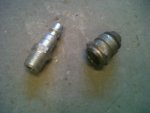
It basically amounts to an air fitting that you screw into the spark plug hole. So- I started with an air fitting (male quick-connect) and an old J17 spark plug.

I cut the center electrode off, and chucked the plug in my vise. I then proceeded to beat the living crap out of the ceramic insulator with a hammer and punch, until all I was left with was the hollow steel component of the spark plug. PSA- Use safety glasses when you do this- ceramic is basically glass, and it would suck to have a chunk fly into your eye.

I selected a male Milton-style quick connect plug, with a male 1/4" NPT fitting on it. Please note that some are steel and some are brass. You need a steel one for this.

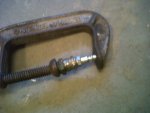
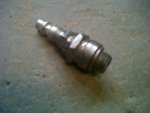
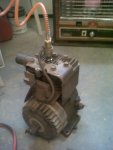
The threaded male portion of the quick-connect just fit into the top of the spark plug body. Nice! I put a large nut over the plug threads to protect them from weld spatter, and C-clamped the affair together. I welded the air fitting to the spark plug, and Voila! The last pic is a test run on an old 3hp Briggs. (And by doing so, I learned that the valves weren't seating worth a dang!)
 

Attachments

  • PTA1.jpg
    PTA1.jpg
    70.7 KB · Views: 16
  • PTA2.jpg
    PTA2.jpg
    73.8 KB · Views: 17
  • PTA3.jpg
    PTA3.jpg
    74.9 KB · Views: 15
  • PTA4.jpg
    PTA4.jpg
    100.9 KB · Views: 18
Last edited:

devino246

Official DIYGK Chem Nerd
Messages
3,856
Reaction score
16
Location
Lynchburg, VA
Now that is an ingenious idea! I'm going to have to make one of those. Heck, add in a couple of gauges and a valve and you'd have yourself a leakdown tester!
 

Doc Sprocket

*********
Messages
15,677
Reaction score
151
Location
Ontario, Canada
Thanks- that's what I'm working toward. I'm a big fan of quick connects, so I'm going to make up a little unit consisting of M and F quick connects, a valve, and a gauge for that purpose.
 

devino246

Official DIYGK Chem Nerd
Messages
3,856
Reaction score
16
Location
Lynchburg, VA
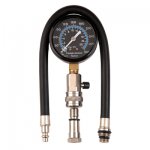
Sure beats the $140 that Matco and SnapOn want for one (I'm becoming a tool snob :surrender:). I might even find a solid block of aluminum and drill and tap it to come up with something decent looking.
 

Doc Sprocket

*********
Messages
15,677
Reaction score
151
Location
Ontario, Canada
Sure does! If you spin up a trick version of my slap-together job, be sure to post it. I don't have machine shop access, so we'll call this the quick-and-dirty method!
 

devino246

Official DIYGK Chem Nerd
Messages
3,856
Reaction score
16
Location
Lynchburg, VA
No machine shop access for me, either, but I figure with a drill press, a little patience, careful measurement, and a well thought out design, I could come up with something decent. I can also borrow the hose off my compression tester for the spark plug adapter.
 

devino246

Official DIYGK Chem Nerd
Messages
3,856
Reaction score
16
Location
Lynchburg, VA
Already has one on it. Looks like the optimal orifice restriction size is .04"
 

Attachments

  • !B-s81swCGk~$(KGrHqUOKpIEy+jC5P88BM9bK6Wkkg~~_12.JPG
    !B-s81swCGk~$(KGrHqUOKpIEy+jC5P88BM9bK6Wkkg~~_12.JPG
    53.2 KB · Views: 4

devino246

Official DIYGK Chem Nerd
Messages
3,856
Reaction score
16
Location
Lynchburg, VA
Thinking something like this:


Plug up your air hose to the male QC on the right, adjust pressure to desired setting. Air flows through orifice, takes a sharp left turn, and flows down to the cylinder.

Main passage would have to be drilled from both sides to allow for the restriction in the center. Left opening would be plugged. A 40 jet would work for the orifice.
 

Doc Sprocket

*********
Messages
15,677
Reaction score
151
Location
Ontario, Canada
The small circle near the QCM- that's a regulator/ valve?

Can you please detail for the masses, the need for the restriction (#40 jet)?
 

devino246

Official DIYGK Chem Nerd
Messages
3,856
Reaction score
16
Location
Lynchburg, VA
Yes, a regulator. Air flow needs to be controlled to obtain a reading. The restriction creates two separate "chambers", if you will. Remember, a leakdown tester supplies air to a cylinder in order to see how much air is escaping. In order to measure the air loss, you need a "control". The first gauge serves as the "control", the restrictive orifice allows for a pressure difference between the first gauge and the second. All you're doing is measuring the difference between the first gauge and the second.

Make sense?
 

devino246

Official DIYGK Chem Nerd
Messages
3,856
Reaction score
16
Location
Lynchburg, VA
Drew it up real quick. Just need to figure out the size hole between the two sides.


Any chance you could dig up a Honda GX jet and check the thread size? Hopefully it's a standard thread, unlike Holley's :toetap05:
 

Doc Sprocket

*********
Messages
15,677
Reaction score
151
Location
Ontario, Canada
Sorry, Devin- at the moment, I'm stumped. When I pulled it out, I thought it might be 1/4"NF28, but the thread pitch is finer than that. I don't know of a finer thread pitch than -28 in 1/4". It could be metric, I suppose. I whipped out a couple of metric dies, and yet the dies were too coarse, too. It looks straight, so I don't think it's an NPT thread. Still thinking...
 

Doc Sprocket

*********
Messages
15,677
Reaction score
151
Location
Ontario, Canada
I was thinking that if you cannot tap to that thread pitch, there are other options. You could tap to 1/8"NPT, and drill a brass pipe plug to the orifice size, or tap to a common bolt thread and (to make it easy) drill your orifice in a nylon bolt. Si?
 

devino246

Official DIYGK Chem Nerd
Messages
3,856
Reaction score
16
Location
Lynchburg, VA
I was thinking that if you cannot tap to that thread pitch, there are other options. You could tap to 1/8"NPT, and drill a brass pipe plug to the orifice size, or tap to a common bolt thread and (to make it easy) drill your orifice in a nylon bolt. Si?

BRILLIANT!!

I just happen to have 0.03125" (1/32") and 0.046875" (3/64") drill bits that I bought to drill holes in circuit boards. Wouldn't want to try those on brass, but nylon would be perfect!

For the record, I'm using these guidelines, with a little tweaking:

In the United States, FAA specifications[1] state that engines up to 1,000 cu in (16 L) engine displacement require an 0.040 in (1.0 mm) orifice diameter, 0.250 in (6.4 mm) long, 60-degree approach angle. The input pressure is set for 80 psi (550 kPa), and 60 psi (410 kPa) minimum cylinder pressure is the accepted standard.
 

devino246

Official DIYGK Chem Nerd
Messages
3,856
Reaction score
16
Location
Lynchburg, VA
It better be!

Now I just need to find a 1"x1" block of aluminum. My uncle knows a machinist that's done some work for him before; I'm sure he's got some pieces that would work.

Regardless, I might make a fitting like yours this afternoon, just for the heck of it.
 
Status
Not open for further replies.
Top