did i kill it?

Status
Not open for further replies.

Doc Sprocket

*********
Messages
15,677
Reaction score
151
Location
Ontario, Canada
As long as his jackshafts gearing was setup to compensate for the taller tires, why wouldnt a centrifugal clutch work and hold up just as well as the same kart with short tires?

If the final-drive gearing was exactly the same, it seems like the only additional strain on the clutch would be the additional weight of the taller tires/rims...

That is, more or less- what I was getting at. Perhaps not explained particularly well, but the basics boil down to this- Having tires that large demand a rather low gear ratio when using a centrifugal clutch. While what you're suggesting looks pretty good on paper, it's not entirely true. The theory does not allow for the additional rotating masses of the jackshafts, sprocket, and chains (when applicable) as well as the much larger, heavier tires and the related frictions.

By the time it's all said and done, yes- you can gear sufficiently low to run 22" tires with a centrifugal clutch, top speed will likely be a disappointment.

My purpose in suggesting a CVT in a case like this is based on the fact that by utilizing the low-range capabilities of a CVT, (somewhere on the order of 2.5:1), you can run a higher overall reduction ratio than you could with a simple clutch. This manifests itself in having agreeable acceleration and a higher overall top speed. To gear for that very same top speed with a centrifugal clutch would surely result in overworking said clutch.

All of this is especially true when-

*Riding over uneven/"offroad" terrain
*Riding trails or other stop/start/slow conditions
*Riding in hilly conditions
*Riding with additional weight such as two people, a heavy chassis, or utility use.

In short- you can gear for tires that size with a centrifugal clutch. It is, IMO not the best idea.

Does this clear things up?
 

MisterRoboto

New member
Messages
97
Reaction score
0
ya ideally id like to go with a cvt but unfortunately the one i have is pretty old and missing the weight/spring pack and i have no money for either a new one or to rebuild this one
 

anderkart

Moderator
Messages
6,427
Reaction score
379
Location
Surprise Arizona USA
Toystory, I agree a T/C would be the best choice for the op's situation. I hadn't considered the additional rotating masses of using a jackshaft, although I cant see that waisting more than maybe 1/4 or so horsepower.

My whole point was just that I've seen several guys here flatly stating that you cant run a centrifugal with taller tires and I consider that to be a total myth as long as extreme jackshaft gearing is used to compensate the ratio.

Another related point is that most guys are comparing $250+ T/C setups to the lowest quality ($39-$69) centrifugal clutch models available. Some of the more exspencive/higher quality centrifugal clutch models available would work and hold up much better under these more extreme conditions. Although I agree a centrifugal would never give the variable ratio advantages of a T/C.
 

Badot

New member
Messages
677
Reaction score
2
Okay, math time! I may have to do a separate post for this later if anyone thinks I should.


Kinetic energy = 1/2mv^2

Let's use 400 lbs, 31 mph (use your speed at max revs)
Convert to metric, 181.4 kg, 13.9 m/s

(1/2)181.4*11.18^2 = 11337 J


Rotational kinetic energy = 1/2IW^2, I is moment of inertia, W is angular velocity (rad/sec)

NOTE: For MOI, I'm using the equation for a cylinder. If there's more weight on the ouside than the inside, such as on a wheel, this number will be much greater in real life.

I=1/2MR^2

Let's use 22" wheels, 30 lbs apiece. (I seriously have no idea what they'd weigh...)
Convert to metric, .5588 m, 13.61 kg

(1/2)13.61*.5588^2 = 2.125m^4

For W, find RPM of wheel at max speed and multiply by 2*pi to convert to radians, and divide by 60 to convert from minutes to seconds.

3600*11/14*10/60 = 471.4
471.4*2pi/60 = 49.36

(1/2)2.125*49.36^2= 2589 J

That's one wheel, now multiply by 4.

2589*4 = 10356 J

_____________________________________________

So with 22" 30 lb cylindrical tires on a 400 lb kart at 31 mph, there are 10.36 kJ spinning your wheels and 11.34 kJ pushing you forward. The wheels almost halve your acceleration.

Again, please note... the formula for calculating MOI of the wheels was for a cylinder, not for something with the weight distributed like an actual wheel. I'd conservatively expect the energy requirement of the wheels to go up around 50%, but it depends on how the weight is distrubuted on the wheel.
 

Doc Sprocket

*********
Messages
15,677
Reaction score
151
Location
Ontario, Canada
I've seen several guys here flatly stating that you cant run a centrifugal with taller tires and I consider that to be a total myth as long as extreme jackshaft gearing is used to compensate the ratio.

Agreed. Frankly, you could tow a double-wide using a centrifugal clutch and 22" tires- It's just not necessarily the best option given the circumstances.

Badot- while my spinning head spools down to an idle with all that math stuff, how does the above formula account for jackshafts or not, extra sprockets or not, extra chain or not, and the difference between tire sizes? How about the additional rolling friction of tires with a large contact patch at lower pressures? Cuz, frankly, that stuff was beyond me.
 

machinist@large

Active member
Messages
2,865
Reaction score
32
Location
West Michigan, 49331
Badot- while my spinning head spools down to an idle with all that math stuff, how does the above formula account for jackshafts or not, extra sprockets or not, extra chain or not, and the difference between tire sizes? How about the additional rolling friction of tires with a large contact patch at lower pressures? Cuz, frankly, that stuff was beyond me.

:eek::ninja::iagree:
 

Badot

New member
Messages
677
Reaction score
2
Badot- while my spinning head spools down to an idle with all that math stuff, how does the above formula account for jackshafts or not, extra sprockets or not, extra chain or not, and the difference between tire sizes? How about the additional rolling friction of tires with a large contact patch at lower pressures? Cuz, frankly, that stuff was beyond me.

That doesn't take into account any friction at all. It just tells you how much energy the tires will have in them at a certain speed, and how much energy the overall weight of the kart will have in it at a certain speed. Since the engine is the only thing providing that energy, it has to power both of those things. You basically consider the wheels to be big flywheels. Extra sprockets, jackshafts, and chains shouldn't take a very appreciable amount of power out of it. Friction and rolling resistance are also rather negligible compared to energy put into wheels and the kart.

For different sizes of 'cylinder' wheels, I=mr^2. This means that you square the radius of the wheel, and multiply it by the mass. Since in the calculation. But you also have to take into account the revs of the wheel at the given speed you're calculating for.

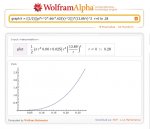
Graphing relations of tire size vs energy:

K=1/2IW^2

Calculating W:
13.86m/s (top speed)= (rev/sec)*circumference
13.86 = rev*2r*3.1415
2.21/r=revs/s
convert to rad/sec by multiplying by 2pi
13.89/r=rad/s=W


I=mr^2

m=pi*r^2*w*d... for W, we'll use 4" width per 1" diameter, for d (density) let's use .625 (close to what it would be in the original post I made)
m=pi*r^2*.66r*.625

so I = (pi*r^2*.66r)(r^2)


so K = ((1/2)((pi*r^2*.66r*.625)(r^2)))*(13.89/r)^2

____________________________________________

Graph of the equation:
kJ of energy (per tire) on the left, radius of tire (meters, .28m rad. ~= 22" dia.)
on bottom.
Remember, a lot of this is just guessing at weight, ratio of width to diameter, etc, and this one is also about 50% lower than it would be as well. It's just to give you an idea of the rough shape of the curve.
 

Attachments

  • graph.jpg
    graph.jpg
    61.4 KB · Views: 3

machinist@large

Active member
Messages
2,865
Reaction score
32
Location
West Michigan, 49331
:surrender:Badot, I'm just gona have to take your word for it; my old TI-36X Solar Scientific that I bought for MA 101 & 102 as well as Geometry ( and that I've been using for the 20 or so years since) seems to be missing about 1/2 the symbols you just used.

Please keep in mind, there are a few of us out here who learned addition, subtraction, multiplication, and division with nothing more than pencil and paper; in my 6th grade class, we thought the calculator that our teacher won as a prize was really cool. And if my memory is clear, it had to be plugged into the wall because it couldn't even run on batteries. translation, please?:angelsad2:
 

MisterRoboto

New member
Messages
97
Reaction score
0
worked out pretty good, not as much take off as id like still but worked way better than when my ratio was 5.5 or w/e anyway after riding it in the rain for a good 2 hours or so it started doing something weird... when i would let up off the throttle after getting it going good, the clutch would bind up and sorta lurch forward and then stall out.. i thought that maybe this was cause of the spacer pushing the clutch bushing up against the end shaft washer/bolt but i took out that spacer and it still happend...
 

Badot

New member
Messages
677
Reaction score
2
Good to hear that you have at least a semi-functional kart now. Try it out again once it's all cooled off an see if it still does that. I personally have no idea what would cause that, but some other people may have experienced this before.

translation, please?:angelsad2:

Basically... wheel size is across the bottom of that graph. The farther right you go, the larger the wheel is. The number represents the radius of the wheel in meters.

The energy it takes to get that wheel up to speed is vertical on the graph. More energy required goes higher. The energy is in kJ, 1000 Joules

The line is where the wheel size meets the energy. So you find the size of wheel you want along the bottom, then go straight up until you hit the line. From there, you go straight left. Where in lands vertically tells you how much energy it takes to bring a wheel of that size up to 31 mph.

This isn't really meant to provide actual numbers for calculations - purely to show that the acceleration cost of using larger, heavier wheels is rather significant, and to give a rough idea of how much larger wheels will slow you down. It also shows that as the wheel gets larger and heavier, this effect increases exponentially.
 

Doc Sprocket

*********
Messages
15,677
Reaction score
151
Location
Ontario, Canada
This isn't really meant to provide actual numbers for calculations - purely to show that the acceleration cost of using larger, heavier wheels is rather significant, and to give a rough idea of how much larger wheels will slow you down. It also shows that as the wheel gets larger and heavier, this effect increases exponentially.

Check- Thanks!
 

MisterRoboto

New member
Messages
97
Reaction score
0
after riding it in the rain for a good 2 hours or so it started doing something weird... when i would let up off the throttle after getting it going good, the clutch would bind up and sorta lurch forward and then stall out.. i thought that maybe this was cause of the spacer pushing the clutch bushing up against the end shaft washer/bolt but i took out that spacer and it still happend...
anyone have this problem before? still unsure whats going on
 
Status
Not open for further replies.
Top