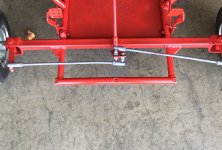
Dangerously Sensitive Steering (Thunder Kart)

icer22x

New member
Messages
4
Reaction score
2
I am in the process of fixing up this Thunder Kart for my kids. After modifying the 212, I am focusing on the steering now. I reluctantly allowed my 12 year-old to drive this for the first time and he almost crashed it due to the horrible steering. Almost gave me a heart attack. Thankfully he wasn't going that fast and had enough sense to listen to dad and let off the throttle and apply brakes.

The steering in this cart is as the title says. If you so much as breath on the steering wheel, the cart is turning. It's also pretty difficult to turn the wheel; requiring more force that it should... so it's very easy to over-steer (which was the cause of my son almost crashing). When this kart gets up to speed, you have to provide micrometers of steering or else you're going to have a bad day.

Where should I be looking to make adjustments/modifications? I have seen people on here suggest crossing the tie rods on the pitman arm. I've also seen the suggestion of drilling new holes in the pitman arm closer to the steering column.
Screenshot 2026-10-07 094256.png
 

Sparkwizard

Well-known member
Messages
715
Reaction score
856
Location
Richlands ,NC USA
Can you post a picture of the spindle where the tie rods attach? Moving that pivot point away from the kingpin /bolt will slow the steering down.
If there are more than one hole, move the tie rod away from the pivot. If no more holes, extend the arm by welding (preferred) or bolting an extension to the lever.
 

Thepartsguy

Well-known member
Messages
1,533
Reaction score
1,423
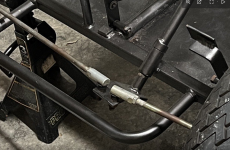
Did you add you own tie-rods and bend the square piece downward? This is how most of my karts are setup and it’s the factory way to do it.

The way your karts tie-rods are run is directly wrong in my opinion.
IMG_9303.jpeg
 

Hellion

Murderator
Messages
9,229
Reaction score
4,205
His steering looks proper for a Brister’s Thunder Kart. The Pittman arm plate, or whatever that is called, is bent or angled from the factory.

Since it is so hard to turn the wheel, every pivot point in the steering should be lubed generously with a few drops of fresh engine oil or something with staying power (3-in-1 oil, etc). Original formula WD-40 is little more than a solvent. It may be necessary to “work in” the lubricant by turning the wheel full lock to full lock in both directions several hundred times. 🥵

This is Carter Brothers' (a competitor kart manufacturer) service recommendation:

KART LUBRICATION - Every two or three hours of use lubricate the following items with several drops of oil; steering bearing points, brake rod pivot points, pedal pivot points, steering spindles, and steering rod ends. Use the same grade of lubricating oil that is used in the engine crankcase.

It might behoove you to disassemble the front steering components, the spindles, spindle bolts, rod ends and assess the condition. Rust and pitting is your enemy and which causes excess friction. If the spindles are rusted and rough on the inside diameter, you could clamp a phosphor bronze/copper or steel bore cleaning brush (20 gauge shotgun brush?) in a drill chuck and go to town on the rust. Once clean, slather the spindle and bearing surfaces in a quality grease and reassemble. As mentioned before, a regular oil on the rest of the exposed parts is your friend.

So it turns nicely and quickly huh? I see you have a one-wheel-drive kart which has by nature a poor man’s ‘differential'. It’ll turn but at the same time the driver must use DISCRETION and drive carefully with some finesse and pre-planning. Just be glad it’s not a live axle, that kind of kart just wants to go in a straight line.....
 

Hellion

Murderator
Messages
9,229
Reaction score
4,205
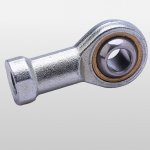
Those socket-over-ball tie rod ends are not my favorite as they cannot be lubed easily (they are upside down and have a rubber seal), and when they wear out (the ball hogs out the socket) the socket pops off the ball and you lose your steering. Can be a real bummer out on the trail.

These heim joints in my humble opinion are superior. They are easy to lube and will stay assembled as long as there’s a bolt going through the ball *(and a nut on the end):

Image 455.jpeg
 
Last edited:

Hellion

Murderator
Messages
9,229
Reaction score
4,205
I reluctantly allowed my 12 year-old to drive this for the first time and he almost crashed it due to the horrible steering.

He might just be the problem. He’s a first timer and you were reluctant (that might have been your gut instinct giving you a warning). Sounds like a slightly troublesome scenario to me. Again, Carter Brothers:

TURNING MANEUVERS​

The new rider must learn to shift his weight and control the throttle to allow the rear tires to negotiate the turn. This is the primary technique to be mastered in riding this vehicle. Practice turning at slow, constant speeds. Defer increased speeds until you are confident of your proficiency and are intimately familiar with the terrain.

Steer in the direction of the turn, and lean your body to the inside of the turn in order to maximize front tire traction. Use the throttle to maintain power throughout the turn.

Once this technique is learned, turning maneuvers can be performed within a relatively small area.

Incorrect turning techniques may cause the front wheels to slide straight ahead without affecting the vehicle's direction of travel. If this should occur, come to a stop, then resume the technique outlined above.

If the front wheels tend to skid in mud, sand, or snow, you may be able to improve control by releasing the throttle and allowing the vehicle to coast through the turn.

If the rear wheels inadvertently skid sideways, correct your slide by steering in the direction of the skid, if you have room to perform this maneuver safely. Avoid braking or accelerating until you have control.

To avoid skids while traveling on slippery terrain, the rider must exercise a high degree of caution. Turning maneuvers on slippery terrain are more hazardous than those performed under full traction and must be done slowly.

Surface composition is a major factor affecting skidding. It is easier to slide on packed snow than in deep sand. It is dangerous to skid on ice, because you may lose all directional control, and it is dangerous to skid on pavement, because you may regain traction suddenly and unexpectedly, which can cause the vehicle to overturn.

All that High IQ driving stuff being said, lube the steering and keep it greasy. 🛢️💧
 
Last edited:
Top