Completely remove governor VS disable

Status
Not open for further replies.

Russ2251

AZUSA:Powered by LAWN-BOY
Messages
6,622
Reaction score
41
Location
Huntington Station, Long Island, NY
Addendum to post #10

I would like to add to my post (#10) that in giving it further thought, there just might be a problem with disabling governor as opposed to completely removing it. I've been more involved with removing the air vane type of governors which are actuated by airflow generated by flywheel. There is no real danger in doing this as long as engine is not run for extended periods in a "no load" condition. However, a mechanical governor is different from air vane governors in the way that they are driven internally by crankshaft or camshaft. I can see that they could be over-spun and actually fly apart. At say 5500 rpm, if this mechanical portion of governor should let go, what would happen to these now liberated parts. I shudder to think...might resemble an IED :eek: . Might be a better idea to completely remove mechanical governor. Other opinions?
 

RobertD

Administrator
Staff member
Messages
3,019
Reaction score
74
Location
Texas
I'm thinking let's make a new thread! :)

Here's what Russ said in the other thread he's referring to (#10 in the "have you removed a governor" thread)

Governors do 4 things.
1.) Protect the engine
2.) Protect equipment
2.) Protect inexperienced operators
3.) Prevents me from having some REAL fun.

I never use them and, so far, have not had a governor related failure. When converting a mower, tiller, edger, snow thrower or any other governed engine for kart or minibike use, the first thing I do is remove anything that restricts engine speed and/or horsepower. This includes removing governor and (usually) an undersized carburetor. Only time I had failures (not governor related) was when I converted weed eater engines for use on bicycles. 2 different flywheels blew apart at about 9500 to 10,000 rpm. I have a hole in my garage floor to prove it. In both cases, key sheared (no load) and split flywheel. Scary stuff.
I agree that it seems that only in a no load (ie, wheel spinning free / no wheel connected) that you could end up destroying the mechanical parts to the governor. However I say this about the old style L head Briggs engines I used to run. I have a honda clone now, but I haven't cracked it open to look at how the governor actually works. On that engine I'm hoping you guys have some answers before I crack mine open to figure it out. (i'm looking at you, jerry!) :)
 

kibble

I banned myself
Messages
2,766
Reaction score
15
If you're chonda's are anything like my Subaru, the Crankshaft has a gear on it that spins a second plastic gear which contains two weights on it that push a little rod against the shaft that protrudes out of the engine and attaches to the rest of the governor assembly. The faster it goes, the more the weights put pressure against the rod and the more the shaft moves. Boy that's a mouthful! If I knew all the technical names I would have used them....

I have some pics I took when I opened up my engine to remove it. I'll post them up later tonight if I get a chance.
 

Russ2251

AZUSA:Powered by LAWN-BOY
Messages
6,622
Reaction score
41
Location
Huntington Station, Long Island, NY
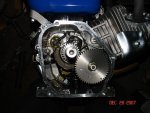
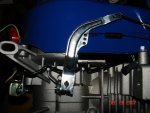
Here's a pic. That would be governor at approximately 11 o'clock. Just as kibble described. 2 sheaves move apart due to centrifugal forces. This in turn causes linkage rod to move slightly anti-clock wise. This rod exits crankcase (must be a seal there) under tank where linkage rods/springs then run to carburetor. Looks like removal is relatively easy. Tank will have to be removed so I can get to linkage. Maybe I'll do that after I shave my back.
 

Attachments

  • honda clone internal.JPG
    honda clone internal.JPG
    144.3 KB · Views: 57
Last edited:

Jblankster

*********
Messages
458
Reaction score
0
Location
Illinois
with the clones, dont remove the gov. unless you are going to be upgrading the rest of the internals. or you WILL blow it up.

but on briggs and stuff, i would suggest you remove the governor in the case, less crap in there= less stuff to break
 

Russ2251

AZUSA:Powered by LAWN-BOY
Messages
6,622
Reaction score
41
Location
Huntington Station, Long Island, NY
with the clones, dont remove the gov. unless you are going to be upgrading the rest of the internals. or you WILL blow it up.

I have heard claims like this before. What would make this engine different from any other? Do you have evidence of this? A magazine article or photo would help.
Testing limits is what I do. This engine will not be treated in any way differently from any other. The governor comes out.
 

kibble

I banned myself
Messages
2,766
Reaction score
15
Out with the governor! Out with the governor!!! Oh, I sound like a revolutionary... Viva la revolucion! :D

Thanks for posting up the pics, Russ. You beat me to the punch. That's basically what mine looked like too before I removed it. I did leave the linkage rod still in place so as to cover the hole. I could always go back and find something else to place in the hole to cover it up.
 

kibble

I banned myself
Messages
2,766
Reaction score
15
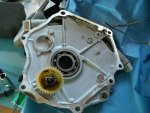
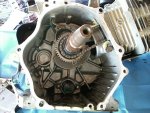
Here's a couple of pics of mine. Unlike Russ's though, the plastic gear is on the crankcase cover, not inside the crankcase.
 

Attachments

  • cover.jpg
    cover.jpg
    143.3 KB · Views: 71
  • crank.jpg
    crank.jpg
    163.6 KB · Views: 71

mikeandike

New member
Messages
232
Reaction score
3
Kibble looks like you got an ohc chain driven engine. Anyways.. You must remove that plastic gear and all the little pieces that come with it because at high speeds they can fly apart. It's ok to leave the rod in there but i would rather remove it/cut it shorter so that there is no chance it will get in the way. Theres a whole bunch of threads about this on 4cycle.com. Just go look under ohv engines in the forum. Stock (c)hondas will not exceed like 5000 or 6000 rpm (can't remember) with the governer removed because the valve spring arent strong enough to close fast enough at high speeds (valve float). This acts as a governor in a way so that the engine dosnt rev like crazy.
 

Jblankster

*********
Messages
458
Reaction score
0
Location
Illinois
I have heard claims like this before. What would make this engine different from any other? Do you have evidence of this? A magazine article or photo would help.
Testing limits is what I do. This engine will not be treated in any way differently from any other. The governor comes out.

it is made of inferior materials, there is numerous records of them breaking and/or "throwing" parts. things like, the flywheel breaking apart, push rods bending, crank breaking, and rod breaking. all of those have been reported numerous times.
 

mikeandike

New member
Messages
232
Reaction score
3
when i opened my engine i didnt like the look of the crankshaft and that cam looked alright but not great (i havnt seen good parts in person but it just looks cheapish to me) and the crank journal is hollow :S
 

Russ2251

AZUSA:Powered by LAWN-BOY
Messages
6,622
Reaction score
41
Location
Huntington Station, Long Island, NY
This is a quote from a website that describes the mechanics behind a radial engine:

The crank pin is usually hollow. This reduces the total weight of the crankshaft and provides a passage for the transfer of lubricating oil. The hollow crank pin also serves as a chamber for collecting sludge, carbon deposits, and other foreign material. Centrifugal force throws these substances to the outside of the chamber and thus keeps them from reaching the connecting rod bearing surface. On some engines a passage is drilled in the crank cheek to allow oil from the hollow crankshaft to be sprayed on the cylinder walls.
 

Attachments

  • hollow crankshaft.JPG
    hollow crankshaft.JPG
    129.1 KB · Views: 17
Last edited:

mikeandike

New member
Messages
232
Reaction score
3
Thanks. That cleared some things up. But you can buy crankshafts with solid journals for strength reasons obviously. I guess it dosn't matter that much because the crank isnt usually the part that fails.
 

Jerryburger

Admiral Annoy
Messages
1,104
Reaction score
13
Location
The Nation's Catbox...er, AZ.
Regarding the clone vs. name-brand engines, I've read in the gokart racing forums that the clones don't hold up as well to the abuse (7000 rpm) as the name-brand engines. The general opinions seemed to imply that they ALL remove the internal governor gear, and that the clones hold together up to 5500 rpm without too much problem. They reason that you can buy two clones and run/modify them for less than the cost of one name-brand engine. I'm a bit chicken to burn up my spanking new clone engine, so I keep it at a wimpy 3600 rpm.
Regarding the Wankel engine. Really looks like fun- expensive, though. Has anyone messed with one of those Sachs Rotary engines from a snowmobile? Those look like fun.
As an aside- I WISH I had a buck for every over-dramatized YouTube vid that has to try and look like more entertainment than it is. That Aixro XR50 is a good example!... Heck, I could afford one of those engines, then!
 

Jblankster

*********
Messages
458
Reaction score
0
Location
Illinois
i want to get one, i saw one on ebay for 400. it was pull start n air cooled! it was perfect, but i diddnt have a need for it then :(
 
Status
Not open for further replies.
Top