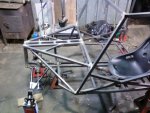
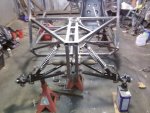
where would be the best place for rear shock location
It depends on your shock absorber. You need to know how much your kart weighs, and how many shock absorbers you're using, how much weight it takes to compress them, the length of the lever (how far out on the swing arm they are mounted), and the angle they are mounted. All of these variables add up to give you the whole answer.
I was just reading the comments about your belts, and it made me wonder...... The main thing about the belt is how the friction of the belt on the pulley compares to the friction of the wheel on the ground plus the inertia of the vehicle's mass. If your belt has less friction you'll only be able to take off slowly and you won't be able to climb hills. If your belt is tightened to optimal tension and you have big enough pulleys to give you lots of contact area, then it will work. But using the belt as a clutch doesn't seem right to me.
I think you would want your belt to be way over-rated for the application to keep it from smoking. Belts are not intended to be slipping devices. They are meant to grab and hold. Maybe that's where you got your opinion of CVTs, that they tend to lug down when they engage. Brakes and pressure-disc clutches are designed to slip. They're like a variable control, but rubber belts are more of an off/on device. Either a belt is off or it's on, but if it's anywhere in between, it's burning. Riding lawnmowers sometimes use a belt tensioning system as a clutch, but for that application they burn the belt for just a moment and then run the equipment for a long time. The momentary belt-frying is considered a good trade-off for simplicity because you don't start and stop a lot.
If you want to use a belt drive with a tensioner, and a 62 horsepower engine, I think you need to use a lot of belt contact area, and maybe more than two belts. You want it to grab and hold when you engage it, which means you'll be spinning the tires a lot and probably getting a jerky ride. Anything less than that, and your belts are history.
I had a 100 hp wood chipper that I sold last spring. If I remember correctly, I think it had 4 V belts. I thought it didn't seem like much for the amount of power being transferred, but the contact area was huge because the knife wheel was about 4 feet in diameter and the drive wheel was at least a foot. The power had to be engaged only with the engine at idle, and then the RPM had to be increased gradually, otherwise the belts would burn. And that was on a machine that had a pressure plate clutch PTO driving the belts.




 Boat motors dont need the torque that land vehicles do.