machinist@large
Active member
Semi trailers have their sides fastened with rivets… Keep in mind that those rivets, as well as the rivets used in olden days, are not the pop rivets you buy at the hardware store. They are solid rivets hammered/peened in place, either with heat or by sheer force.
The reason the side panel's in your example are riveted instead of welded together is because of the grade of aluminum they're made out of; they fall into a class of types that are heat treated, and can not be reliably welded together. That includes spot welding, which would be the most preferred way to assemble such a structure if it were made of steel.
Were I to build a bolt together kart, I would most definitely use sleeves (The "spacer" that goes in the tubing) and either loctite or locknuts, preferably the non-nylock ones.
Used correctly, the nylon insert type work well; I'm guessing the reason you haven't had any issues, 'Sid, is because you haven't exceeded their intended operating range.... And with all the types of thread locking compounds available out there now a days, most people should be able to find something that will work in their application....Non nyloc? is there a reason for this (I use them alot) well not U.S or AUS TM ones of course but nylon inserted nuts
Do you think there's something wrong about using them?
Not a single one came loose (well mainly because I never build a vahicle with them of course) but I also used them on my cars over the years.
Now I'm baffled, please let me know, maybe I have to rethink my behaviour (i.e. at least check them again... now it's set and forget)
'sid
Having to delved into 1800's rail road construction some time back ago. the problem wasn't the riveting of the rail road bridges, it was the metal used to do it.. Iron alone could not hold the stresses steel could. Once steel became available, they used it to build some well known bridges today, that are still standing and still working like they where "almost" brand new. and even then, the steel was riveted. I think now, most were updated though, and welded at major stress joints..
 Why do people seem to think that I'm saying riveted and/ or bolted construction is automatically bad or wrong? If you go back and re read my post, nowhere did I say it was wrong, or couldn't be done. All I said is that it would require more thought and planning than many people seem to think it needs.
 By all means, weld if you can! I'm not saying to go free willy and bolt your stuff together, without an ounce of research into the subject.
For someone like myself, I have been making friends who will on occasion let me use their welders, and I've personally come to enjoy stick welding [TIG] It just has so much control, and I feel like I screw up less with it, because I had done a lot of soldering during my childhood.. now I'm sure I'm gonna get even more heat for comparing TIG to soldering...
John, you're confusing the two processes again; stick welding, your filler rod is also the electrode that carries the current used. Tig welding, the electrode is held in a separate torch body, and only serves as the delivery system for the arc, and the filler metal is supplied separately. As for your description comparing Tig welding and soldering, Tig can only join similar types of metal; soldeing can be used to join many different types of metal, due to the low melting point of the metal being used to "glue" the join together.
Well AFAIK, welding is still not allowed for most (if not all) structural parts of an airplane.
Those have to be riveted!
friction-stir welding is the only exception and that only has been done to floor panels of an airbus A400 military transport yet.
'sid *slowly strolling away whistling*
Traditional aluminum alloys used in aircraft construction are usually considered to be unweldable, hence the riveted construction. Friction stir welding is the new exception; so new in fact that it's being developed as we speak, with your Airbus application one of the first to make it out of the lab and into the real world....
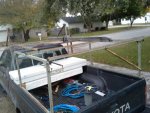
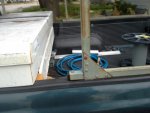
I built a lumber rack for my little Toyota pick-up without a welder years ago. I used two 12 guage triangles about 6" long to make the 90° uprights and attached them with self tapping sheet metal screws. Those started working loose so I used a two part epoxy on the triangles and the screws and they haven't moved since. The whole thing is one inch square tubing bolted together with 5/16" nuts and bolts with the aforementioned lock washers. Contrary to popular belief, those washers don't hold by spring action but by the sharp edges of the cut ends digging into the metal. Anyway, despite putting 100, 000 miles on the truck and many many hauls so heavy I had to be extremely careful turning without putting the truck on it's side- nothing has failed. Not a single nut has come loose. I didn't use spacers in the tubing or Loctite. By now rust may be on my side.lol. You guys up north could just drive a bolt together kart on winter roads- Loctite red? - meet your one-uppense- Loctite brown! Lol.

The nylons are supposed to be a one time use only nut. They work mainly by friction, whereas the other kind is an interference fit type.
Back in the 40's a lot of warships were built with rivets. Electric welding technology came about, production was streamlined, and ships were built in a matter of weeks rather than months. However, every single ship that was welded together sank, while a few of the riveted ones survived. It's theorized that the issue was the welded sections would not allow the ship to flex slightly as it passed through waves like the riveted ones did. Add to that my theory that metallurgy back then wasn't what it is today, and semi-skilled welders not laying a good bead added up to disaster.
Metallurgy has improved tremendously since WWII, that is true. What isn't true is that many of the ships built with welded joints sank because of that fact; what got most of them sunk was the fact that they were prime targets for the enemy, transports and cargo ships. And while there were design flaws in the hull plan for the first class of liberty ships, the design was quickly modified to remedy the problem. At the same time, the US Navy was leading the charge to help codify and develop the use of the arc welding process as applied to naval ships. That included training the yards on how to weld.


 Gonna try and post pictures of the rack: