Well it still may be my fault, my exhaust is smaller than it should be and runs at an extreme angle. It glows red on freeway trips to work, the theory is that since the header stays red for so long it keeps too much heat to close to the valve resulting in warpage over time?

You are using an out of date browser. It may not display this or other websites correctly.
You should upgrade or use an alternative browser.
You should upgrade or use an alternative browser.
billet rod failure
- Thread starter vegasboy
- Start date
- Status
- Not open for further replies.
Denny
Canned Monster
It looks as though you had a simple aluminum rod failure to me. With aluminum rods there is a finite useful life. It is usually reached when the rod has grown 20 thousandths if an inch longer than when it was new, some manufacturers as much as 40. But that is in a drag engine. Do you have any pictures of the rod bolts themselves? If you were jumping up and down 60 to 80 times a second (yup second) you'd get break too.  Who knows what kind of heat treating that rod had after machining or even if it was. A lot of different factors at play here.
Denny

Who knows what kind of heat treating that rod had after machining or even if it was. A lot of different factors at play here.Denny

OzFab
Well-known member
Well it still may be my fault, my exhaust is smaller than it should be and runs at an extreme angle. It glows red on freeway trips to work, the theory is that since the header stays red for so long it keeps too much heat to close to the valve resulting in warpage over time?
You see, it's the seemingly small, unimportant details like this that make the biggest difference & shed the most light on the subject...
You are ABSOLUTELY CORRECT! If the exhaust is glowing red, that means the heat is not escaping away from the engine, which transfers back towards the head & the smallest, most exposed parts are effected first, in this case, the valve stem &/or guide...
This also means that the engine was not running at its full potential as the exhaust gasses were not escaping from the engine, creating "back pressure" or a "non scavenging" effect (be prepared, that sentence just may have opened a huge can of worms...)
I see one of two possible scenarios:
1. The heat from the exhaust heated the area around the valve guide (being aluminium, it's softer than the steel valve) which meant the valve was no longer travelling true & made contact with the piston; that contact then bent the valve & transferred through to the conrod...
2. As the valve guide is part of a larger amount of material, the heat could be transferred & dispersed through the entire head & block, leaving the valve stem vulnerable to the heat, which caused it to soften & bend & make contact with the piston; that contact then transferred through to the conrod...

Poboy kartman
Senior Moments Member
You see, it's the seemingly small, unimportant details like this that make the biggest difference & shed the most light on the subject...
You are ABSOLUTELY CORRECT! If the exhaust is glowing red, that means the heat is not escaping away from the engine, which transfers back towards the head & the smallest, most exposed parts are effected first, in this case, the valve stem &/or guide...
This also means that the engine was not running at its full potential as the exhaust gasses were not escaping from the engine, creating "back pressure" or a "non scavenging" effect (be prepared, that sentence just may have opened a huge can of worms...)
I see one of two possible scenarios:
1. The heat from the exhaust heated the area around the valve guide (being aluminium, it's softer than the steel valve) which meant the valve was no longer travelling true & made contact with the piston; that contact then bent the valve & transferred through to the conrod...
2. As the valve guide is part of a larger amount of material, the heat could be transferred & dispersed through the entire head & block, leaving the valve stem vulnerable to the heat, which caused it to soften & bend & make contact with the piston; that contact then transferred through to the conrod...
Awwwww....what do you know? No WAY!!!!! JK... I believe Tony has nailed it.....(not saying rod stretch is out of the realm of possibilities....but, given this info..)....ALMOST ASSUREDLY. valve failure....
And....YES....we could spend a couple of threads on "backpresser"....at the same time...."scavenging'" was mentioned....and...anyone who wants to spend the time to defend either theory....(and I use that term loosely) ....had better be PACKING! !!!!......(and I mean facts and knowledge) ....
Because, "backpressure" is absolutely BS! HOWEVER, scavenging is not! The confusion comes in because without any "backpressure"....there is no way for the previous charge to "hook up" with the newly created one, as it has to be slowed down enough to still be around so the new charge can "hitch a ride with it"....
Sooooo.....the charge is creating pressure in front of it....and vacuum behind....and that vacuum is EXACTLY what and why "backpressure" is important..... (It aids the intake charge to enter the combustion chamber....
THAT'S IT!!!!! I don't think I can describe it or teach any better! !!!!
EDIT: One last thing: the EXHAUST will always work fine without "BACKPRESSURE"....."backpressure" can only HURT the exhaust....as the more heat and pressure released at that point the better....AND!!!!! The intake does NOT require it either, However, will work at a very small percentage of potential without it!
Sinbad001
Member
The valve could have hit the piston after the rod broke. At one point he said the he might have over tightened the con rod bolts. (always use a torque wrench) If the rod failed at the top of the stroke and left the piston there then as the engine keeps turning one of the valves will eventually hit it. Con rods suddenly stopping tend to break on the central portion of the rod. This one looks like it broke right above the bolts.
Poboy kartman
Senior Moments Member
The valve could have hit the piston after the rod broke. At one point he said the he might have over tightened the con rod bolts. (always use a torque wrench) If the rod failed at the top of the stroke and left the piston there then as the engine keeps turning one of the valves will eventually hit it. Con rods suddenly stopping tend to break on the central portion of the rod. This one looks like it broke right above the bolts.
Engine failure forensics are nearly impossible.....been through this before on an automotive forum....
Which came first? The chicken or the egg? The one thing that points to valve failure....is the amount of time between assembly and fatal demise....
Now, it's possible that an over-torque of the rod cap bolts could have caused a slightly higher stress point on the rod than normal....therefore causing it to fail at that point rather than the usual expected one....but consider this:
Those most "common" break points are the area where the connecting rod itself is the cause of failure......and that usually occurs when the rod is at an acute angle to the cylinder and side loads are greatest.....
Breaking where it did is more consistent with the piston being in a more top dead center position....as the rod is still not completely straight, but the offset is close to the crank....and only in that position is that offset most vulnerable....
My two cents.....
OzFab
Well-known member
We could debate this subject for weeks but, the fact is, unless the OP is willing to hand a sizable wad of cash to a metalurgist, we will never truly know for sure what caused the failure, all we can do is make suggestions to prevent it happening again...

machinist@large
Active member
We could debate this subject for weeks but, the fact is, unless the OP is willing to hand a sizable wad of cash to a metalurgist, we will never truly know for sure what caused the failure, all we can do is make suggestions to prevent it happening again...
:toetap05: :toetap05: :toetap05: :toetap05: There you go again, Tony. How dare you to be so dastardly as to bring LOGIC to an argument!!!!!!!!

OzFab
Well-known member
 Sorry Pat, that's just what I do...
Poboy kartman
Senior Moments Member
Now....hmmmm....that's interesting....a whole different can of worms!
I feel compelled to tell a story....but I won't do it here, because not only is it a long one....but only marginally relevant....so I'll just start another useless (but hopefully entertaining) thread in the off topic section....
I feel compelled to tell a story....but I won't do it here, because not only is it a long one....but only marginally relevant....so I'll just start another useless (but hopefully entertaining) thread in the off topic section....
OzFab
Well-known member
My guess is the sheared bolt was the last piece to go...
Poboy kartman
Senior Moments Member
My guess is the sheared bolt was the last piece to go...
Well....this is all an excersize in speculation, but I not only now think that was the first to go....but the cause....
Follow my line of thinking: that bolt goes....now, you have a "C" spinning around the crank journal....there's no force or reason for it to come back together...(hence the nearly pristine condition of the mating surfaces....meanwhile, the other side and rod cap are getting the full load....and the only thing keeping the two together, and the damage they sustain tends to support this theory....
Well i think given new evidence-based on the valve condition, that it has to be bolt failure. If the valve slowly warped the engine wouldve had ran like crap, however the engine ran perfect up until the destruction and i was driving at a slow speed when it occurred. The valve didnt heat warp instantly. It would have been impossible. And the valve guides were in perfect shape. The rod had to let go and hit the valve to do that much damage. Here are the valve pics
Attachments
-
 CAM00649.jpg127.9 KB · Views: 14
OzFab
Well-known member
Well....this is all an excersize in speculation, but I not only now think that was the first to go....but the cause....
Follow my line of thinking: that bolt goes....now, you have a "C" spinning around the crank journal....there's no force or reason for it to come back together...(hence the nearly pristine condition of the mating surfaces....meanwhile, the other side and rod cap are getting the full load....and the only thing keeping the two together, and the damage they sustain tends to support this theory....
Very plausible theory; my only concern would be, in this situation, you would think something would hit the crank journal, causing damage but, maybe not...
Well i think given new evidence-based on the valve condition, that it has to be bolt failure. If the valve slowly warped the engine wouldve had ran like crap, however the engine ran perfect up until the destruction and i was driving at a slow speed when it occurred. The valve didnt heat warp instantly. It would have been impossible. And the valve guides were in perfect shape. The rod had to let go and hit the valve to do that much damage. Here are the valve pics
I could be wrong, it could simply be a camera trick but, if you look at the valve stem, just above the carbon line, there appears to be what looks like heat damage, which may have caused binding on the guide, causing the valve to hang open...
Neverdone
Member
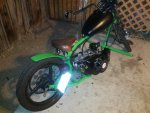
I just want to say, that is a pretty sweet looking little bike. What are you using for a trans?
Noram centrifugal clutch
---------- Post added at 06:04 PM ---------- Previous post was at 05:49 PM ----------
Update!! My roomate called to inform me his engine just blew up. Ill get pics when i get off work. His engine wasnt buil by us. It was built by vegas carts. Twice we have had billet rod failure. Not good, one case of breakage occurred at slow speeds and the other at high speeds. Both rods were from ARC. These rods are supposed to prevent this from happening!?!? Just pisses me off.
---------- Post added at 06:09 PM ---------- Previous post was at 06:04 PM ----------
After mine blew up, i installed a stock engine back in my bike except air filter and exhaust. I drive freeway in vegas at 65 to 70mph and 40mile round trip. Stock engine has never given me problems, go figure.
---------- Post added at 06:04 PM ---------- Previous post was at 05:49 PM ----------
Update!! My roomate called to inform me his engine just blew up. Ill get pics when i get off work. His engine wasnt buil by us. It was built by vegas carts. Twice we have had billet rod failure. Not good, one case of breakage occurred at slow speeds and the other at high speeds. Both rods were from ARC. These rods are supposed to prevent this from happening!?!? Just pisses me off.
---------- Post added at 06:09 PM ---------- Previous post was at 06:04 PM ----------
After mine blew up, i installed a stock engine back in my bike except air filter and exhaust. I drive freeway in vegas at 65 to 70mph and 40mile round trip. Stock engine has never given me problems, go figure.

It is probably best just using stock. If you are happy with the speed you are getting out of it, why upgrade
- Status
- Not open for further replies.