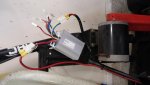
thanks for help guys.
is the fuse you refered to in the control box?
as you suggested I did connect the motor,then the batterys before plugging in the throttle
if you have one it'll be inside of course.
that's why i asked you to call the seller for a replacement
or ask if you can open it to see what's wrong,
since a pic of it's inside would be very helpful,
it could not only show you what exactly popped (HOPEFULLY a fuse let's say)
it could also tell us if it's worth to be replaced
most parts are a penny and a half on digikey and can be swapped easily.
Hey Sid,
If you have time, could you explain/demonstrate, for us, how to change this fuse?
I didn't even know there was a fuse in there.
I thought they were sealed units.
Eager to know
...where it's located
...what it looks like
...how to change it
Well, I can't for more than one reason I'm afraid:
first.. indeed not all controllers have a fuse for some odd reason
(I gues cheap chinese means CHEAP chinese)
Second, I don't have any controller I could take apart for you.
For fun I checked the
schematics of a YK31C (yiyun controller for my1020 motors)
and.. it didn't have any fuse whatsoever.. just a few voltage regulators, a voltage comparator (4way) and a few transistors
packed with some capacitors and resistors and that's all that's in that tiny silver box.
One (a 3 or maybe 5W resistor stands out being that big and all..)
I wouldn't be surprised if that's one of the first parts to fail tbh,
just because of it's rating

Anyways, there are 15 and 5 Volt regulators
some voltage divider (for the comparator and the undervoltage protection circuit)
and a current limiter that feeds the PWM signal from the throttle.
frankly, nothing really that'd calls for failure in case the battery is connected w/o throttle.
maybe a charged cap from a previous installation attempt can trigger unwanted behaviour .. but I don't see how it could cause something to fail.. (there is no reverse polarity check however... so battery in reverse can fry a handfull of components indeed)
Anyways, I'd have a fuse in there since some parts cannot tolerate high currents (well most don't tbh)
but since thre's no processor of any kind, there might be nothing that calls for secure protection really.
*shrugs* maybe it needs a programmable controller to find a fuse.
fuses can be anything really, common is a glass tube (5x20 mm std size) directly soldered onto the PCB (likely shrink wrapped)
but they can be smaller (down to smd fuses that look like a cap just white not beige)
can sit in a fuse holder (if they are meant to be replaced) or as said soldered onto the pcb directly.
location is even worse.. there shouldn't be any "main power" fuse.. the amps are just too high for it to not just ask the enduser to install one inline with the battery himself, since it'll likely fail.
it's the controll circuits internally that IMHO need protection,
and based on the layout such fuse needs to be placed accordingly of course.
IF you insist I'll show you a few examples, but it's basically as telling as googling for "pcb fuse" I'm afraid
'sid