18lb Spring Install- No start and some kickback

haughr

New member
Messages
5
Reaction score
0
I'm a newb. The engine is a non hemi predator 212 .

First time doing spring work on a small engine, first time adjusting valve clearances.

Little stuck on this one.

Successfully got the springs in... set the lash while the engine was TDC, did .003 on exhaust and intake. Rotated the engine a full time to cycle it and checked lash again at TDC, still at .003.

Engine feels like it has compression pulls fairly easy... but it's not firing up... has fuel, fuel level is on, killswitches are on and not off. New spark plug (Autolite racing 3910). The engine turned over roughly a couple of times but can't stay up and running... occasionally it's ripping the handle outta my hand. Wondering if I need to try 0 lash or use factory spec and do .004, .006. Also not sure the valve clearances are the only thing to blame. The engine is in time but I could pull the cover again I guess.
 

Denny

Canned Monster
Messages
11,991
Reaction score
8,502
Location
Mayberry, Indiana
Are the lash caps on the end of the valves, or did they fall off? Did you set the lash with the side cover on or off? Inquiring minds would like to know?
 

madprofessor

"Loose Cannon Creations"
Messages
2,899
Reaction score
968
Location
Jacksonville, Florida
212 hemi would have a lash cap on both valve stems, your non-hemi should have a lash cap on just one of the valve stems. If it's missing and not laying in the valve cover recessed area, you'll likely need to fish down the pushrod passages with a telescoping magnet to retrieve it from on top of the lifter guide plate. I had to go to an auto parts store to find a pocket telescoper that was smaller in diameter than my existing one to fit down in there. Voila, cap came right out.
 

haughr

New member
Messages
5
Reaction score
0
I have the non hemi model that uses the valve keeper style retainers. I don’t recall seeing any lash caps when I removed the rockers at all.
 

haughr

New member
Messages
5
Reaction score
0
212 hemi would have a lash cap on both valve stems, your non-hemi should have a lash cap on just one of the valve stems. If it's missing and not laying in the valve cover recessed area, you'll likely need to fish down the pushrod passages with a telescoping magnet to retrieve it from on top of the lifter guide plate. I had to go to an auto parts store to find a pocket telescoper that was smaller in diameter than my existing one to fit down in there. Voila, cap came right out.
I don't think this model comes with lash caps to be honest. I'm looking at other users who have the same engine... no lash caps when they remove the rockers. I think I just need to check all my work after taking this thing apart for gov removal and then I'll try the 0 lash method GPS metions. If that doesn't work I'll try stock clearances.
 

Flyinhillbilly

The great cornholio
Messages
2,468
Reaction score
132
Location
North West Arkansas
Recheck your lash, but rather than doing it at tdc, roll the intake lobe to full lift and check the exhaust, the vise versa.
Did you remove the side cover?
 

haughr

New member
Messages
5
Reaction score
0
Recheck your lash, but rather than doing it at tdc, roll the intake lobe to full lift and check the exhaust, the vise versa.
Did you remove the side cover?
The first time around i did this with the side cover off just to have a visual aid for tdc, but that was not wise cause the shafts were moving a bit and getting me bad reads. The last adjustment I did (.003 on both) was with the cover torqued back down.
 

haughr

New member
Messages
5
Reaction score
0
Just got off the phone with GoPowerSports and they confirmed, this version does not come with lash caps (valve keeper style retainers) and they recommended .002 on intake, .003 on the exhaust.
 

Willie1

Active member
Messages
589
Reaction score
152
Location
Newport, Mi
Recheck your lash, but rather than doing it at tdc, roll the intake lobe to full lift and check the exhaust, the vise versa.
Did you remove the side cover?
Setting the valves with the piston at TDC and both valves closed seems to be the way most of the "vendor sponsored" people set the lash on small engines, and it works well. It does require pulling the plug and putting something down thru the spark plug hole to identify TDC.

Setting lash with the opposite valve open method probably works in most circumstances, especially on engines with small cams and not a lot of overlap. The downside is that it can be hard - especially for a novice - to tell when the cam is centered on the nose and fully open. If there is a flaw in this method, it's because the lobes aren't spaced 180* apart.

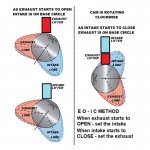
The EO-IC method - Exhaust opening, Intake closing - is the method I was taught and use for all engines, and why. Granted, this method is geared towards engines with more aggressive cam profiles, but the concept is a good method to follow. Most 4 stroke engine cams are ground with about 105-120* of separation between the intake and exhaust centerlines. As duration increases, or you read the max lift of the cam wrong, the chance increases that when one of the valves is on the nose of the cam, the other valve will be starting to open. In the EO-IC method (as shown on the left) when the exhaust valve starts to open, set the intake. The right side image is a little more complicated, but it shows that when the intake starts to close, set the exhaust. It is easier to "read" what the valve is doing this way. It is more complicated, which is why I keep this pic on my toolbox to reference if necessary. I have shared it countless times with builders and have never had an issue when setting lash this way.
 

Attachments

  • Cam EO-IC.jpg
    Cam EO-IC.jpg
    176.7 KB · Views: 9

Flyinhillbilly

The great cornholio
Messages
2,468
Reaction score
132
Location
North West Arkansas
Setting the valves with the piston at TDC and both valves closed seems to be the way most of the "vendor sponsored" people set the lash on small engines, and it works well. It does require pulling the plug and putting something down thru the spark plug hole to identify TDC.

Setting lash with the opposite valve open method probably works in most circumstances, especially on engines with small cams and not a lot of overlap. The downside is that it can be hard - especially for a novice - to tell when the cam is centered on the nose and fully open. If there is a flaw in this method, it's because the lobes aren't spaced 180* apart.

The EO-IC method - Exhaust opening, Intake closing - is the method I was taught and use for all engines, and why. Granted, this method is geared towards engines with more aggressive cam profiles, but the concept is a good method to follow. Most 4 stroke engine cams are ground with about 105-120* of separation between the intake and exhaust centerlines. As duration increases, or you read the max lift of the cam wrong, the chance increases that when one of the valves is on the nose of the cam, the other valve will be starting to open. In the EO-IC method (as shown on the left) when the exhaust valve starts to open, set the intake. The right side image is a little more complicated, but it shows that when the intake starts to close, set the exhaust. It is easier to "read" what the valve is doing this way. It is more complicated, which is why I keep this pic on my toolbox to reference if necessary. I have shared it countless times with builders and have never had an issue when setting lash this way.
It’s easily doable for a beginner, and it eliminates the possibility of setting the lash with it on the compression release which is where most problem like this come from.
 
Top