Rotore
Teh SPIK
were there any gears on the tredmill

$50 gets you a 500W motor. Done, not modding. EFFICIENT (c'mon, a AC motor with a plug usually means it'll draw whatever power it wants).
And 500W will haul you around decently.
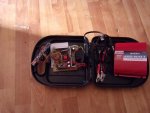
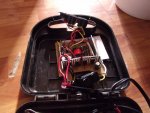
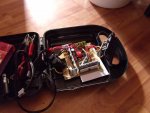
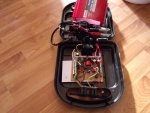
I calculated that since that motor has a 21.4 amp rating, if it's running at 95vdc it's at about 2000 watts. At 48vdc, about 1000 watts.
Sounds like it would work fine running on 48volts.
The math works out that if you run this 95 volt motor on 48 volts the power is about 25% or around 500 watts.
If you lower the voltage the current will be lower.
So in order to calculate the actual power we need to find the R or resistance of the motor. If we use ohms law V = I x R and rearrange it to V/I = R then 95Volts/21.4amps= 4.44 ohms.
The formula for Power in watts is Vsqrd/R or
48v x 48v / 4.44ohms = 519 watts
At full voltage 95v x 95v / 4.44 = 2033 watts
V = volts, I = current, R = resistance in ohms.
Mike
How would the treadmill motor compare to a 24VDC 450W MOTOR by currie tech?
The math works out that if you run this 95 volt motor on 48 volts the power is about 25% or around 500 watts.
If you lower the voltage the current will be lower.
So in order to calculate the actual power we need to find the R or resistance of the motor. If we use ohms law V = I x R and rearrange it to V/I = R then 95Volts/21.4amps= 4.44 ohms.
The formula for Power in watts is Vsqrd/R or
48v x 48v / 4.44ohms = 519 watts
At full voltage 95v x 95v / 4.44 = 2033 watts
V = volts, I = current, R = resistance in ohms.
Mike
Your math for Ohm's law for solving resistance is correct, but it has flawed data for current. Specifically, the 21.4 amps is not the stall current. You have to take into account the motor's back EMF when it is turning. He would have to lock down the shaft and apply low voltage to the motor then read the current that flows to the motor and measure the voltage at the motor terminals to get as accurate a result as possible.
Hi HelloYOU,
I agree with your statement, so it seems if the motor is run at
a lower voltage the back emf is lower which would cause more current to flow, but, there is also less voltage to push the current against the lower back EMF. Is there anyway to get a better estimate of power other than between 25% and 50%?
Mike
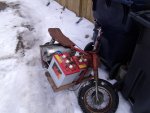
PS This all seems to get complicated without the data, as you suggested. I have a 2 HP, 28 volt, 65 amp motor I run at 48 volts on a gokart. It cruises at about 40 amps, but if I floor it from a stop the current goes over 250 amps. That's 12,000 watts or about 16 hp, so for a short time that 2 hp is working its tail off. The current goes down as the motor speeds up(more back EMF).
Here's my video, I have since got new batteries and a beefier
motor mount that holds up better under all the torque.
From the video it appears you are using a series-wound DC motor which is hard to get the motor data for with formulas other than the resistance data since their torque curves are exponential instead of linear like PM brushed motors. However, if you can get the torque curve data by dyno that can measure at very low speeds or motor manufacturer, then you can apply a ratio, in that at higher voltages the motor torque curve simply shifts up. In other words if you were to graph motor torque for various voltages you will notice that at higher voltages the curve has shifted some X amount. So if your motor is developing say 10 Ft*Lbs at 2400 RPM when ran at 36 volts, then at 72 volts if the same torque amount is required, then the new RPM will be 4800 RPM. From this you can also calculate the HP curve for the new voltage.