212 + TC + GB... Oh My!

Status
Not open for further replies.

LVScottT

New member
Messages
18
Reaction score
10
Location
Las Vegas
I have been tasked with designing a utility cart that can carry a heavy load and pull a vendor cart, all for under 1500. I've got one designed for 1350 in parts, I'm just not sure how the drive train will all fit, and if I'll need a bunch of extra mounting hardware.

It will have a stock Predator 212 with a TAV2 replacement TC. That'll feed a forward/reverse gear box with a #35 12t out to the 72t in on the jack shaft and a 15t jack-out to a 60t drive sprocket. Final ratio will be 24:1, and on 12.5 tires it should have a top speed of about 5.5mph.

Now obviously the TC attaches directly to the Predator. And the jack shaft and drive axle are no problem.

My question is: Does the 5/8 shaft on the gb replace the one that comes with the tc, and if so, will the gb fit neatly under the 212's cylinder? Has anyone put these 3 components together before that can post pics?
 

itsid

Moderator
Staff member
Messages
11,563
Reaction score
247
Location
Ruhrpott [Germany]
Hi, paragraphs?.. may I introduce you to Scott? -- Scott? Paragraphs!

Okay, depending on the gearbox you're aiming for,
the 5/8" shaft is MEANT to take a torque converter pulley [say a comet gearbox ;)]
So I see no problem with that, just make sure to buy a 5/8" driven

And since the gearbox holds the driven pulley, there is no need for a backplate at all..
you can position it under the cylinder of course or further back as you like,
just make sure the center to center distance (of the two pulleys of your TC)
is covered by a TC belt (list of belt lengths can be found online)

'sid
 

LVScottT

New member
Messages
18
Reaction score
10
Location
Las Vegas
Thanks for the introduction. I wasn't sure if Paragraphs was a member here.

That explains why all of the pics I did find had no back plate. Ok, so I will need some extra hardware to mount & align everything, and a TC without a back plate.

As far as the gear box, I like this one from BMIKarts here.
 

bob58o

SuckSqueezeBangBlow
Messages
9,646
Reaction score
1,857
Location
Chicago-town USA
24 :1 with TAV-2 is 64 :1 in lowest gear. With a 212cc engine and those tires, that's like 1000 lbs of force! Just curious, how much does the vendor cart weigh?
 

itsid

Moderator
Staff member
Messages
11,563
Reaction score
247
Location
Ruhrpott [Germany]
you're welcome ;) he is :D

Anyways, yes that gearbox looks like it's a perfect example of one made for Torque converters.
(the loooong input shaft is a giveaway, that's where your driven pulley mounts to)

The backplate is no longer necessary, it's sole purpose is to give you an convenient jackshaft to mount the driven pulley. (at a nice distance)

And you can of course still buy a set WITH a backplate, you have no use for one, but if it comes cheaper WITH than w/o, no reason to avoid one.
downside is: you'll likely need to buy another belt which will set you back another 22 bucks or so.
But chances are a set w/o backplate comes w/o a belt anyways sooo yeah just check twice on what's available.

Here is a list of available belts (series 30 is likely what you're aiming for... since you had the backplate in mind and such)
https://www.gokartsupply.com/tcbelts.htm

And the std driven pulley is 6" (that's what come in ALL series 30 tcs with backplate and most without ;))

NOW... one more question..
I seem to be missing one step in your gear explanation.

It will have a stock Predator 212 with a TAV2 replacement TC. That'll feed a forward/reverse gear box with a #35 12t out to the 72t in on the jack shaft and a 15t jack-out to a 60t drive sprocket. Final ratio will be 24:1, and on 12.5 tires it should have a top speed of about 5.5mph.

engine->TC->Gearbox (no chain or sprockets until here!)
then gearbox out to axle... 12 on 72 is 6:1 ratio

well those gearboxes are internally geared slightly (IIRC 1.3:1 in FWD, 2.6:1 in REV)
so 7.8:1 in forward and 15.6:1 in reverse as your overall ratio...
(not taking the internal ratio of the TC into account which will only kick in when needed
[times 2.7 -> 21.06:1 or 42.12:1 in reverse ])

I think you need to rethink your ratios if you were aiming for 24:1 ;)

OH btw.. that ratio is pushing serious torques, so you might want to think about a beefier chain, I'd go for a #40 chain sprocket with 420 chain (fits nicely.. a lot stronger than #40)

'sid
 

LVScottT

New member
Messages
18
Reaction score
10
Location
Las Vegas
bob58o, I believe he said his cart weighs about 600 lbs and has about 10" tires. He also has an accessories box that will sit on the cart's 3' x 3' cargo platform.

itsid, the 24:1 was the GR before adding in the gear box. It isn't a target, just a reference.

And, yeah, I've been giving the #35 chain the hairy eyeball myself. I chose it to give me more clearance under the drive axle - 7.5" sprocket vs 10" sprocket. Let me plug in some #40 numbers and see what I get. Oh, and might as well factor in the GB ratios too.

Update: It added another $100 for the beefier parts, but I upgraded the drive system to #420/40. I also factored in the ratios of the TC and GB. I'll see if I can post a pic of the table.
 

LVScottT

New member
Messages
18
Reaction score
10
Location
Las Vegas
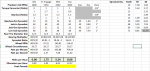
Calculations Table (hopefully).

I still need to calculate the foot pounds at each RPM.
 

Attachments

  • Calcs.png
    Calcs.png
    35.6 KB · Views: 13

bob58o

SuckSqueezeBangBlow
Messages
9,646
Reaction score
1,857
Location
Chicago-town USA
So we are talking TC Driver Unit on crankshaft,
Then TC driven unit on Gearbox input,
Then Sprocket on Gearbox output,
Connect by chain to Jackshaft Input Sprocket,
Then Jackshaft output sprocket connect by chain to Axle Sprocket????

TC Reduction,
Gearbox Reduction,
Jackshaft Reduction,
Final axle sprocket reduction...


That's a lot of reduction!
83:1 at engagement with 12.5" Tires. I want to see the wheelies this thing does when pulling no load!!!! I vote for a wheelie contest against KartFabs wheelie machine.
In reverse, with double the torque, OMG 166 :1 !!! the frame might just fold up on you. Or maybe not? I've never thought about reverse. RWD in Reverse is same as FWD in Forward? That stuff is above my pay grade.

2 pulleys,
1 belt,
1 gearbox,
4 sprockets,
and Two Chainz?
•MERGED•
And I think the spreadsheet might need some work...

12.5" tires = 3.27' / revolution.

At 3600 RPM when TC is in overdrive....
Gear ratio = 1.3 (gearbox) x 4.0 (Final Axle Sprocket) x 6.0 (jackshaft) x 0.9 (torque converter)
Gear ratio = 28.08 :1

MPH(3600 RPM) = ((3600 Crank Rev per Min / 28.08 Crank Rev per Axle Rev) x 3.27 Feet per Axle Rev x 60 Min per Hour) / 5280 Feet per Mile =
4.8 MPH.
 

Attachments

  • twochainz.jpg
    twochainz.jpg
    8.4 KB · Views: 62

LVScottT

New member
Messages
18
Reaction score
10
Location
Las Vegas
I think I know what is wrong with my calculations. Nothing! They are correct... but the information I found online to make my calculations is apparently wrong.

The gearbox is available from numerous eBay sellers, and almost all of them state that the gearbox has a forward ratio of 1:1.3. However, I suspect the actual ratio is 1.3:1.

Ratios are stated in terms of Drive (input) Revolutions to Driven (output) Revolutions. That means for every 1 revolution the input gear makes, the output gear would make 1.3. However, since the Gear Ratio is calculated as Driven / Driver, it would have a GR of 1/1.3, or about 0.77, which is some serious Overdrive!

I seriously doubt a basic Forward/Reverse Gearbox would incorporate so much overdrive, so it must be 1.3:1. I'll change that section of my Speed Calcs spreadsheet and see what it does to my numbers.

Thanks Bob58o for catching that.

PS: One site (https://www.gokartsupply.com/gearbox.htm) says it has "Forward Gear Ratio: 1:1:3 - Reverse Gear Ratio 1:2:6". Figure that one out!
 

LVScottT

New member
Messages
18
Reaction score
10
Location
Las Vegas
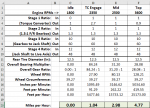
Yes, much better! Now, how would I calculate overall torque for each RPM?

The Predator specs say it is a 6.5HP engine with a max speed of 3800 RPM that can produce a Maximum Torque of 8.1 ft.-lbs. @ 2500 RPM. I thought I could use that as a baseline, but when I plugged those values into the "5252" formula, I came up with something like 3.8HP.
 

Attachments

  • Calcs.png
    Calcs.png
    29.1 KB · Views: 5

bob58o

SuckSqueezeBangBlow
Messages
9,646
Reaction score
1,857
Location
Chicago-town USA
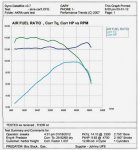
You would find a Torque vs RPM curve for your engine.
You would multiply TQ at the Crank by Final Drive Ratio to Get Torque at the Axle.
But you would subtract 15-20% due to losses from the belt system.
Now you have TQ at the axle at a given RPM.
Divide that TQ (in Lb-Ft) by radius of the rear tire (in Feet) to Lbs of linear force used to propel the vehicle.

HP = TQ x RPM / 5252
8.1 x 2500 / 5252
HP = 3.8 @ 2500
HP is only 3.8 at 2500 RPM because that is where Pk TQ is made, not where peak HP is made.


If a 6.5HP engine really makes 6.5HP at 3800 RPM then,

6.5 = TQ x 3800 / 5252

TQ = 9.0 Lb Ft @ 3800 RPM, which is higher than the pk TQ the manufacturer advertised at 2500 RPM.

I suspect both the TQ and HP are underrated on the box.

Here's a graph showing TQ vs RPM for a Stage 1 Modified 212.
 

Attachments

  • dyno.jpg
    dyno.jpg
    58.5 KB · Views: 7

bob58o

SuckSqueezeBangBlow
Messages
9,646
Reaction score
1,857
Location
Chicago-town USA
Uhhh....they said there would be no math today.

He started it.:cheers2:

BTW, if a CVT is tuned correctly, the shift should begin at Pk HP RPM.
The CVT "should" hold the engine at "constant" RPM where peak HP is being made.

Stays in "low gear" until you reach peak HP.
Then holds engine rpm as the CVT shifts from low to high gear.
After the CVT has fully shifted, if the engine has engoung post peak power, the RPM should increase again.

If cruising along on a flat road at pk HP RPM and you start up a hill, the CVT should hold RPMs steady while it adjusts the Gear ratio for you. This allows you to stay at the RPM where you are making the most HP which gives you best acceleration.

There is math, but this is EZ and every gearhead should fully understand all of this in this video.
https://www.youtube.com/watch?v=cb6rIZfCuHI

---------- Post added at 12:15 PM ---------- Previous post was at 12:03 PM ----------

No....that was meth.

Part of my education was at Eastern Illinois University in Coles County.
The next town over was Mattoon.
Lots of Meth in Mattoon.
Not very many teeth either.

http://jg-tc.com/news/local/mattoon...cle_0c3747fb-ed50-5a4f-aa23-ca4b04ed5991.html
 

bob58o

SuckSqueezeBangBlow
Messages
9,646
Reaction score
1,857
Location
Chicago-town USA
https://www.cogentoa.com/article/10.1080/23311916.2017.1398299.pdf
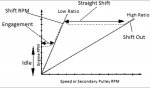
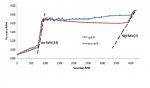
2.1. CVT operation
Ideally, the whole operation of CVT is divided into four phases Idle, Engagement, Straight shift and
Shiftout as shown in Figure 1. In Idle phase engine speed is below CVT engagement speed because
flyweight does not create enough centrifugal force for primary pulley sheave to shift and engage
with the belt. The belt seats in a low ratio (lower gear) setting (Aaen, 2007).
In engagement phase engine speed is sufficient to cause enough flyweight centrifugal force to
compress the primary spring and engage the belt. This phase starts with initial slipping between belt
and sheaves as engine speed is not high enough to clamp the belt properly but as the engine speed
increases the centrifugal force of flyweight increases and causes enough clamping force so that the
slipping is eliminated and engine speed increases and vehicle accelerates along the low ratio (Aaen,
2007).
Straight Shift starts when the engine speed reaches an optimal power output rpm (usually peak
power rpm) the primary pulley start to push belt out of its seating area and thus increasing its diameter
and decreasing secondary diameter starting the shift. Ideally, the vehicle accelerates consistently
through its range of speed while engine speed remains constant and CVT shift from lower gear
ratio to higher. The vehicle accelerates and the engagement of both pulleys allows for sensitive
torque feedback (Aaen, 2007).
Shift out phase starts when the pulleys have been fully shifted to high range gear ratio and last
from optimal engine speed to engine peak at which it cannot operate any faster (Aaen, 2007).
 

Attachments

  • TC tuning.jpg
    TC tuning.jpg
    70.4 KB · Views: 3
  • shift.jpg
    shift.jpg
    40.1 KB · Views: 3

LVScottT

New member
Messages
18
Reaction score
10
Location
Las Vegas
Help! My thread has been hijacked by math-heads!

At least they have some teeth left in Mattoon... unlike Decatur, Peoria, Monticello, Clinton, etc
 
Status
Not open for further replies.
Top