bob58o
SuckSqueezeBangBlow
Jetting
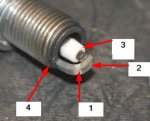
Top: This area is the idle circuit indicator. For a race engine, this area has no real application; race engines don't rely on the idle circuit the way a street engine does. However if you're tuning a street driven vehicle then this portion needs to be a dark gray/tan color. This is achieved by tuning the idle air/fuel ratio. This is done by changing the air bleed orifice size, changing the idle feed restrictions, adding or subtracting idle bypass air, or a combination of these things.
Warning Note: The initial timing has a direct effect on how much the primary throttle blades need to be opened to achieve a good idle. If the initial timing is insufficient, the transfer slot might be overexposed in an attempt to raise the idle speed sufficiently. An overexposed transfer slot will cause an noxious smelling, poor quality idle and poor off-idle response.
Middle: This is the area that will show the combustion chamber condition and air/fuel ratio at part throttle cruise (primary side only) with the power valve and secondaries closed. This is a high vacuum condition, vacuum advance will be fully activated. The mechanical advance may not be fully in. Usually about 30-50 MPH depending on the gear and weight of the car.
Bottom: This indicates the conditions at high load, low vacuum, open throttle settings. This is a priority if drag racing. Using a 5x or 10x scope you need to look right down to the bottom of the porcelain where it meets the metal body of the plug. This is the area that will have the color that you need to study and tune to. The other 2/3 of the porcelain will be burned clean by the high heat generated by WOT and high RPM, so cruise or idle characteristics will not show.
Look for a colored ring at the base of the porcelain. The color will vary depending on the type of fuel: Unleaded E10 pump gas will leave very little color because of the additives like detergents, as well as the methanol. If using 108-110 octane race gasoline, these fuels will leave a tan color while the C17 and higher octane fuels will leave an almost gray fuel ring.
If you study the ring you will see that it starts to show color just below the base of the ground strap, this is caused by the shielding effect of the strap leaving that portion cooler thus showing the most color. The ring will develop from each side and form a full circle of correct color as you get closer to the correct tune up.
If you look down into the bottom of the porcelain and you detect a thin oily deposit you are seeing oil from the combustion chamber caused by either worn or improperly seated rings. This may also be seen with a new engine that hasn't fully seated the rings yet, just don't confuse this with the fuel ring.
Top: This area is the idle circuit indicator. For a race engine, this area has no real application; race engines don't rely on the idle circuit the way a street engine does. However if you're tuning a street driven vehicle then this portion needs to be a dark gray/tan color. This is achieved by tuning the idle air/fuel ratio. This is done by changing the air bleed orifice size, changing the idle feed restrictions, adding or subtracting idle bypass air, or a combination of these things.
Warning Note: The initial timing has a direct effect on how much the primary throttle blades need to be opened to achieve a good idle. If the initial timing is insufficient, the transfer slot might be overexposed in an attempt to raise the idle speed sufficiently. An overexposed transfer slot will cause an noxious smelling, poor quality idle and poor off-idle response.
Middle: This is the area that will show the combustion chamber condition and air/fuel ratio at part throttle cruise (primary side only) with the power valve and secondaries closed. This is a high vacuum condition, vacuum advance will be fully activated. The mechanical advance may not be fully in. Usually about 30-50 MPH depending on the gear and weight of the car.
Bottom: This indicates the conditions at high load, low vacuum, open throttle settings. This is a priority if drag racing. Using a 5x or 10x scope you need to look right down to the bottom of the porcelain where it meets the metal body of the plug. This is the area that will have the color that you need to study and tune to. The other 2/3 of the porcelain will be burned clean by the high heat generated by WOT and high RPM, so cruise or idle characteristics will not show.
Look for a colored ring at the base of the porcelain. The color will vary depending on the type of fuel: Unleaded E10 pump gas will leave very little color because of the additives like detergents, as well as the methanol. If using 108-110 octane race gasoline, these fuels will leave a tan color while the C17 and higher octane fuels will leave an almost gray fuel ring.
If you study the ring you will see that it starts to show color just below the base of the ground strap, this is caused by the shielding effect of the strap leaving that portion cooler thus showing the most color. The ring will develop from each side and form a full circle of correct color as you get closer to the correct tune up.
If you look down into the bottom of the porcelain and you detect a thin oily deposit you are seeing oil from the combustion chamber caused by either worn or improperly seated rings. This may also be seen with a new engine that hasn't fully seated the rings yet, just don't confuse this with the fuel ring.
Attachments
-
 jetting.jpg19.8 KB · Views: 2

 Should be able to drain/fill/run/repeat a few times and hopefully get most of the old fluid out.