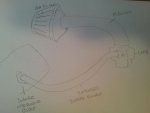
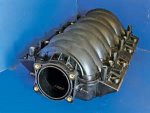
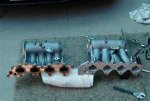
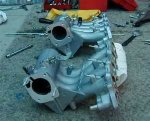
Ok. So a tuned intake runner is a piece of pipe/tube that carries the air/fuel mixture from the carberator to the engine block, where it then follows the path inside the head to the intake valve and finally into the combustion chamber. So it looks basic and kinda funky. Here is a sketch I made up to show one version of what it could look like:
http://s53.photobucket.com/user/chromerhino10/media/20160410_145654_zpsipxaetlf.jpg.html
Now, as a piston moves down it creates a low pressure wave in it's wake. The low pressure that the piston causes is less then the atmospheric pressure (normal pressure outside of the engine, i.e. 14.7 psig at sea level) so the higher pressure (atmospheric pressure) pushes air through the air filter, intake, carb, intake runner, past the intake valve and into the combustion chamber.To understand the thinking behind a tuned intake runner you have to understand that air has mass. If you have ever stood in a 30mph wind gust you get that concept. So imagine the intake valve opens and the piston is moving down, there is a high pressure wave that has moved through the air filter, through the carb and picked up some fuel and is heading towards the cylinder. Since the air/fuel mixture has a mass, it has a measure of energy in the form of inertia, so when the intake valve closes the air slams into the valve and is compressed. The molecules being compressed transfers the energy back up the way it came in by slamming into the other molecules, which causes a sonic compression wave that will travel near the speed of sound until it hits something else to bounce off from or escape to the atmosphere. This is one of the reasons people say it's important to keep your air box on with a proper air filter in it. So now there is a compression wave bouncing back and forth in the intake system.
So, If the wave is traveling back towards the intake valve when it opens, the air will create a force of pressure into the combustion chamber greater than the force that the atmospheric pressure alone would cause. Any amount of air forced into the combustion chamber is considered to be "forced induction" or have a "charged" effect. This is the basic idea to a tuned intake runner and intake system design. Will it act like you have a super charger or turbo on it? No, not even close. But you can improve efficiency (increase power) at different rpms in narrow bands. To do this, you take the average temps of your intake in normal operating conditions, use the calculation to determine the rate of speed a compression wave travels at that tempature (speed of sound), and then find a length of pipe that would provide the a harmonic travel length starting and ending at the intake valve. The rate of speed between the valve closing and opening depends on the specs of the cam and rpm. If you put it all in to a revelant equation you can determine at what rpm you would get a "charged" effect. So, if you wanted more torque taking off you could tune for a lower band of rpm's but if you want more power mid or at high rpm you can tune for those rpm's as well.
You will likely find that you can get a "charged" effect throughout the rpm range in spots anywhere the compressions wave is heading back towards the combustion chamber. There are other advantages to using a tuned runner intake. For instance, the pipe will allow distance from the hot engine allowing a cooler charge of air, allows more time for the air/fuel mixture to atomize (break the fuel particles up into smaller droplets and mix into a more fine and mixed charge so it explodes more efficient and quicker), and moves the carb further from the engine heat. There are drawbacks from this idea also. You have to have more room to add the additional tunned intake runner pipe, you have to secure the carb so that it doesn't shake too much and cause too much stress on the mounting points, it looks goofy, you get a slight reduction in efficiency in the rpm range where the compression wave is moving away from the intake valve and a few other things you could argue if you wanted to be picky. To further cover the fuel/air mixture I think it's important to understand why a longer path from the carb to the combustion chamber, if properly designed and executed, would improve power. All fluids have a certain amount of surface tension that prevents it from breaking apart. A longer runner will allow the tumbling of the faster air hitting the fuel particles to overcome the surface tension of the fuel and break them in to a more desirable finer mist of air and fuel. Also, the air flow passing the butterfly in the carb is tumbling and slow. A longer runner will allow the air to straighten out and be more organized, increasing velocity and efficiency. This allows more of a charge of air to enter the combustion chamber, breaks the fuel apart more, mixes the air with the fuel more and allows you to design the length and diameter to tune it to certain ranges of rpm's.
An important part of this system is to have a well tuned intake system. It works best if you have a plenum to hold a reserve of charged air to act as a spring to bounce against and make the wave move back towards the intake valve (like an air box or length of pipe with an air filter seperating the atmospheric pressure and intake pressure and compression waves) and a proper air filter. Yes, a proper air filter IS essential to a proper tuned engine. Sure, it's there to stop dirt and debris from getting into the intake system and engine but one of the secretes of a proper air filter is to easily allow air to enter into the intake system but not back out. It is designed to allow the air in but have enough resistance of air moving back out to keep in a charged (more pressure than the atmospheric pressure) back out, along with allowing the compression wave to hit it and be able to bounce back instead of escaping into the atmosphere. Grab a K&N filter, put it up to your mouth and blow a forceful amount of air in the direction that it's supposed to go, then try it the other way and you will quickly get what I'm talking about. It should be much harder to force air backwards out of the air filter and very easy to blow it the direction that it was designed to flow.
While this is generally designed and better suited for 4 strokes you can use the same principles and thinking to have a simular effect on a 2 stroke. The difference is that normally this is done with a tuned exhaust pipe because of the inherient properties of how a 2 stroke makes power. You can use this information to design an entire tuned system from air filter to tip of the tuned exhaust pipe.
I will try to add illistrations later but I hope this helps explains what I'm talking about, why it would help and maybe learn a little more about the inherient properties of an internal combustion engine and how it works. This is certainly not a comprehensive explaination of how an engine works or a perfect way to describe what a tuned runner intake and intake system does, but I hope it has helped.
Let me know what you think. I have no pictures since I have had two phones destroyed that had all my pictures on. I will design and build another system with all the steps. Hopefully I can get a dyno pull of before and after to show peak hp/tq and rpm graphs to show how it works and how much it effects the output of the engine.