first, theres a european limit for motorcycles (young[beginner] drivers / experience drivers)
that was 27hp a few years ago then changed to 34hp
but that limiter is likely why you got a 27hp version for the bike
unrestricted it'd be 41 horses!
Anyways back to electic motors.
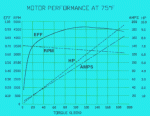
Charts like that are not a pain to read..
although the "line" does not represent the meaning of it too well in most cases.
It works as follows:
Say you require a specific amount of torque
(weight // acceleration or climbing hills most likely)
you look up that requirement on the X-axis (say 120 lb/ft.. )
[what a BS idea with metrics on the y-axis.. aaaanyways]
take the Manta for example
for that torque requirement you now know your motor cannot
rev more than ~3200 rpms (to calculate your speed under max load)
you know your motor puts out ~6hp of power and draws about 110 Amps
running at 93% efficiency.
( everything left is still relevant for you however.. since you can still speed downhill @3500 rpms drawing as little as 5 amps or such)
You can also read the graph another way..
say you know your batpack cannot deliver more than 120 Amps for some reason
you get the x-axis intersection for the amp-curve at 120Amps ,
so you now know you MUST NOT exceed a torque demand of ~138 lb/ft
and now what to gear you vehicle for in order to stay below that number.
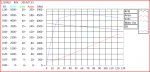
the 36 vs 48 Volt charts are providing you with quite an interesting observation...
Contrary to some idiots believe (*cough*) you CANNOT FEED Amps to a motor!
you can only supply and hope for the motor demand...
So no matter what the max draw on that motors coils are 105-110'ish amps
And as a direct result, the 36V setup only supplies 3.2'ish kiloWatts
wheras the 48V setup peaks at 4.5+ kW
And (dumbed down) since the Amps is what makes the torque,
there is very little difference in peak torque in the two setups.
The only noteworthy difference int he two setups is the motor speed
(changing from ~3300 rpms for the 48V to 2400 rpms for the 36V setup for 100 lb/ft)
so you are slower but have essentially the same oomph

'sid


 mantapowercurve.gif66.6 KB · Views: 6
 manta36v.jpg211.8 KB · Views: 3
 manta48v.jpg213.1 KB · Views: 4
 So, is this telling us that this motor runs most efficient (~90%) when running


