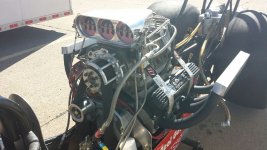
Gx200 supercharger

Denny

Canned Monster
Messages
11,559
Reaction score
7,983
Location
Mayberry, Indiana
It seems that Lemmiwinks there did everything the hard way except for the blower manifolds. Those are way cool. I hope Bobo sees this. Note no blow off valve! Not necessary with a supercharger only a turbo. All tubing is nice and short.
 

Thepartsguy

Well-known member
Messages
1,409
Reaction score
1,254
It seems that Lemmiwinks there did everything the hard way except for the blower manifolds. Those are way cool. I hope Bobo sees this. Note no blow off valve! Not necessary with a supercharger only a turbo. All tubing is nice and short.


This actual setup backfired on this guy and it blew the tubing apart and sheered the bolts from the intake. Video is on his YouTube channel shorts.
 

Denny

Canned Monster
Messages
11,559
Reaction score
7,983
Location
Mayberry, Indiana
He did not have a burst plate or a backfire valve. Superchargers sneeze sometimes. So in the early days they had a valve or 2 that were about 3” in diameter and you set the pressure to pop the valve off the seat at a pressure slightly above max boost pressure. If the engine sneezed the valve would open and relieve the manifold pressure in a big fireball. On modern top fuel cars that valve or valves has been replaced. It has a couple of panels maybe 3”X6” or so with a thin aluminum panel that is scored to tear open when a backfire occurs. These things don’t stop all the damage. They just slow down the flying shrapnel a little.
 

Thepartsguy

Well-known member
Messages
1,409
Reaction score
1,254
He did not have a burst plate or a backfire valve. Superchargers sneeze sometimes. So in the early days they had a valve or 2 that were about 3” in diameter and you set the pressure to pop the valve off the seat at a pressure slightly above max boost pressure. If the engine sneezed the valve would open and relieve the manifold pressure in a big fireball. On modern top fuel cars that valve or valves has been replaced. It has a couple of panels maybe 3”X6” or so with a thin aluminum panel that is scored to tear open when a backfire occurs. These things don’t stop all the damage. They just slow down the flying shrapnel a little.
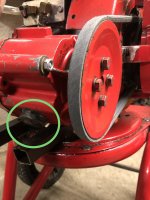
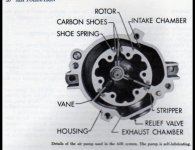
Something I always was a bit worried about was a backfire in my smogpump draw through setup. You can see the pressure relief valve in the diagram in picture #1

It was leaking off all the pressure so I Jb welded it shut. But there went the backfire valve..
IMG_5630.jpegIMG_5629.jpeg
 

65ShelbyClone

Active member
Messages
667
Reaction score
157
Location
SoCal
Note no blow off valve! Not necessary with a supercharger only a turbo.

It's not necessary on either when the throttle is upstream of the compressor. It is necessary on both when the compressor blows into the throttle as with most turbo and centrifugal supercharger setups. How necessary is debatable as some factory turbo cars still didn't have them and generally didn't suffer for it. In niche applications they can even serve a purpose on diesels.

Regarding the video, it seems strange to put so much effort into the blower brackets and then just mail it in with 3D printed piping to handle the hot pressurized air and fuel. Discharge temps for that blower at 25psi are going to be very, very high. Like >400°F high. It looks like the pulley ratio is about 1:1, so....theoretically capable of ~31psi?

That path is fraught with peril.
 

Edwin Spangler

Well-known member
Messages
786
Reaction score
759
It's not necessary on either when the throttle is upstream of the compressor. It is necessary on both when the compressor blows into the throttle as with most turbo and centrifugal supercharger setups. How necessary is debatable as some factory turbo cars still didn't have them and generally didn't suffer for it. In niche applications they can even serve a purpose on diesels.

Regarding the video, it seems strange to put so much effort into the blower brackets and then just mail it in with 3D printed piping to handle the hot pressurized air and fuel. Discharge temps for that blower at 25psi are going to be very, very high. Like >400°F high. It looks like the pulley ratio is about 1:1, so....theoretically capable of ~31psi?

That path is fraught with peril.
-But makes for a good "lets improve my failed design" video...
 
Top